
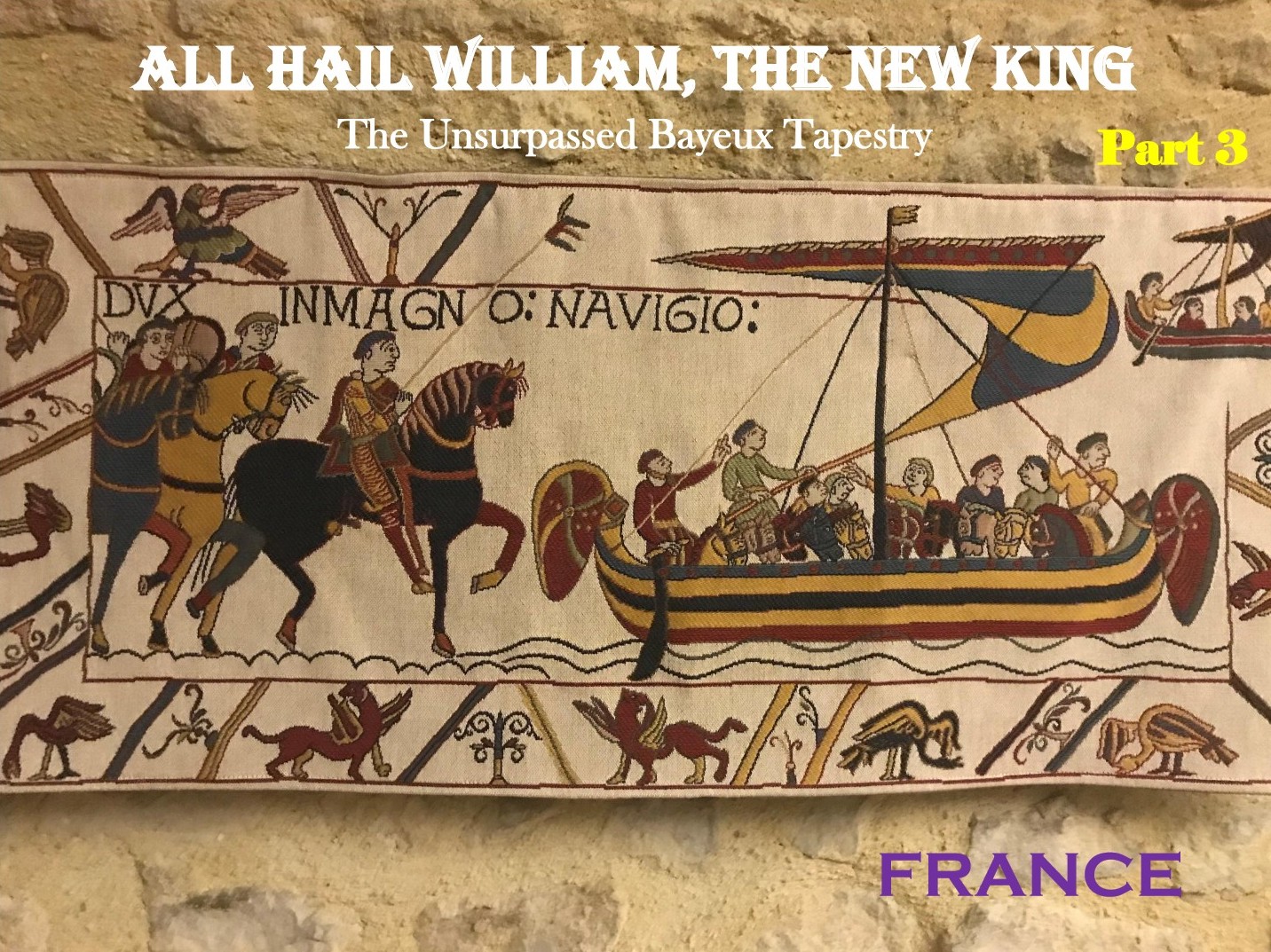
THE BAYEUX TAPESTRY, THE SCENES, EXPLAINED.
When William, the French Duke of Normandy, went across the English Channel in September, 1066 CE, to take England and make it his own, he gave two excuses for this unreasonable aggression.
One, he said that King Edward the Confessor, who was his uncle once removed (see the history in Parts 1 and 2 of this blog post), had, during William’s first and only visit to England some fifteen years earlier, declared that he wanted William to follow him on the throne.

The very first scene of the Bayeux Tapestry—detailing William’s conquest of England—is a meeting, presumably at the Palace of Westminster which was the royal abode then, between Edward the Confessor and his successor, Harold. Harold was Edward’s brother-in-law—Edward had married his sister. Image Source.
Two, William said that the man who donned the crown after Edward the Confessor’s death in January of 1066 and became King Harold, had also promised him (promised William that is) that he would absolutely not take the crown after Edward, and that it would be kept for William.
I can, and will, poke several holes into both these excuses.
Willam had absolutely no connection to England, her people, and the English throne other than his uncle, Edward. Edward, although brought up in Normandy, a Frenchman in language and culture if not in birth, did have a right to England. Because, Edward was an ᴁtheling—an Anglo-Saxon word for ‘son of a king,’ a.k.a a prince. Edward the Confessor’s father had been king of England.
William’s father? He had simply been Duke of Normandy, and nephew to the Norman princess (Edward’s mother, Emma) who had married the king of England.
William was also illegitimate—you could argue he had no right to rule over the Normans, let alone such a foreign country as England.
Whatever Edward may have wished, or said to William during his first visit in 1051 CE (and even the happenstance of that visit is in doubt), William had no legal right to the rule of England.
He could, of course, take it by might. And, he did.
A brief review of William’s actual origins:
Remember Emma of Normandy from Part 1 of this post? She, in 1002 CE, married ᴁthelred, the king of England—this was the first real connection between Normandy and England. And, Emma’s brother, Duke Richard the Good of Normandy, was our William’s grandfather.
So, let’s follow the two lines of descent in parallel with each other.
Emma had three children with ᴁthelred—we’re only concerned with Edward, yup, Edward the Confessor, William’s uncle, he of the great promise given.
On Richard the Good’s side, first one son succeeded him, and then another called Robert—who was William’s father.
So, Emma was William’s grandaunt—related to him of course by blood, but her children (two of her sons became kings of England, see Part 1) were only cousins to William’s father.
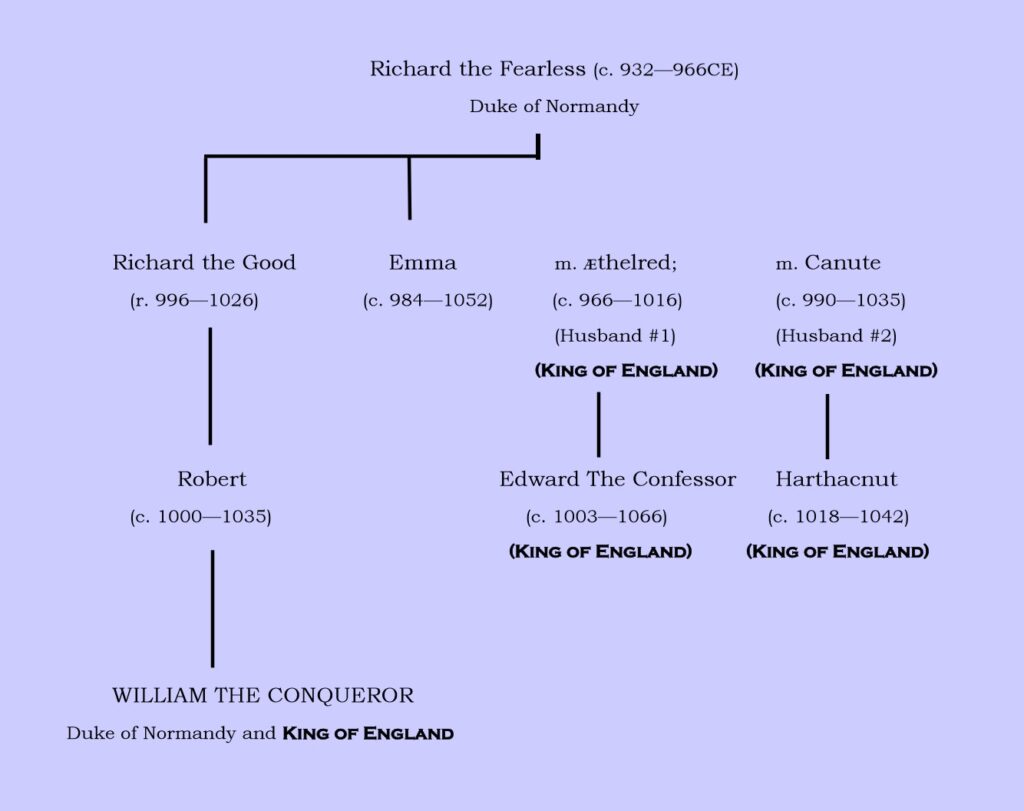
I constructed a very bare family tree to show you William’s relationship to both Emma and to Edward the Confessor.
As I said, no direct line of descent.
Yet, perhaps in 1051 CE, Edward the Confessor, who finally came to sit on the throne of England (long story there, Parts 1 and 2 of this blog post) and who had been brought up in Normandy, was more, far more French than English himself, promised William the C the throne because Edward had no sons himself.
Edward wanted to put any other claimants out of the reckoning. But, that did not happen.
As for William’s second excuse. . .that Harold made a promise to him also:
Harold, being the Earl of Wessex—very much an Anglo-Saxon, although not of royalty, was definitely a better option for the English after the childless Edward died. Because, again, see the holes I poked just above for excuse #1. So, Harold became king of England after Edward the Confessor.
That whole story of Harold’s promise comes from a tale told in the very beginning of the Bayeux Tapestry. Namely, Harold came to France, owed some debt to William, and took an oath to give up England to repay that debt. And, that Harold was, at the same time, betrothed to William’s daughter—William was making doubly-sure of the agreement with this alliance.
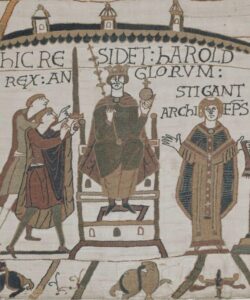
Here’s Harold being crowned after Edward (in the Bayeux Tapestry), seemingly indifferent to the guarantee he had given to the French William, that he would be king of England! Where did this coronation take place? It’s not clear what this building in the tapestry, but it’s certainly not the newly-built Westminster Abbey. And, it should have been.
But, this ambiguity about the building falls in very nicely with the tradition after William conquered England from Harold. Because William’s recorded as the first king to be crowned at Westminster Abbey–which Edward had just built. Hmmm. . . Image Source.
The only problem is that maybe, perhaps, Harold’s trip to France also had never happened. As in, William and Harold never met, and William never extracted that pledge from him.
So, with this incident of a French trip beginning the very story in the Bayeux Tapestry, does it mean that William the Conqueror was rewriting history? To the victor go the spoils, including the privilege of telling the story to his advantage?
In (mild) redemption of William:
Historians have had a gala time with all these theories since the Norman Conquest of England. If they lived in France, it was yes, Edward promised William the crown, yes, Edward had a right to do so, yes, Harold was grateful to William for saving his life, no, Harold had no right to the throne, he was just part of the nobility, and bastard though William was, blue-hued blood ran in his veins.
And, so on. And on, through the centuries.
The one thing I’ve not seen commented on is the speed with which William roared up to England to take the country after his uncle’s death.
Edward the Confessor died in January of 1066 CE. Harold was crowned the day after his death. William conquered England after the Battle of Hastings on October 14th, 1066 (he’d landed in Sussex at the end of September). So, Harold was king for nine months.
Several historians do say that William began preparations for the war as soon as he heard that Harold had been given the scepter and the orb. But, it’s unlikely that William—having heard of Edward’s death in say, February, and sailing to Sussex by September—could have built an entire flotilla of ships for his conquest in such a short period of time. Especially, beginning from the cutting down of trees in deep winter.
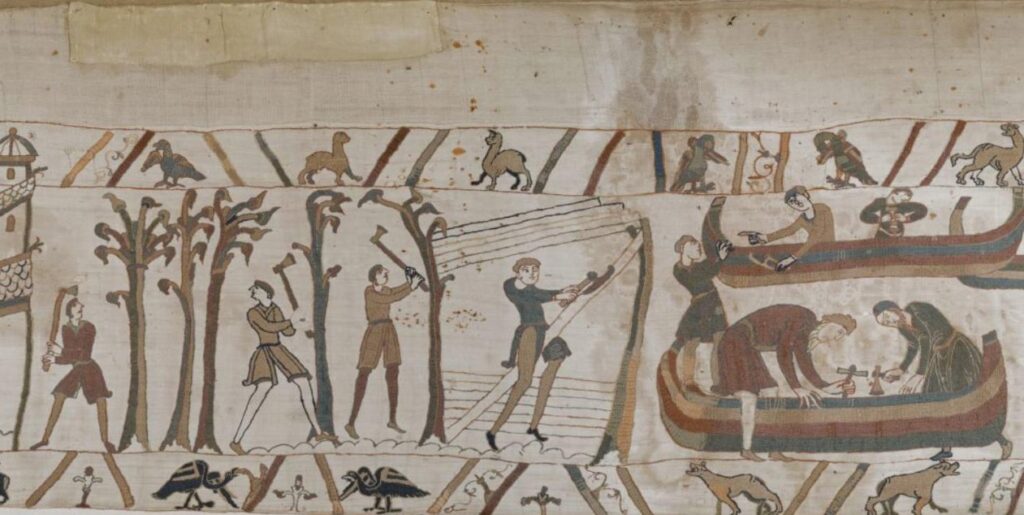
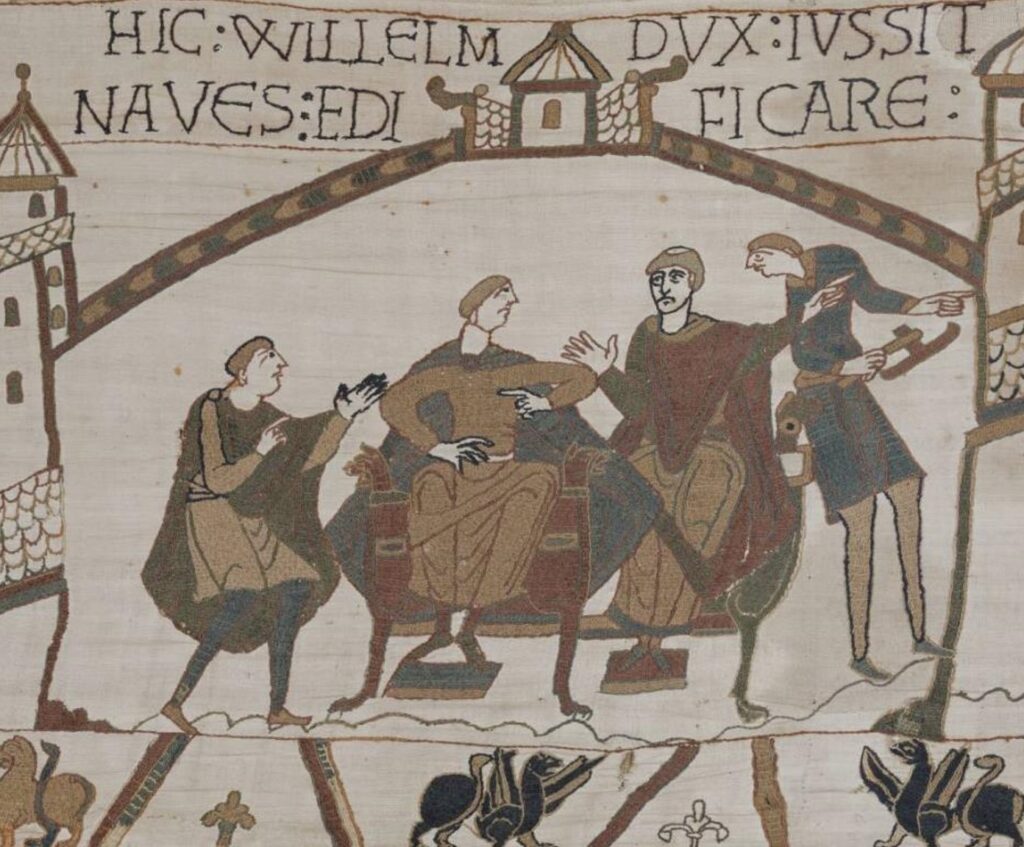
The preparations for the conquest of England began with the felling of trees, for timber to build the ships that were to take William across the English Channel with his army. Image Source.
See, the thing is that Harold (who was merely Earl of Wessex, although a very powerful courtier) hardly had any right to promise England to William. Just as the reigning king of England, Edward, had no legal right either.
But, in a very short while—and here I’m commenting on the speed of conquest—from January to October of 1066, William was ready to invade England, which leads me to believe that he had, much earlier, decided to take England when his uncle died, no matter what.
So although the Bayeux Tapestry (commissioned by William himself) tells of William’s preparation only after he heard of Edward’s death—most likely, the fleet had been building for a while.
It was a bold move for a man who had until then ruled over the Duchy of Normandy, in size about a third (?) of England. It was a bold move because it was such a foreign land to William. And yet, he did it.
So, I think somebody gave William the idea that he deserved England. He thought so too, and was resolved to grab the English crown from the man who took ownership of it after William’s uncle.
The somewhat similarities between William the C, and. . .me!
When I begin a novel, I’ve usually spent a fair bit of time sketching it out (vaguely or in some detail) in my mind—on a tapestry in my mind, if you will. (Sorry, couldn’t help that pun.)
Then, I step back and look at my protagonist’s life with this question uppermost—where do I begin the story for most effectiveness?
William the Conqueror could very well have waltzed into England as William the Invader and taken the country—nobody would have said nay to this narrative. And yet, he felt compelled to vindicate himself, you know, Edward said this to me, and Harold said this to me, etc.
And so, the Bayeux Tapestry does not begin with the conquest of England but the justification for that conquest. In other words, the tapestry begins with Harold’s trip to France.
Another look at the very first scene of the Bayeux Tapestry. Edward (with the word ‘REX’ written over his head) talks with a more diminutive Harold. Presumably, Harold’s asking permission of his king to visit France? Or Italy on a pilgrimage, and passing through France?
William’s people—the ones who made the tapestry, and we’ll examine who that was exactly later in this blog post—are rewriting history a bit perhaps, with Edward being so kingly in this scene, and Harold fairly subservient. It wasn’t exactly that kind of a relationship, as you’ll see as you read on here. Image Source.
And just to show how long William dwells upon the Harold drama in the tapestry—it’s a very long rationalization, really—we have to go through thirty-four of the fifty-eight scenes before we get to the point where some messenger leans into the Duke of Normandy’s ear to say, well, Harold is king now.
That’s close to sixty percent of the tapestry, just on Harold.
After Edward’s death, Harold becomes king:
We’re going to back to Emma of Normandy again just for a bit, because Harold—ruler of England after Edward the Confessor—has his somewhat origins during her time.
Emma was the wife of two kings of England and the mother of two kings of England.
The first king she married was ᴁthelred, and she had three children with him, including Edward the Confessor. So far, so good. The ᴁthelreds were driven out of England (to Normandy) by the Danes, of whom Canute became king of England.
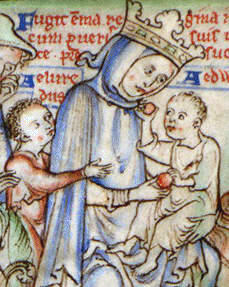
The reason Edward the Confessor was more French than English, was because his mother, Emma, left him, his brother, and his sister in France when she went on to marry her second English king husband, Canute. But, here she is, properly maternal toward her two sons. Image Source.
When her first husband, Ethelred, died, Canute, king of England, ‘sent’ for Emma and married her, and they had two children—Harthacanute and a girl. Eventually, Harthacanute became king of England—here’s Emma’s first foray into becoming the mother of a king of England, and then her son from her first husband, Edward the Confessor, became king.
Now, that we’re up to date on Emma’s chronology, let’s go back to her second husband, Canute.
Goodwine, the Earl of Wessex, and Harold the king:
During Canute’s reign (and remember, he was very much a ruler whose hold was shaky because he was an invader), the most prominent Saxon nobleman was Goodwine, earl of the West Saxons, or, Earl of Wessex.
(Wessex was the fictional county of Thomas Hardy’s novels. Only, it wasn’t entirely fictional; it dates to this time period in England’s history, and Hardy borrowed it from here. We visited Hardy’s house in the south of England—The House that Tom Built—Part 1.
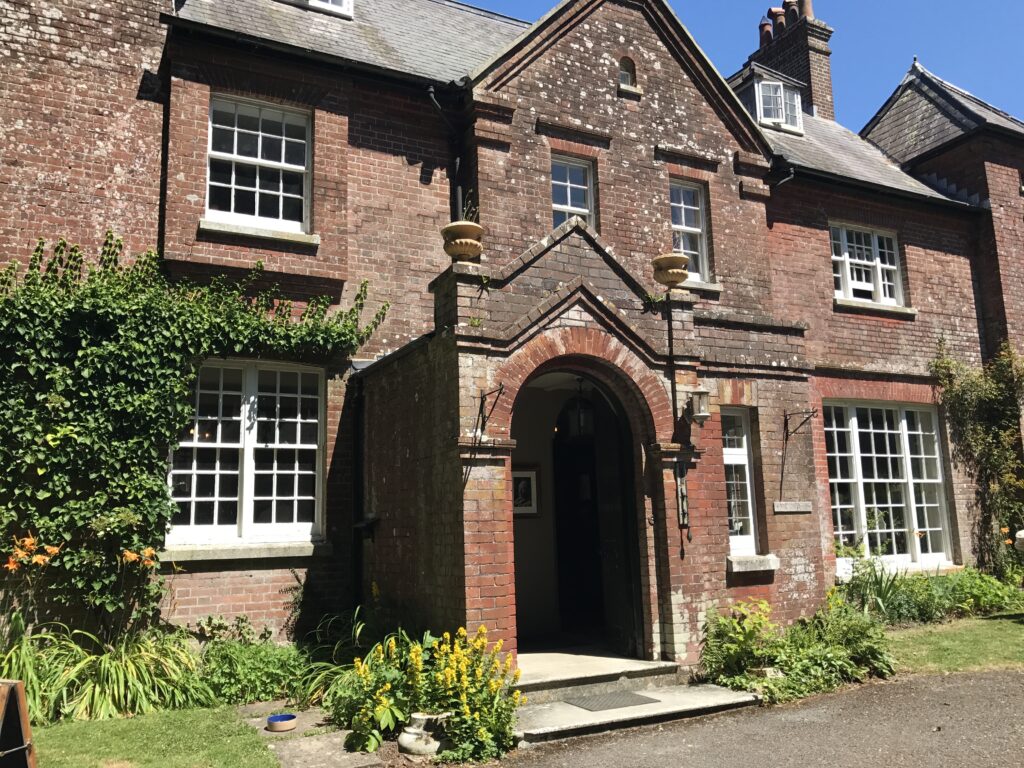
Thomas Hardy’s house in Dorchester, England. Hardy had trained as an architect before he became a writer of those splendid novels, and designed this house with his earnings from his writing. His father and brother were the builders. What’s that they say about not working with family? By the end, with our Tom nitpicking on every detail, they were at loggerheads with each other.
With good policy, great forethought, and to consolidate his power, Canute gave Goodwine, Earl of Wessex, a leading position at court.
The Earl of Wessex became powerful enough to dabble in the succession when Canute died, lending his help to Emma when she ruled as regent for her son, Harthacanute. But, there were other claimants to the throne, most notably, Emma’s own two (other) sons, Alfred and Edward (the Confessor) born of an actual Anglo-Saxon king of England, ᴁthelred.
The two boys were called, picturesquely, the ᴁthelings.
Goodwine participated in. . .was responsible for. . .was complicit in. . .take your pick—he was involved in Alfred’s murder. Perhaps for the very reason that Emma was (as regent) was malleable in his hands, he had an enormous influence over her, and over the country, and if Alfred came to be king, instead of the absent Harthacanute, Goodwine would lose his power.
This accusation of being a murderer was eventually Goodwine’s downfall, although not quite yet.
Goodwine as a kingmaker again:
Whatever reservations Goodwine might have had about one of the ᴁthelings—Alfred—while another of Emma’s son’s ruled nominally over England (Harthacanute), he seems to have had none when Harthacanute eventually died.
In the inevitable shuffle for the throne (and even though he had supposedly murdered Alfred, Edward’s brother) Goodwine pushed for Edward the ᴁtheling to be king now. And so, Edward the Confessor was crowned under Goodwine’s gaze and under his patronage.
So grateful was the new king, that he married Edith, Goodwine’s daughter, and now the Earl of the Wessex could look forward to having his grandson sit on the English throne.
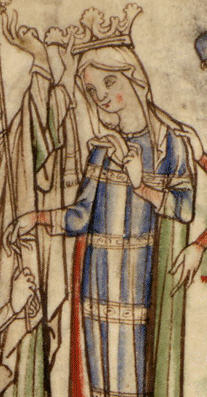
Edith, Goodwine’s daughter, Harold’s sister, and King Edward the Confessor’s wife. Image Source.
Harold—the king after Edward from whom William the Conqueror took England—was Goodwine’s son, and so, Edward’s brother-in-law.
But, Edward and Edith did not have children. And Edward had been brought up in Normandy; he was as French as an English king can be. He surrounded himself with Norman lords, he appointed Norman clergymen to the highest offices in the church, including the Archbishop of Canterbury.
And slowly, Goodwine’s influence over King Edward the Confessor began to wane. Until, Edward banished him from England, along with his son, Harold.
Yup, that Harold, son of Goodwine, and future king of England:
Very soon after William the Conqueror (supposedly) went to England on his uncle King Edward’s invitation in 1051CE, and was practically handed the country, Goodwine returned from his banishment.
Interestingly enough, Goodwine had fled to Flanders—yes, by now William was married to Mathilda of Flanders (see Part 2), and it was his father-in-law, the Count of Flanders, who had given Goodwine refuge.
Goodwine’s return was not at his sovereign’s bidding, however. It’s not as if King Edward the Confessor had repented of his harshness and cruelty to this man who had been so supreme in the English court for so long.
Goodwine came back as a conqueror. He landed on English shores, not quite sure of his reception, but the English, the Anglo-Saxons, were all on his side—from the shore to the court. King Edward’s Norman allies—the ones who had effected Goodwine’s banishment—fled from the country, knowing that they no longer had any support.
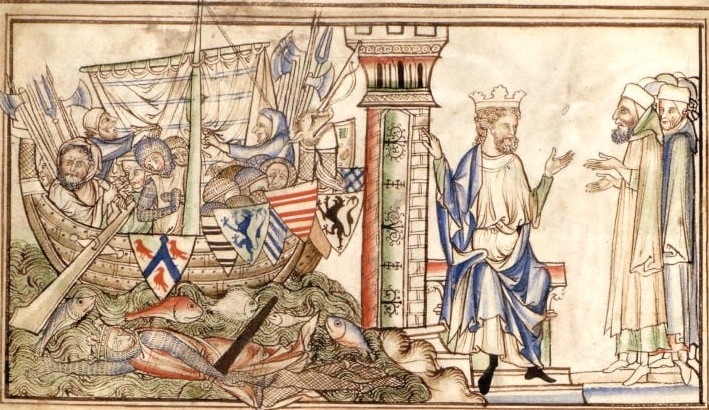
Goodwine sailing back to England and meeting his sovereign, Edward the Confessor. Image Source.
So, Goodwine strolled back to the king’s table, assumed his old position, and was given back all of his honors and lands (that had been stripped from him), and became as powerful as he had been.
In fact, more than he had been, and without an arrow fired, or a blow given.
The English nobles at court had been thoroughly disgusted with Edward’s Norman appointments, and quite a few of them, including the Norman Archbishop of Canterbury, fled from the country—to stay would be to part his head from his neck at Goodwine’s behest.
Goodwine died soon after, within a year, in 1053 CE.
Harold now becomes pseudo-king, even during Edward the Confessor’s rule:
Harold succeeded his father to the earldom of West Sussex, but it seems he succeeded to far more than just that. Goodwine had not exactly been a weak man, but Harold was more dominant.
He didn’t quite take on the reins of government—Edward was still, very much, the king—but he suppressed rebellions for the English crown in Scotland and Wales, gaining considerable respect from all men, keeping his name in the news, so to speak.
King Edward the Confessor tried at this time to bring back his stepbrother, Edmund Ironside’s son, presumably to declare him heir. Long story here, but briefly, the stepbrother had also been king of a part of England before Canute (yes, our Emma’s second husband) had sent him packing. Historians (presumably English, not French) point to this attempt as a proof that Edward never wanted William of Normandy to succeed him.
Hmmm. . .perhaps. But also perhaps, with the Anglo-Saxon Harold so authoritative right now, Edward read the room, and realized that he could not very well expect a French Norman to succeed him.
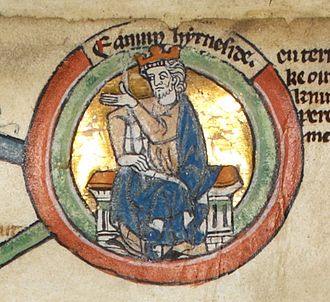
This is Edmund Ironside, Edward the Confessor’s stepbrother (his father, ᴁthelred’s son by a first wife). He had briefly been king of England, but at this time his son and his grandson were still alive—it was them Edward the Confessor looked at as future kings.
If this is confusing, and really, the throne of England was a game of musical chairs during this period; one and then the other sitting upon it briefly—the only thing I want to point out is that Edward the Confessor had, perhaps at this moment, forgotten his promise to William. Image Source.
Anyhow, for various reasons, the stepbrother’s son (despite his very Anglo-Saxon origins) did not establish himself as heir.
From this moment, Harold became all-powerful. Men began to refer to him as subregulus—under-king.
The under-king Harold, goes to France, and meets William?
The Bayeux Tapestry begins at this point—with that long justification for William’s conquest of England. In that, Harold took this trip across the English Channel, William saved him, betrothed his daughter to him, and Harold then said, sure, I’ll let ya become king after Edward the Confessor dies.
This was, most likely in 1064 CE, two years before Edward the Confessor died.
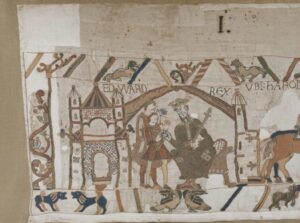
Ok, a third look at the very first scene in the story of the Bayeux Tapestry—Harold and Edward, seated and on the right (with the ‘rex’, ‘king’ written above his head) in conference with each other. I didn’t crop out the left side, so you can see that the tapestry begins here. Image Source.
What were Harold and Edward nattering about? The stories, told by the English and the Normans, differ from each other. Some English historians claim that the trip to France never happened. Others say Harold went on a pilgrimage to Rome, and so, of course, had to cross over to France.
Another theory is that Harold was merely on a pleasure sail in the English Channel when a storm came on and he was shipwrecked in Normandy.
Whatever the true story might be (and it’s difficult to comprehend that from this distance of years), this is the story that is told in the Bayeux Tapestry.
As I said, much real estate is given to Harold’s journey to France—because, again, that’s how William supported his takeover of England. In the tapestry, I think, with Harold and Edward conferring, it means that Harold had his king’s permission to travel. And he does. But first, he goes back to his estate in Sussex to prepare for the trip (that’s in the tapestry also).
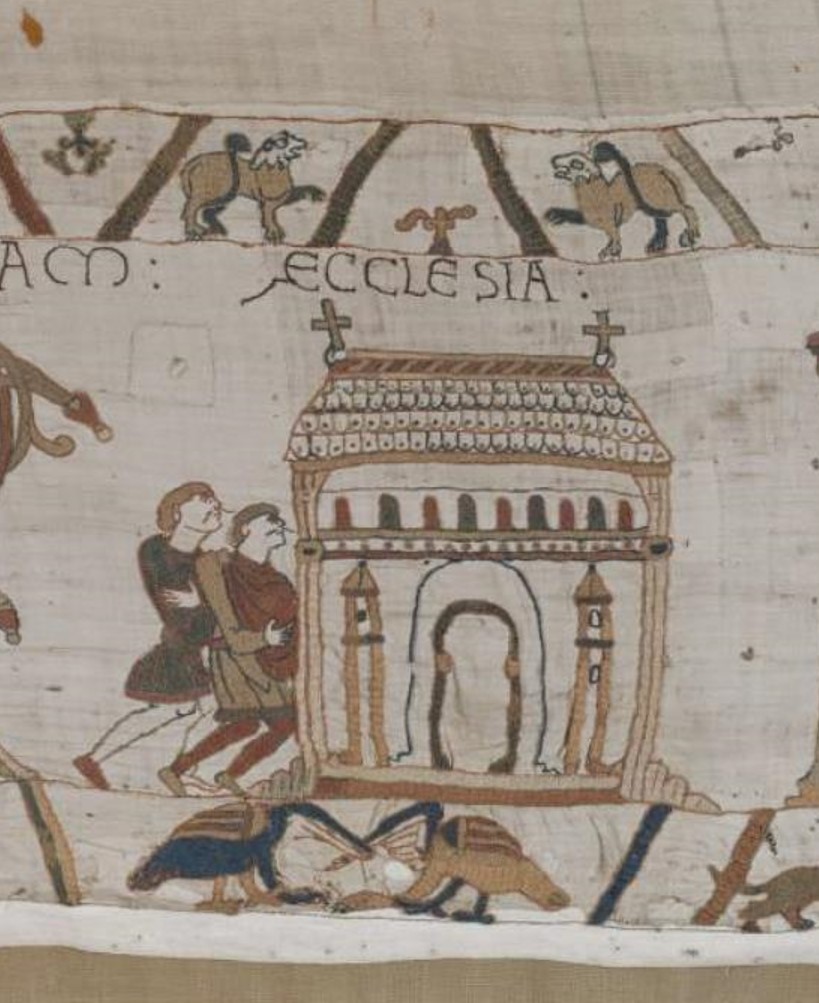
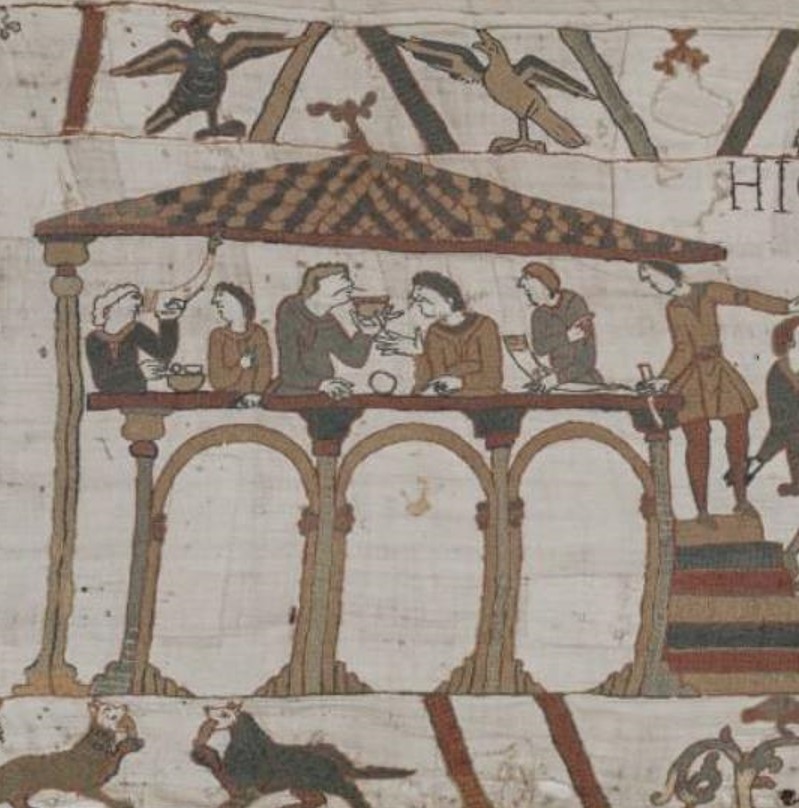
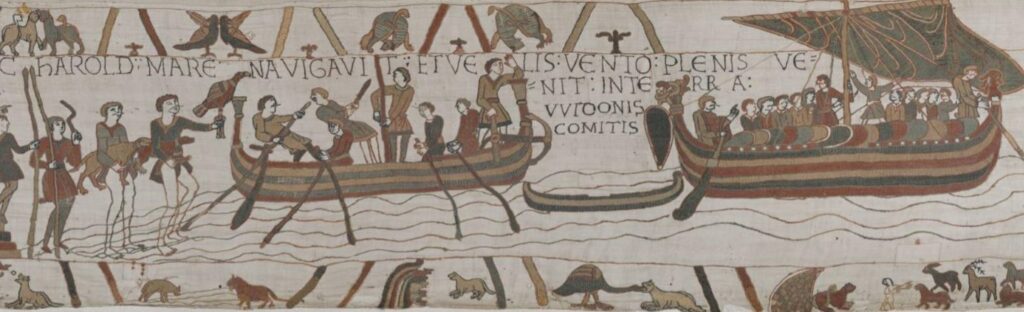
Harold preparing for the trip across the waters. First image, he prays for a safe journey at Bosham Church. Second image, he eats his last meal in England. Third image, he sets sail with his hounds and his hawks. All image sources.
Upon landing on the Norman coast, Harold was captured by Guy, the Count of Ponthieu—a nobleman who owned an estate within William’s territory. Guy threw Harold in jail, until his people could bring over a ransom, or some such devious motive.
William, not ruler over his own lands (of Normandy) for nothing, hears of Harold’s imprisonment and sends Guy a stern order to bring Harold to Rouen, where William will meet them.
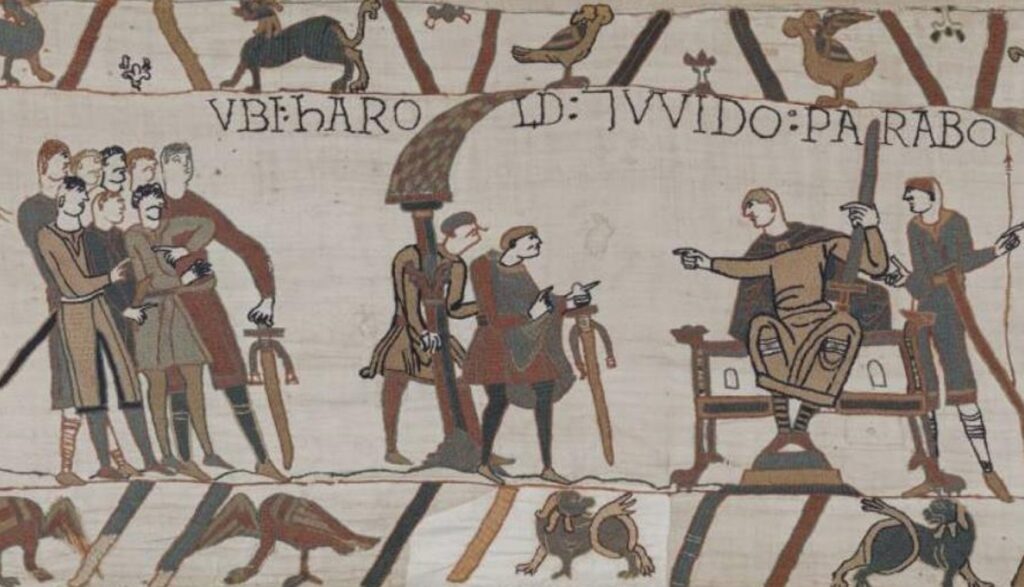
Guy de Ponthieu, seated majestically on the right, points his finger at a poor Harold cowering before him. All of Guy’s bravado disappears, of course, when William slapped him (figuratively) and insisted upon Harold being brought to Rouen.
You can almost say that the figures and the embroidery on the Bayeux Tapestry are. . .crude, but look at Harold’s soldiers on the left, all aslant and leaning away from Guy and Harold. Their very stance shows apprehension. It’s quite marvelous. Image Source.
William and Harold meet in Rouen:
Why did William seek an alliance with Harold? They were rivals for the English throne, weren’t they? Perhaps it was that same sort of diplomacy where you keep your friends close, and your enemies closer.
Perhaps William thought if Harold became his son-in-law, he would more easily give up claim to England.
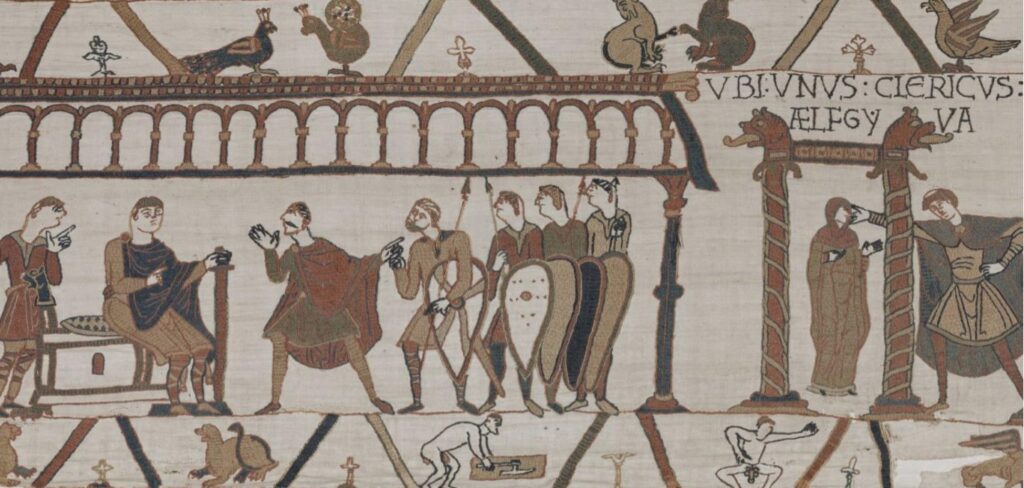
William, seated left in a black shawl, and Harold standing and gesticulating in front of him. It’s now, right after they met for the first time, that William offered Harold his daughter in marriage. Her name’s embroidered over the entrance to the hall, on the right, where she’s standing. ᴁlfigu. The figure ushering her in is probably one of her brothers? (As an aside, I read another interpretation to ᴁlfigu in the doorway, which I won’t go into now–just to say, the Bayeux Tapestry is open to varying interpretations in a lot of scenes!) Image Source.
As for that daughter? It’s not clear who ᴁlfigu is, most probably William’s eldest daughter, and his eldest child, who would have been about twelve years old at this point. She’s also called Adeliza/Adelida, and she lived until 1113 CE. She never married after Harold’s death—and remember it was her own father who killed him.
Oh, btw, let’s fight a battle now:
Then, the Bayeux Tapestry goes off on a narrative tangent. William and Harold go together to fight the Duke of Brittany. There’s a theory that Harold came to France to create an alliance with William’s enemies: Enemy #1 was the king of France; Enemy #2 was the Duke of Brittany.
If this is true, then William was one very smart man, in forcing a (captive) Harold to mount war against the very Brittany duke he had come to ally himself with.
Anyhow, the Normans were victorious and they return home.
Here, is where the whole Harold swore an oath to William comes in, and this (below) is how it is portrayed in the Bayeux Tapestry.
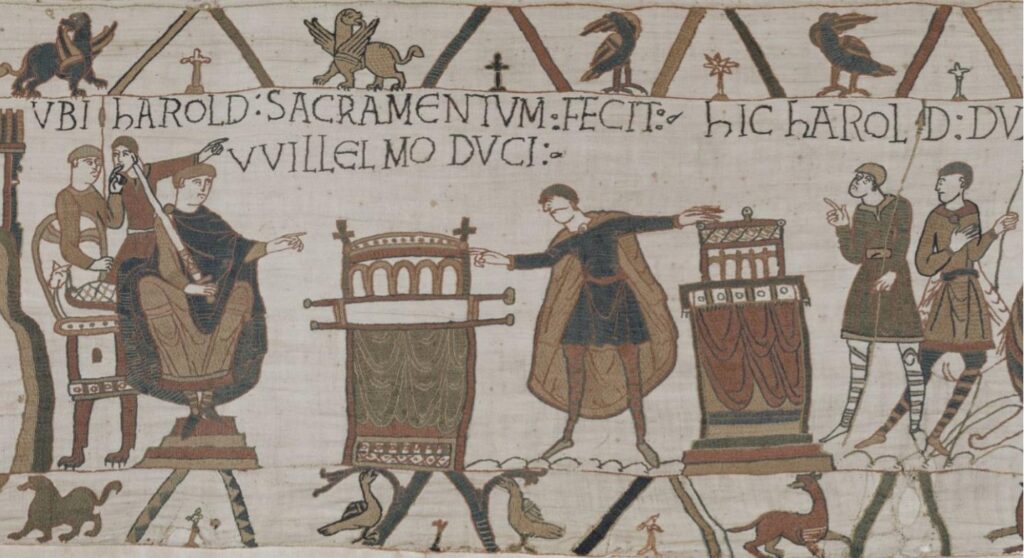
Harold, before departing for England, swears an oath on two chests of relics (of holy men and saints, I think, bones most likely) that he will not put the English crown upon his head when Edward the Confessor dies.
This is the very crux of William’s argument against Harold, the very reason he invaded England, when Harold became king after all. Image Source.
And then Harold returned to England.
Edward dies, and Harold becomes king:
On the 5th of January, 1066, Edward the Confessor died. This was some two years after Harold’s trip to France, although in the tapestry, of course, it’s almost the next scene.
Edward had just completed building the Church of Saint Peter at Westminster (Westminster Abbey today) and the grand edifice was to be the burial place and the site of coronations of English kings.
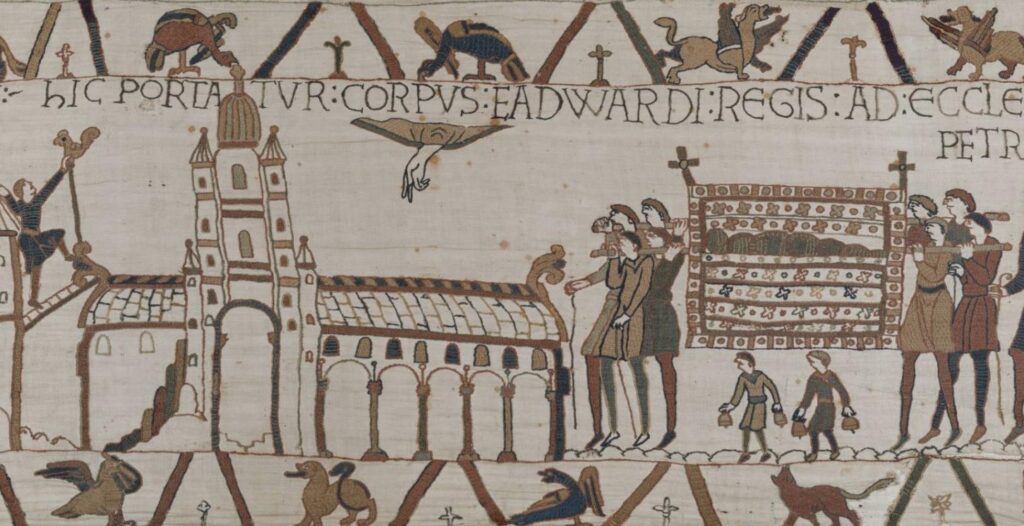
Westminster Abbey on the left, and Edward’s body being taken in for burial on the right. Image Source.
We’re going to zoom out a little on the tapestry to see the previous scene and the Westminster Abbey one.
Edward built the Abbey, and it’s possible that the earliest rendition of Edward’s church is here, in the Bayeux Tapestry. Over the past eight centuries, obviously, Westminster Abbey has had its changes and design alterations—but this is what the church must have looked like then.
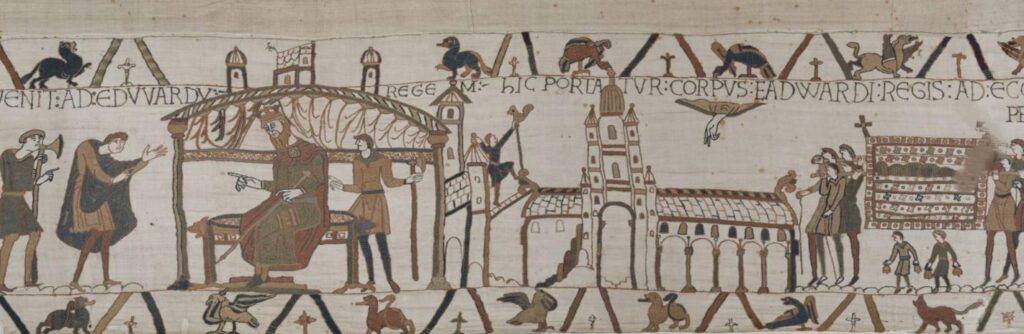
Here are three scenes from the Bayeux Tapestry—first, Harold returns to England and tells his king, Edward, about what happened in France. Second, is Westminster Abbey, right close to the Palace of Westminster (the royal abode). Third, Edward’s body is being taken into the Abbey for burial. This sketch of the Abbey in the tapestry shows the extension of the west side—the five bays to the right of the tower (which could have been more, but only five are shown) the tower itself, and, on the left, a weathercock on the eastern end (left of tower). Image Source.
In trying to determine what parts of Westminster Abbey can be attributed to its original construction by Edward, architectural historians study this rendition in the Bayeux Tapestry. And, take a look at that same view of the Abbey today.
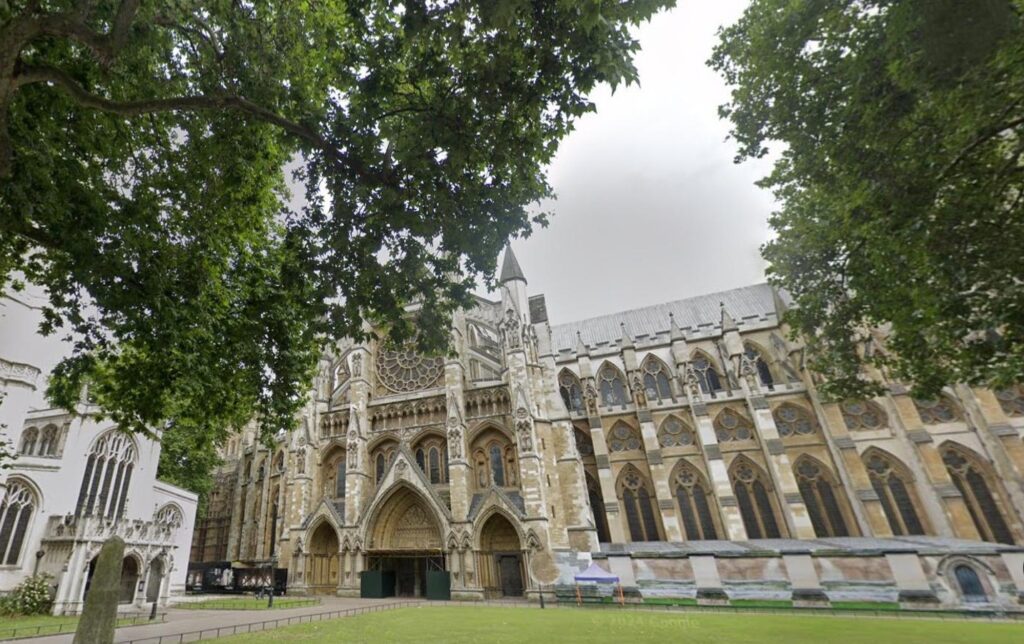
The western extension of Westminster Abbey, and the northern doorway with the tower, today. Does it look like the sketch in the Bayeux Tapestry? If it does, then there’s another theory about where the tapestry was made—the embroidery took place not at Bayeux, but at London. Bayeux embroiders could not have, as faithfully, reproduced the Abbey from all the way in France. We’ll go into who made the tapestry later in this blog post. Image Source: Google Maps.
Within a few days of Westminster Abbey being consecrated, it served both its purposes—of kingly burials and coronations. Edward the Confessor was buried there, and the next day, Harold was declared king of England by the Witan. Although, as I mentioned before, William the Conqueror is claimed as the first king of England to be crowned in the Abbey.
But, we’re not there yet—beyond The Conquest—so, in the tapestry, Harold is crowned in some. . .indeterminate place.
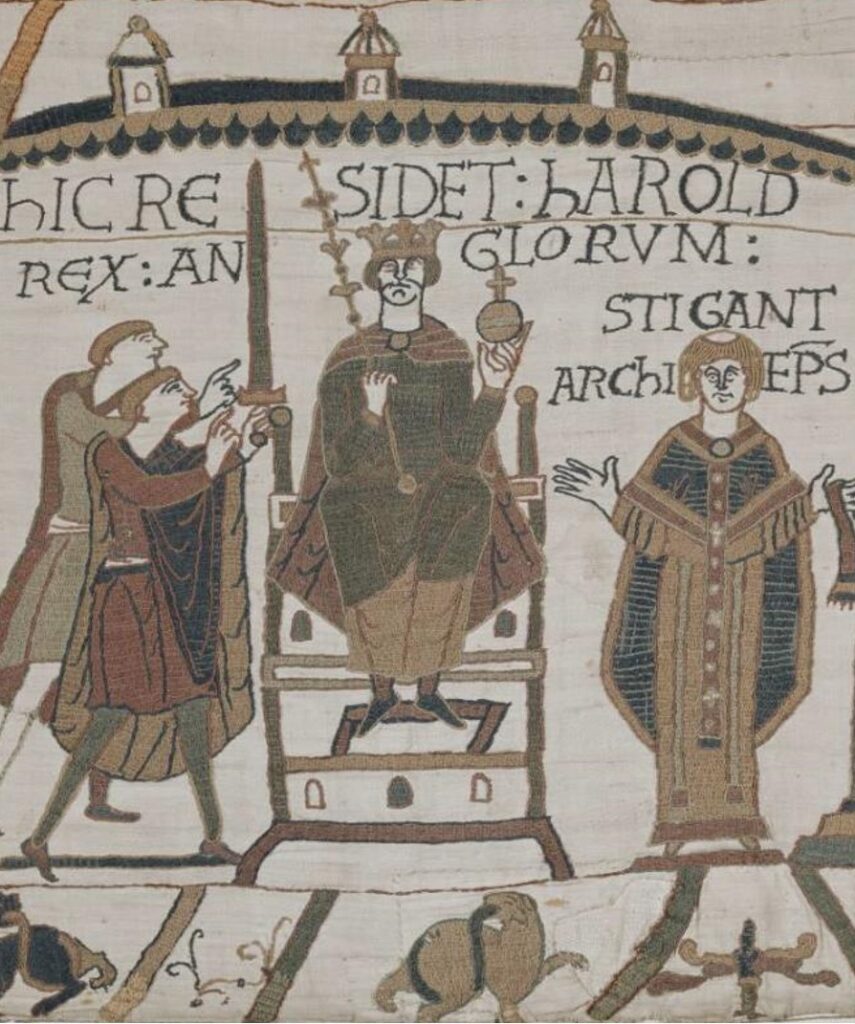
Harold crowned king of England, and a fuming William, in Normandy, hears the news. Image Sources.
William the Conqueror asserts his claim upon England:
Very soon after Harold’s hallowing as king, William began building a fleet of ships to invade England. King Harold had his other troubles meanwhile—the ceremonial county of Northumberland did not accept his sovereignty, and he spent some time convincing them to bow to his rule.
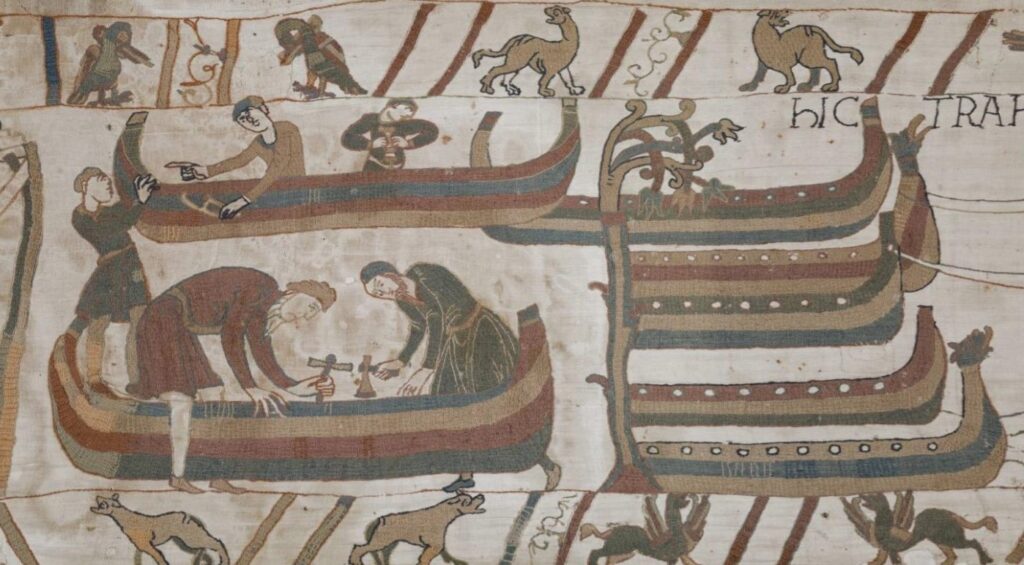
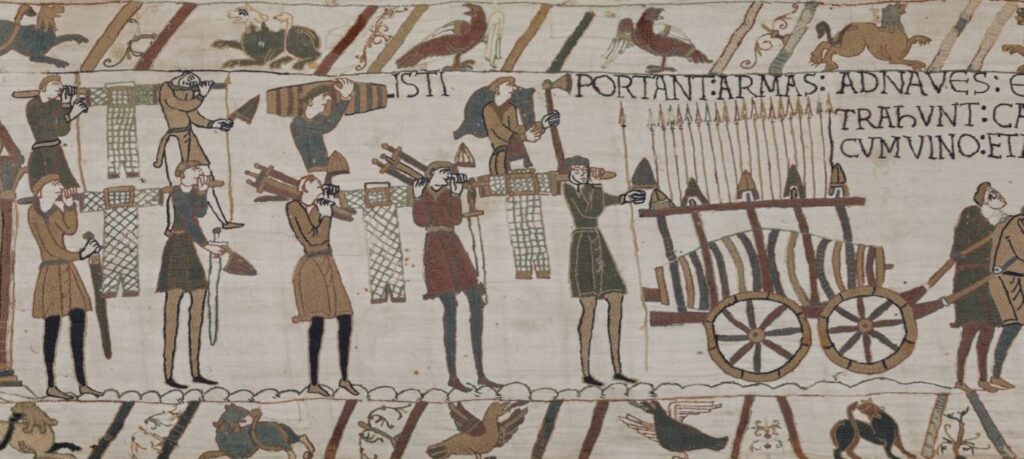
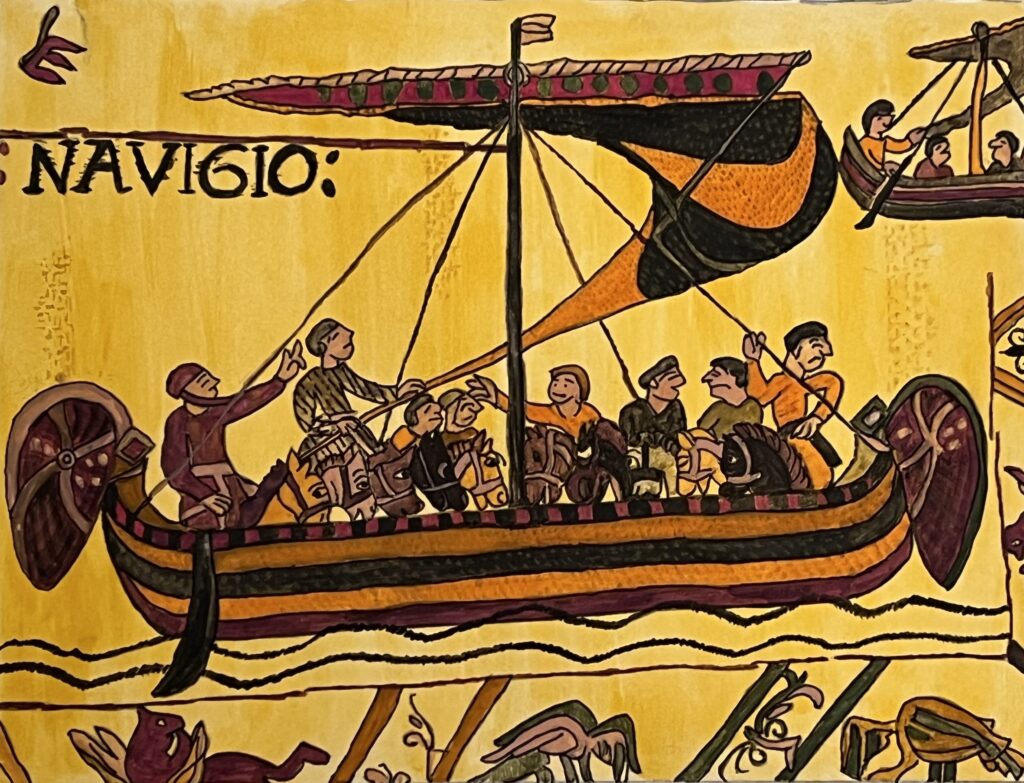
William begins preparing for his conquest of England (in the tapestry anyhow—whether he began earlier, no one knows). He orders a new fleet to cross the channel. Trees are hewn, boats are built, boats are loaded with arms—chain mail armor, lances, swords and axes. Image Sources.
The summer of 1066 came, and then September. On the 8th of the month, Harold Hardrada, the king of Norway, invaded northern England. In four short days, York had fallen to him, and he was now declared king of northern England.
King Harold marched northwards with an army to protect his kingdom. And, he left the south neglected.
William. . .meanwhile:
At dusk on the 27th of September, well after William’s preparations had been completed, the wind turned, and blew, finally, from the south. That night, the conqueror of England set out to cross the English Channel. His boat, the Mora, led the fleet across the dark waters, with a powerful lantern on its mast as a guide across the gloom.
William landed at the coast of Sussex on the morning of the 28th of September, 1066 CE. Harold had been king for just nine months, and was, of course, nowhere nearby, being engaged up north with the York issue.
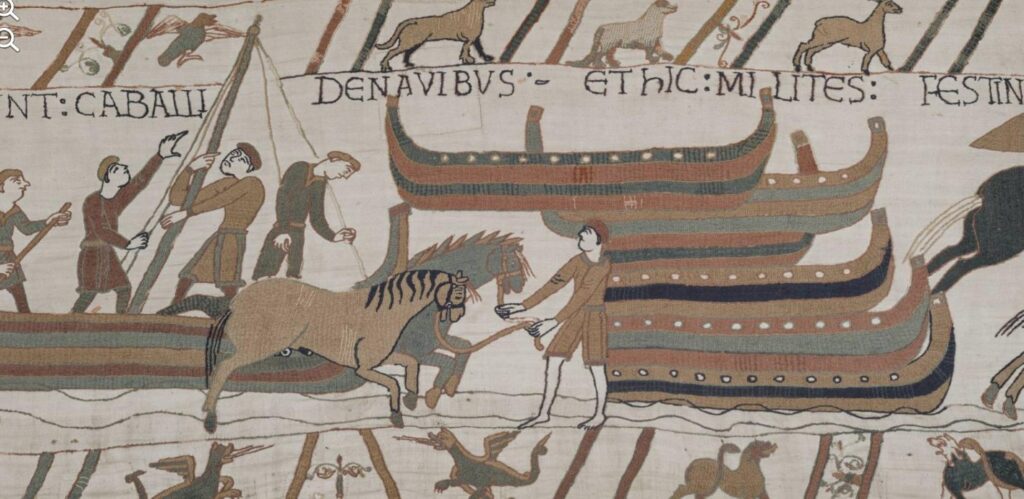
William’s fleet lands on English shores, and the army and horses are brought onto land. Image Source.
Upon disembarking from the Mora, the future king of England lost his footing in the mire, slipped, and fell to the ground. When he rose again, he had a fistful of mud in his hands—and with that dirt, William claimed that he had all England within his grasp. Or so, the story goes.
William did not take his army very far, only northeast some ten miles to the town of Hastings. Here, he set up a great mound of earth as a defense, and built a wooden castle from which he went on sorties to defeat and lay claim on as much of English earth as he could.
So, where exactly is this Hastings? It’s not on the contemporary map of England:
In the 13th Century, Benedictine monks established a monastery at the village of Battle in Sussex. They claimed it to be the site of the Battle of Hastings, a good hundred years or so after the event.
Their abbey house, Battle Abbey, still exists in its splendid ruins, and you can visit there.
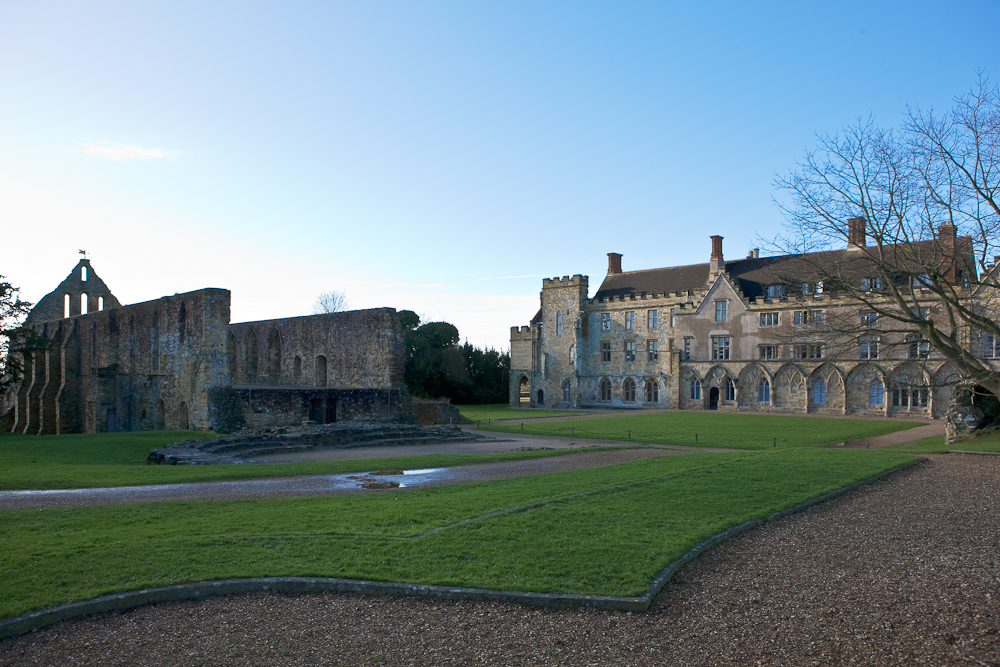
Battle Abbey in Battle, Sussex, the site of William the Conqueror’s base during his English invasion, and the site of the Battle of Hastings that won William the crown. Image Source.
That Battle of Hastings:
King Harold met William at Hastings for that decisive battle on the 14th of October, 1066.
The previous day, William’s army went down on their knees in prayer for the combat, and Harold’s men drank and caroused—or so the legend goes, attributing piety to the victorious, and less seemly behavior to the defeated.
On the morning, William led his army up the hill of Telham, so as to have a good sight of Harold’s men on another hill named Senlac. Battle Abbey stands today on this latter hill, Senlac. In getting ready for the fight, William had put on his hauberk back-to-front—it’s a mail shirt worn as armor, with an opening in the front collar to accommodate, I suppose, the face and nose.
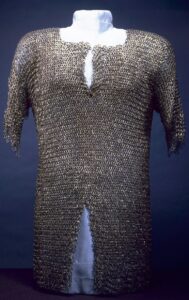
A hauberk from the 15th Century, very much like the one William and his army must have used as armor for the Battle of Hastings. Image Source.
Someone said, “Your hauberk’s turned, Sire.”
And William, glancing down, replied, “A sure sign that I am going to be turned from duke to king today.”
Or, something like that, a bad omen anyhow, turned into a good one.
The Norman army set off in three directions, right, left and center, with the middle army comprising of William and his two half-brothers (sons of his mother) Robert, and Bishop Odo of Bayeux.
Do you see how we’re approaching the Bayeux Tapestry now, at least, for now in name?
Each flank of the army had the light artillery in front—first, the archers with their skill at the bow, pelting the enemy with arrows that would sow confusion and cause them to duck their heads when they most needed to be alert. Next, came the more heavily armed foot soldiers with their shields and their swords. And last of all was the cavalry, with their lances and shields.
The second and the third layers of soldiers were clad in the haubreks and the helmets with a straight line of nose-piece in front to protect their faces.
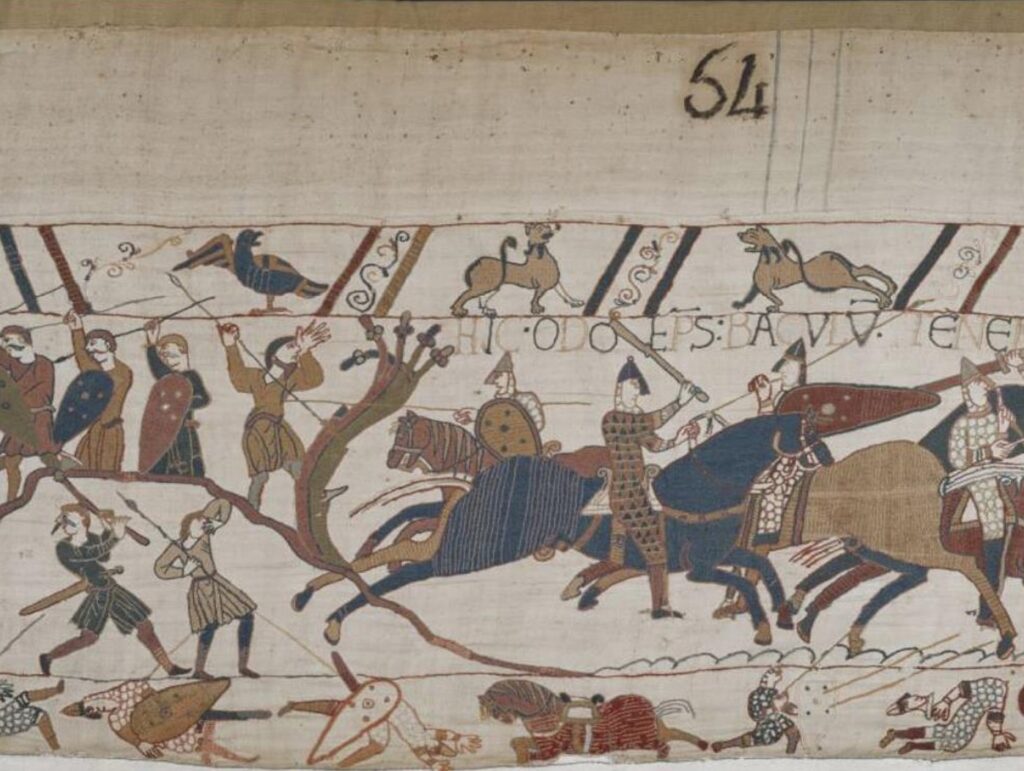
Odo, on the battlefield, standing center in front of the dark horse, wielding his mace. Image Source.
Only William and Bishop Odo carried a mace instead of a lance—what William’s reasoning was, no one knows, but the bishop, being a man of the cloth, was constrained to not shed blood. Instead, he crushed his enemies skulls (!)
Meanwhile on Senlac. . .
The English army on the hill of Senlac was very similar in character to their Norman brethren, in terms of armor, helmets and weapons, with a few differences. Instead of archers, they had javelin throwers in the front, and their heavy artillery was mostly the Danish axe, which took the place of the Norman mace.
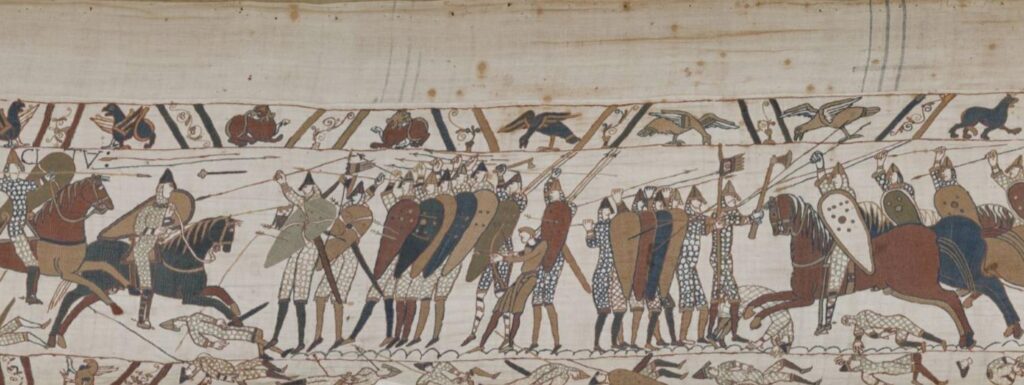
Another line of English defense was this wall of shields comprised of soldiers standing neck-to-neck. A shower of Norman arrows falls around them. Image Source.
One other thing was unusual as a line of defense, literally. On the outer edge of the English army, the men stood close to each other, shoulder-to-shoulder almost, with just enough gap to wield their weapons. So, unless the Normans plowed through this front of soldiers, they had no way of reaching through to Harold.
The Battle of Hastings begins:
The first stage of the Norman army found its way up the hill of Senlac to confront this shield wall of English soldiers, and the Battle of Hastings began.
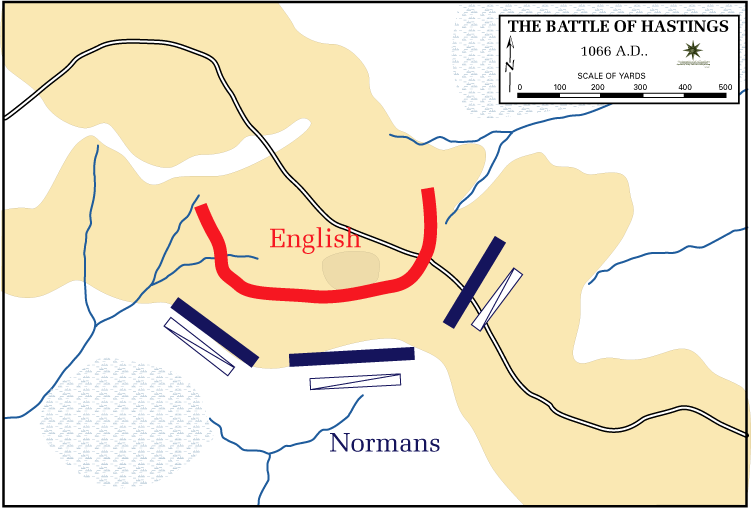
The English, ensconced on the hill of Senlac, and the Normans, making their way up in three battalions. Image Source.
For the first few hours, that shield wall held, and the Normans were beaten back down the hill. Even William, attempting to ride up the slope, had to retreat, and in all that confusion of noise and death, a rumor began that the Duke of Normandy had been killed.
At the bottom of the hill again, William rode around his army, reassuring them of the falsehood of the report, and encouraging them to regroup and begin the assault on Senlac anew.
In the meantime, the English soldiers, filled with the thirst for a bloody battle, celebrating their supposed victory prematurely, began peeling away from their shield formation, and a few of them sped down the hill to fight the enemy at the bottom.
They were cut down, naturally. But what they had done was to weaken the English defense by creating that rupture in the shield wall.
William, thrown off his horse and fighting on foot:
In a second attack, William, with his brothers, Bishop Odo and Robert, raced uphill again, looking for a weak spot in the English army that they could pierce to get at the well-guarded Harold.
How did William know where Harold was? A soldier held up a standard above the army, to obligingly mark the king’s position!
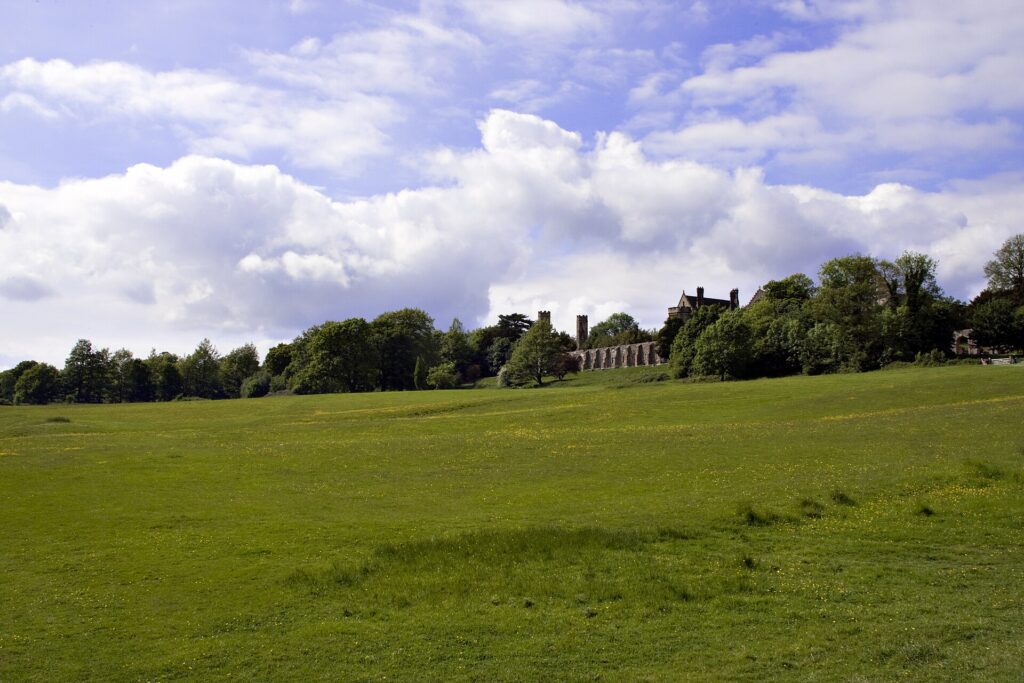
The hill and the slope of Senlac, with the ruined buildings of Battle Abbey in the background. Image Source.
Harold himself was accompanied by two of his brothers, both earls, Gryth and Leofwine. It was Gryth, who, seeing William approaching, close enough for a spear throw, flung his weapon at him. It came so near that it pierced William’s horse, which fell dead, tumbling his mount to the ground.
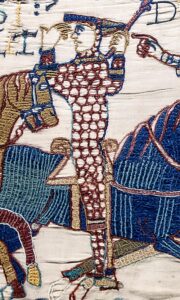
William, after falling from his horse, bolts upright, turns back toward his men, and lifts the visor of his helmet to let his army know that he is still alive. Image Source.
William and Gryth drew their swords in a hand-to-hand combat, while all the fighting was going on around them, and William slew Gryth. In the meantime, the other brother, Earl Leofwine, was also killed.
But, Harold proved elusive, and the line of defense around him held.
The end of the battle, and the beginning of William becoming king of England:
Toward evening, exhausted from the fight, William changed his tactics, unable to get at Harold. He knew that if the king fell, the battle would be over and his victory complete. The English soldiers, despite being aware of the death of the two earls, still kept fighting doggedly.
So, William fell back on a strategy that had unwittingly worked in the morning. He ordered his soldiers to pretend to flee back down the hill, to draw the English soldiers out of their formation again.
It worked, the guard around Harold weakened, and William charged into that gap with twenty of his most able knights to fight the remaining protectors of the king. William was preceded by his archers, who had orders to deluge the king’s bodyguards with a rain of arrows.
One arrow fell upon Harold, or more accurately, pierced his eye.
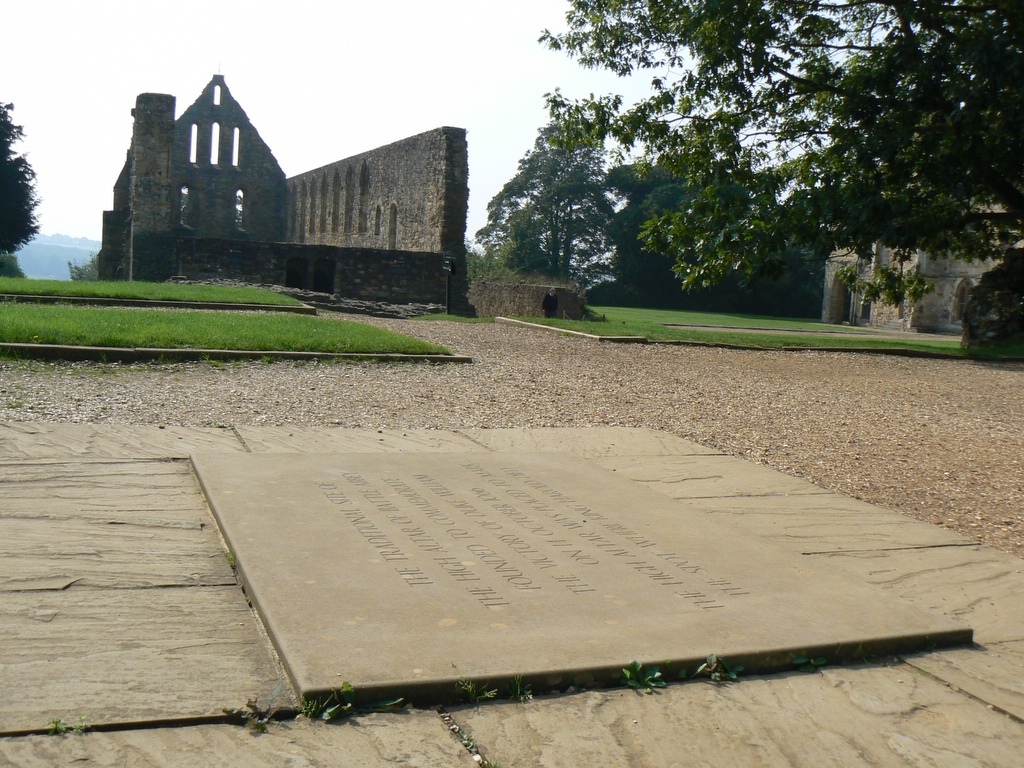
This is the spot where King Harold is said to have fallen during the Battle of Hastings. Battle Abbey was constructed on this Senlac hill a good hundred years after this event. At the time, the monks built their church (which doesn’t exist anymore; only the monastery does) right here with the high altar inside above this spot—marking Harold’s fall, so to speak. The roofless building you see beyond was the dormitory for the monks and the novices. Image Source.
The knights barreled their way to Harold, and finding him still alive, cut him up into pieces.
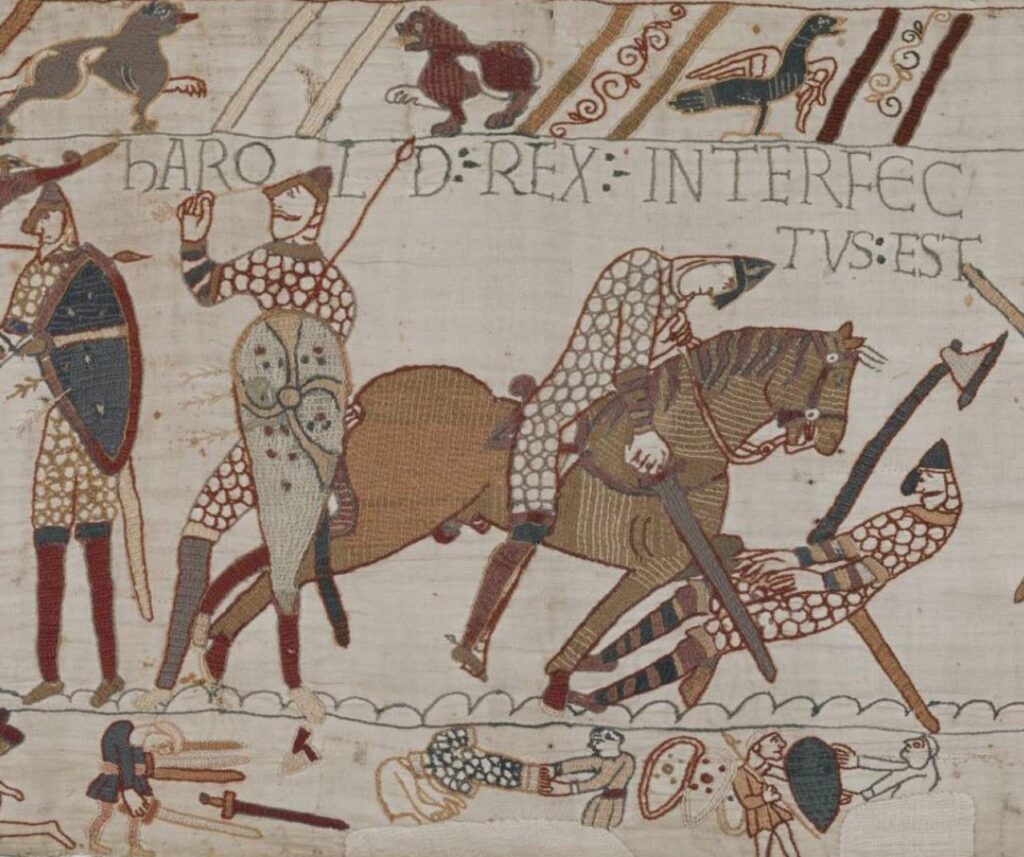
Harold, second from left, holding the arrow that pierced his eye. The next frame is of a soldier on horseback slaughtering a fallen man; the fallen man is also probably Harold. Image Source.
Now, Harold and his two brothers, the earls, were all dead. But, the battle continued through the dusk and the coming night. William went to the top of Senlac hill and established a camp there, listening to the continued sounds of battle around him.
At daybreak, his men went around gathering up the bodies of the slain Normans so that they could be buried with ritual and decency. The wives and mothers of the fallen English soldiers came begging for their remains, and the new king of England gave them permission to take and bury their dead in their own churches and graveyards.
On one of the dead, William the Conqueror was inflexible. No amount of pleading from the dead king Harold’s family would convince him to release his body. Or so, the story goes.
So, where was King Harold buried?
Perhaps right there at the battlefield. In any case, as with any history going back about a thousand years now, there’s no real confirmation of facts, merely suppositions. One of which is that Harold’s body was disinterred from its unhallowed grave and finally taken to Waltham Abbey—a church he had funded and erected, and where he stopped to pray during his reign.
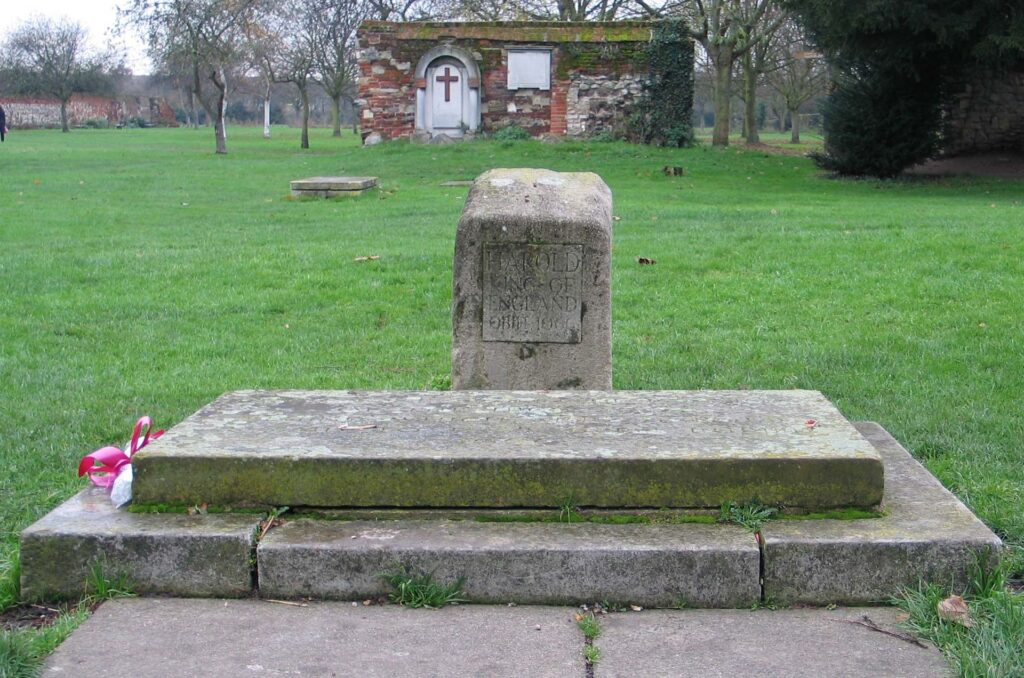
King Harold’s purported grave in the Waltham Abbey churchyard. Image Source.
There’s a tombstone marking King Harold’s grave, east of the church. Waltham Abbey itself, today, dates to. . .where else, the Norman rule, as with most buildings and churches of antiquity in England. Which meant that at some point, William. or his successors, demolished the Waltham church that Harold had built and raised a new, stone church in its place.
Or, in this case, perhaps near its place. Because King Harold’s grave (as in the Battle Abbey grounds) is said to have been under the high altar of the church. Which church? Probably King Harold’s church, the one that was destroyed to be replaced by Norman hands. Which is why the grave is outside the abbey church today.
Conquering all England is very fine, but William’s greatest achievement was the Domesday Book:
The Duke of Normandy had perhaps, mayhap, maybe, visited England in 1051 CE (see Part 2). The then king of England, Edward the Confessor, was his uncle, and had invited him over to promise him rule of the country next.
There’s some doubt whether William ever came to England that year, but William did justify his conquest of England based on that somewhat promise.
If he hadn’t come over, then the first time he visited England was when he occupied it. Either way, it was a brand new country to William—he knew nothing about the land he was going to govern.
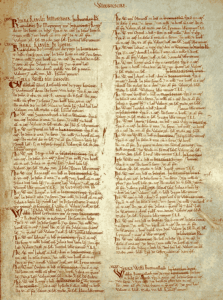
A page from the Domesday Book, with its meticulous detail. Image Source.
So, William the Conqueror sent out his men to make an intensive evaluation of the land—the names of every town, village, and hamlet were recorded. Who held the manor? By lease or by ownership? How many heads of household were there in every place? How many hides of ploughed land, meadows, woods and pasturage? How many pigs, oxen, cows and other domesticated animals? How many freemen and how many slaves and servants? How many churches? How many parishioners?
All this information, an exhaustive census if you will, was recorded in the Domesday Book. It was a meticulous survey of England, a snapshot in time.
Jane Austen in the Domesday Book. . .sort of!
If you’ve been reading all my blog posts, you would have come across the Jane Austen posts from our visit to England. We went to two places where she lived (Steventon and Chawton), and her grave at Winchester Cathedral.
At Steventon, Austen spent the first twenty-five years of her life in the parsonage—her father was rector of the village, and had the church living. That house does not exist anymore, but the church does.
In the Domesday book, in 1086 CE, Steventon was recorded as ‘Stevintune,’ near Basingestoc (Basingstoke; seven miles away, Austen’s market town) in the county of Hampshire. There was no lord of the manor—the lands were under lease by a man noted as ‘Alsi the valet.’ He rented the parish lands from his king (William the C).
The village had five heads of household (their family members were not counted), and eight slaves. The entire extent of arable lands was five ploughlands. A ‘ploughland’ was the amount of land that could be worked by a team of eight oxen in a year. Which does not tell us much by our more contemporary usage of acres as land measurements, but a ploughland was approximately a hundred acres.
This puts Steventon as, that far back in time, at about five hundred acres.
Tiny? Yes. Even in the late 1700s, when Mr. Austen was parish priest of both Steventon and the nearby village of Deane, he had the care of no more than three hundred parishioners in all.
On that summer day when we visited Steventon to look at the Norman church where Austen prayed, where her father conducted the services, there was a sense of old world charm, widespread fields around, a small cluster of homes in the main street. It was not exactly remote, but. . .had a sense of being a detached, and self-sufficient little village.
That Jane Austen church—the Church of St. Nicholas—is of Norman origin, and dates after William’s conquest of England. There’s one other thing that also goes back some nine hundred years and you can see it in the picture below—the yew tree.
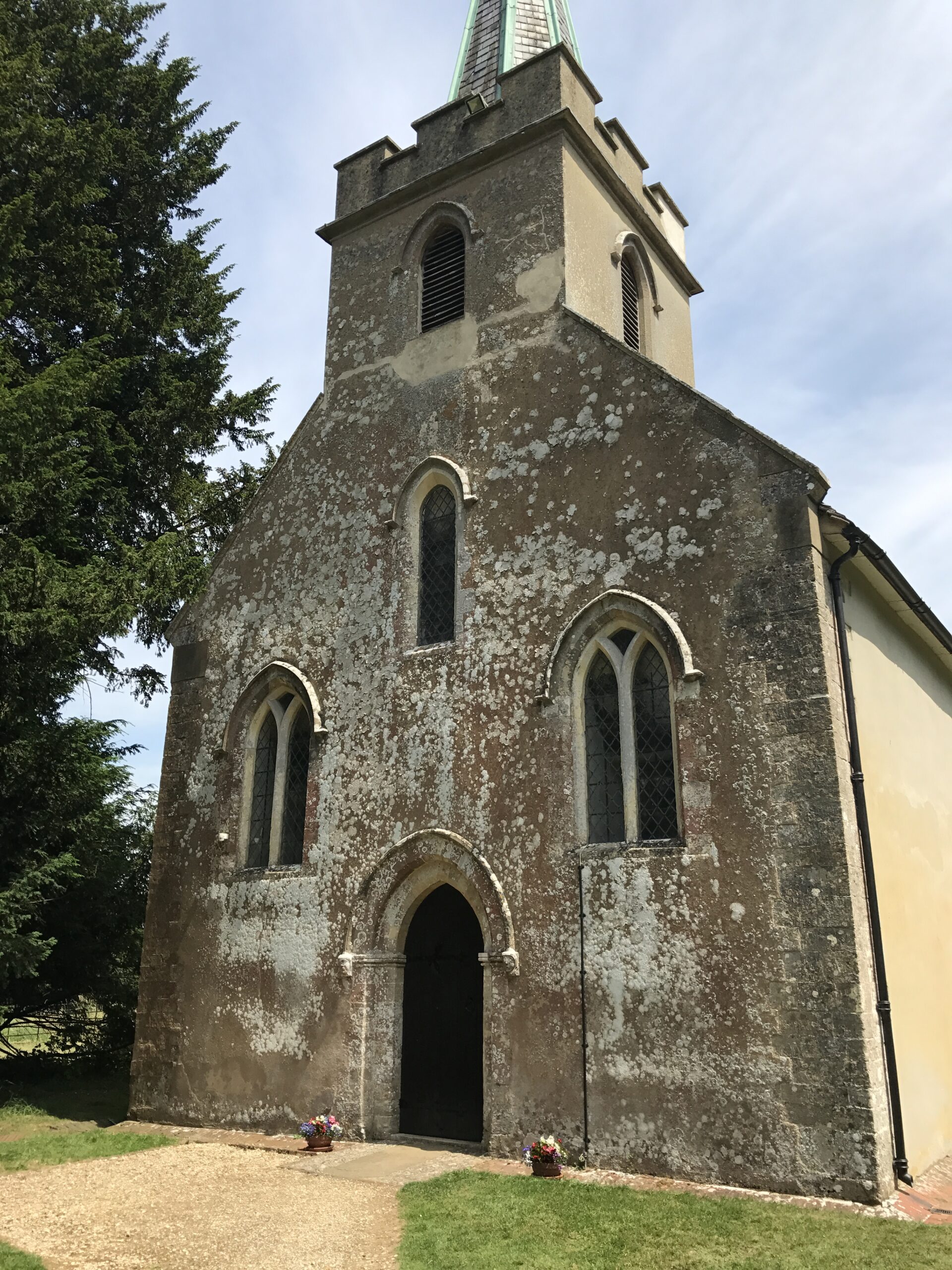
Jane Austen’s church in her home village of Steventon, with the yew tree to the left. It is said to date to the age of the Norman church, and was planted by some Norman overlord. It’s quite possible, that our Alsi the valet, who was then overlord at the time of recording in the Domesday Book, planted the yew himself?
There is one other item, older than even this Norman church in Steventon, and it’s actually kept inside the church now. You see that pillar behind the reading chair in the nave? It’s part of a Saxon cross that was most probably embedded into the ground in front of an Anglo-Saxon (probably wooden) church.
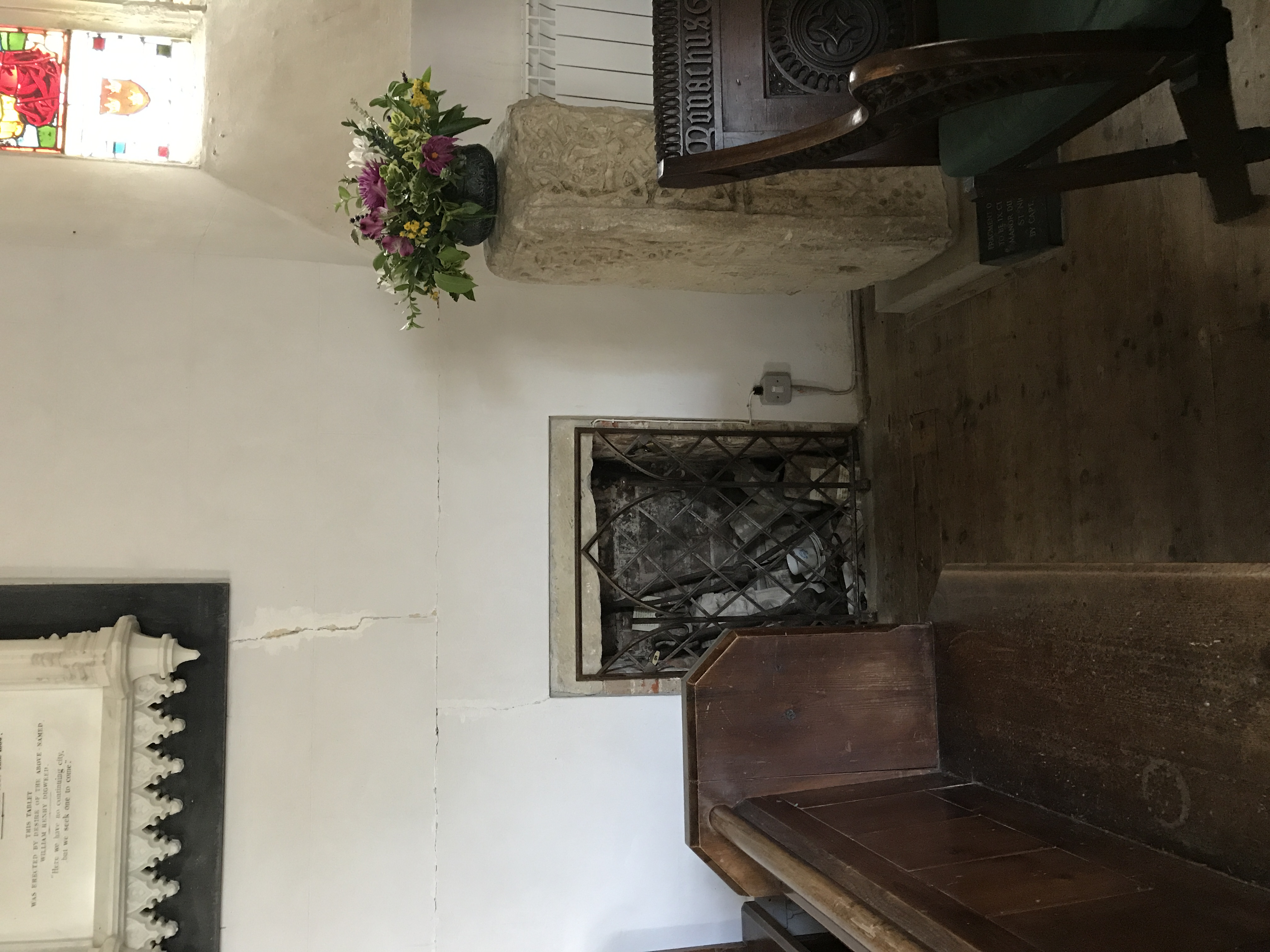
Part of the Anglo-Saxon cross behind the reading desk.
One other thing to talk about before we leave Bayeux. . .
Who made the tapestry? It’s most commonly attributed to Queen Mathilda of England, yes, William’s wife. There’s plenty of doubt about this, as much as there is conviction.
First, needlework and embroidery was a very fine art in Anglo-Saxon England, and the Bayeux Tapestry, in its sketching and its stitches, is hardly sophisticated. So, the queen could not have made it, with the ladies of her court, however much time they might have had on their hands after William conquered England. (The tapestry was displayed for the first time in Bayeux Cathedral in 1077 CE—some eleven years after The Conquest).
Second, there’s some nudity in the margins of the tapestry, mostly men, and a couple of women. Would the Queen of England have done this with her own fair hands? (It’s possible, of course, that those figures were added later on.)
The Victorians wade into the Bayeux Tapestry:
For the longest time, the provenance of the tapestry had always been attributed to Queen Mathilda, and few people questioned this origin. But, by the time the straitlaced Victorians began writing about the tapestry, the narrative. . .changed. Horror of horrors, they could not attribute it to queenly construction. Impossible, surely.
Indeed, an embroidered copy was made in 1885, and all the nude figures either lost their nude parts, or were covered up. (Not so in the original, in the Bayeux Museum today).
But, England, and the rest of the world, hadn’t been so prudish in previous centuries, especially during the rule just preceding Victoria’s prim regime.
George IV, Prince Regent during his father’s madness had a great predilection for debauchery and mistresses. He rented Kempshott Park (in Jane Austen’s neighborhood—she disliked him very much; he loved her books!) as a hunting lodge. Every piece of furniture, the materials for the curtains, the carpets, the gardens outside, were styled and picked by George’s then-mistress, Maria Fitzherbert. When George married Caroline of Brunswick, he brought her to Kempshott for their honeymoon—other guests at the manor included his current mistress, Lady Jersey.
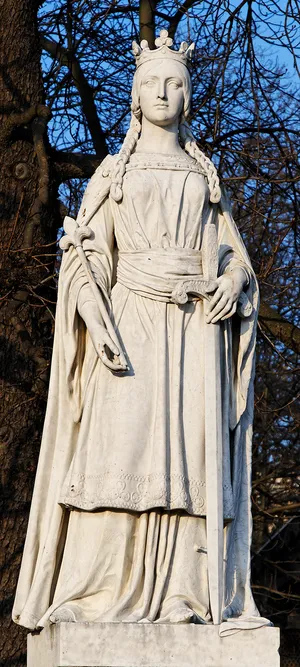
Mathilda of Flanders, William the Conqueror’s wife, was responsible for the Bayeux Tapestry? In all its. . .um, naked detail? Image Source.
So, it’s just possible that Mathilda, wife of William the Conqueror did actually stich every part of the tapestry (or supervised parts anyhow) because they were none of them squeamish about representing the human form in all its detail.
And again, given that Westminster Abbey in the Bayeux Tapestry is fairly accurately delineated, the theory is that the tapestry was embroidered in London.
Maybe Mathilda made this other tapestry? (I’m calling it) The Boudoir Tapestry:
There was actually another tapestry in existence in the 12th Century, telling the same tale as the Bayeux Tapestry. It was embroidered on velum, not coarse linen. A contemporary account, written in Latin by Baldric, Abbot of Bourgueil, says that it hung around Adela’s bed.
Let’s go back to Part 2 here—Adela was one of William’s daughters, the woman who married the Count of Blois, and whose son, Stephen, eventually became king of England (after his two uncles, who were William’s sons).
In the first place, what’s an abbot doing in a royal lady’s bedchamber? And what did he do there for so long that he was able to study the tapestry intently? Never mind that, what he says is very interesting.
This tapestry, ‘The Boudoir Tapestry,’ was exquisite in workmanship. Not just the fact that velum had been used, but the embroidery was painstaking, the stitches so perfect that you could barely see them. The threads were of gold and silver, fine and airy. There were red jewels embedded into the story, along with pearls.
How original is the Bayeux Tapestry you will see today?
The Bayeux Tapestry is not. . .actually a tapestry after all. Because that’s a woven piece of fabric, like a carpet, or a wall hanging, telling its story in warp and weft, thread by thread.
The Bayeux is embroidery, on a long piece of linen. The thread used was worsted wool yarn—which is smoother, and tougher than regular wool and unlike the latter, does not have the fuzz and softness of wool. The colors are muted, in ten different hues, tinted with vegetable dyes.
The Bayeux Tapestry is over eight hundred years old, and it’s not made of stone, or even wood, but cloth.
Over the centuries then, there’s been a fair amount of deterioration—the cloth itself perhaps giving way in places, the weave thinning, and the embroidery threads losing their grip. That last, about the threads, can mean that whatever the original maker’s intention was in telling the story, either in the Latin words, or in the figures, or even their actions, must have either become obscure, or entirely disappeared over time.
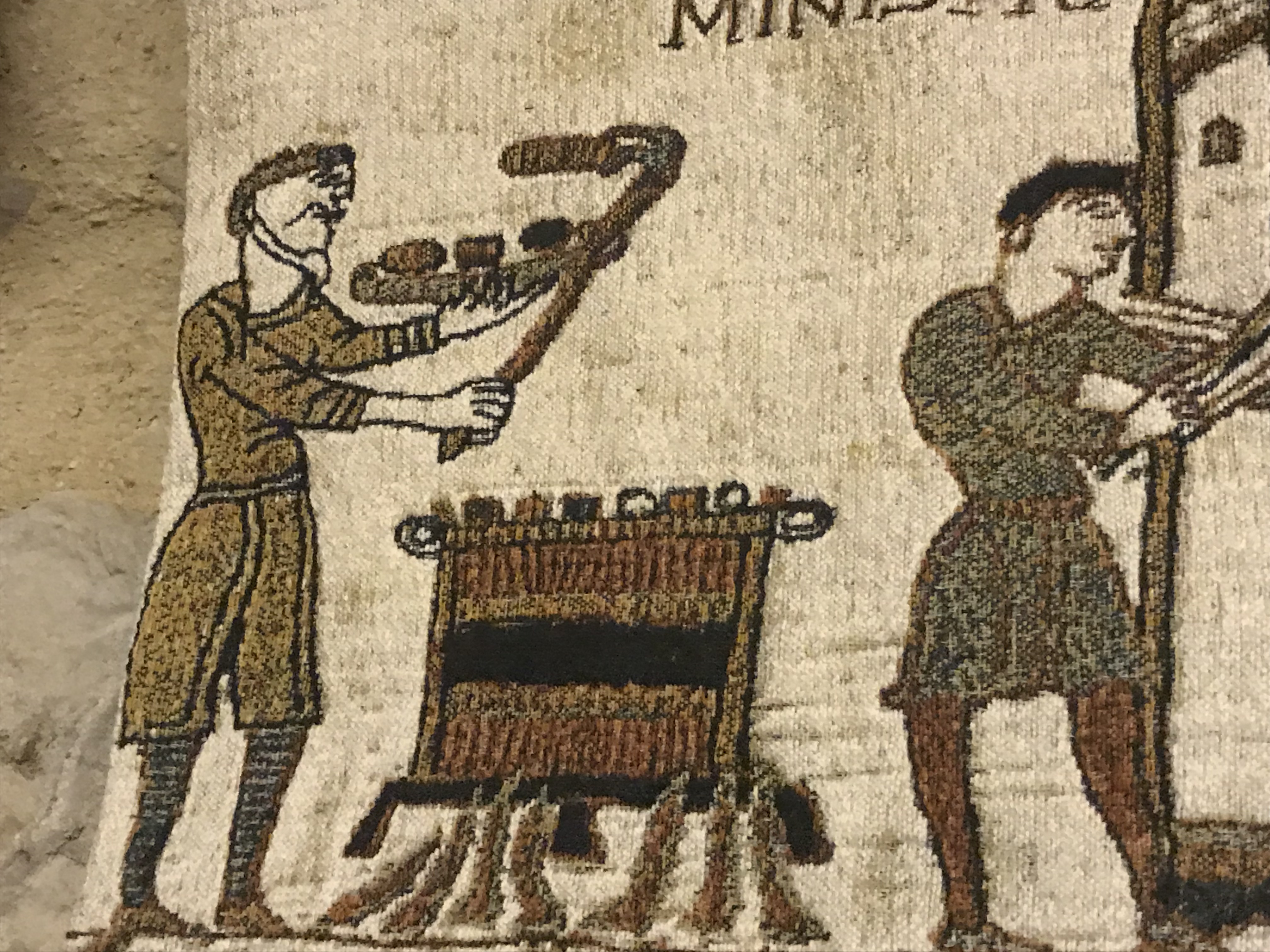
A frame from the Bayeux Tapestry showing cooks preparing for a feast after William landed in England (before he defeats Harold).
After the tapestry’s display in the nave of Bayeux Cathedral (no one actually knows how long exactly), it crops up in an inventory of items and relics in the cathedral’s books, in 1476 and then 1563 CE.
After a few other mentions in the 18th Century, in the early 19th (1814), one visitor to France tells of the tapestry being rolled around a winch with a handle. The winch was pulled up to a table, and the tapestry unwound and displayed on the table when wanted. This visitor also says that the tapestry was very ragged at the edges, and the winding and unwinding had caused the cloth to thin out, and some figures had almost completely disappeared.
The earliest known sketch of the Bayeux Tapestry:
About a hundred years before the tapestry was strung around the winch, in 1721 CE, a Monsieur Foucault sketched out various (not all) scenes from the tapestry.
Foucault was an Intendant of Normandy—either a public security official or an administrative official appointed by the king of France in various provinces. I think he was most likely the latter, and not a policeman, in charge of keeping the peace. The sketches were found among his papers.
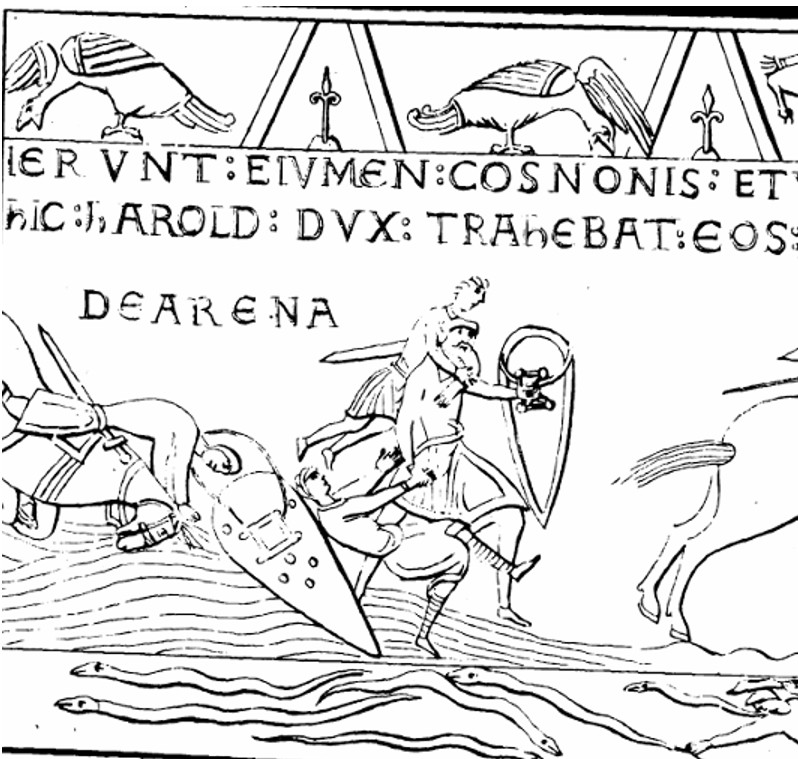
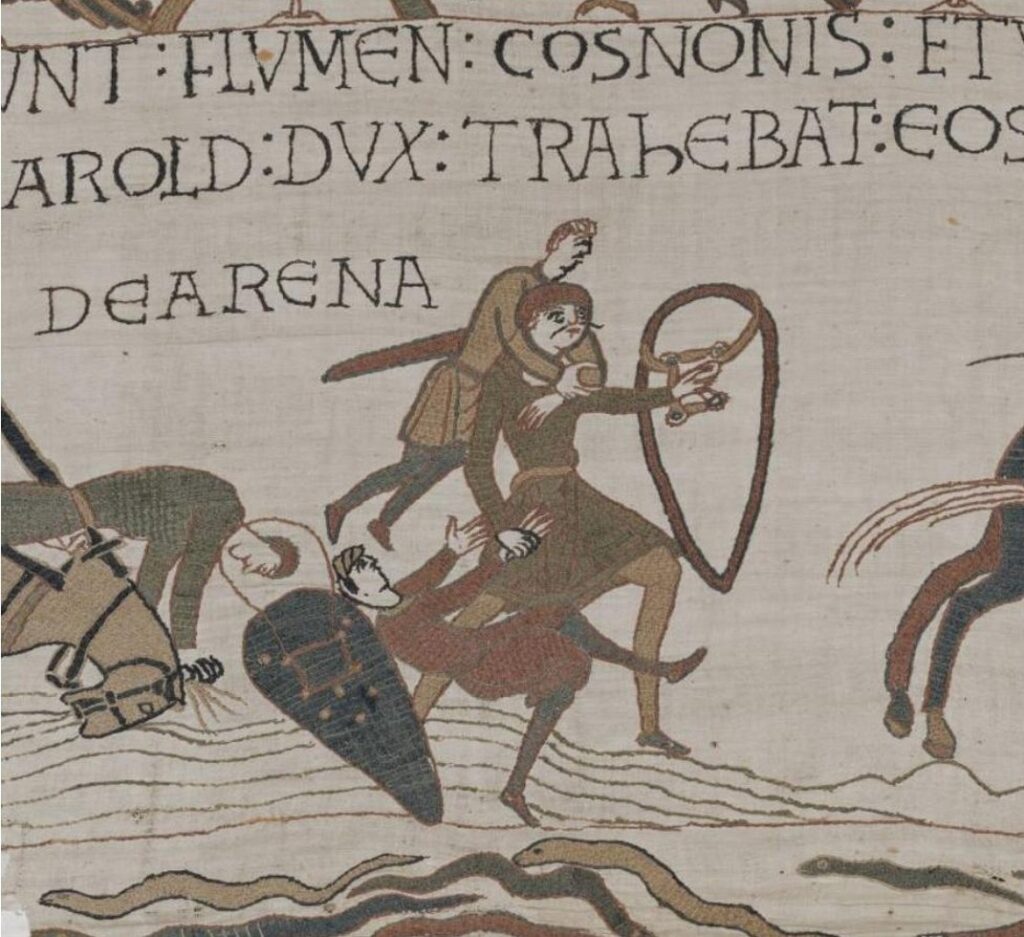
On the left, Foucalt’s sketch of the Bayeux Tapestry which he made in 1721 CE, published in Montfaucon’s book in 1729. On the right, the same scene in the Bayeux Tapestry today. There’s so much vigor in the tapestry–this scene is from when William forces a captive Harold to fight against the Duke of Brittany, when Harold supposedly comes to France before Edward the Confessor dies. William’s soldiers pass by Mont St. Michel on the seaside and get caught in quicksand. That man, with his arms around another’s neck, heaving, is said to be Harold–showing his fealty to William–by dragging his soldiers out of the mire. First Image Source: Les Monuments de la Monarchie Françoise by Dom Bernard de Montfaucon. Second Image Source.
In 1729, Dom Bernard de Montfaucon, a Benedictine monk of the Congregation of Saint Maur, published Les Monuments de la Monarchie Françoise, in which he included all these sketches made by Foucault. So here, in 1729—a hundred years before figures had disappeared from the cloth—the tapestry is not only fairly complete, but also recognizable as similar to what you will see today.
Which means, between then and now, there’s been a fair amount of restoration done—let’s say somewhat. . .accurately (?) since the restorers used Monsieur Foucault’s sketches to fill in the places that had disintegrated. But. But. But.
But. . .Foucault’s sketches aren’t accurately Foucault’s either?
Ok, I will explain that rather confounding subtitle!
Printing books in the 18th Century was a laborious process. They had to fit each letter (a type) into a frame, with tiny metal plugs for spaces between words, and secure it in place–each frame represented a page. Then, ink was rolled over the typeset and the paper inverted over it–that was how books were printed, page by page, and then bound together.
(Another aside: if you’re in the U.S. and have an opportunity to visit Colonial Williamsburg, there’s a printing shop in that colony. I spent a very enjoyable hour there, looking at all the type, the frames, the paper, and watching the printer print off several sheets, as he explained the process in detail. I’m not sure yet if Colonial Williamsburg will come up in a future blog post. . .maybe.)
The same process was used for illustrations, which were engraved into either wooden or copper plates, ink rolled, paper pressed on. Typsetting had to be done, but illustrations were rarely included since they were, obviously, very time-consuming to produce, and expensive.
Dom Montfaucon, the author of the book in which Foucault’s sketches were first published in 1729, gave orders to the engraver, Antoine Benoît, to engrave the illustration plates accurately, and to not change anything from the sketches, other than the size of the engraving to fit the page of a book.
Benoît said sure, will do. But, he did change things–and, you’ll see an example below.
What are the changes then?
There are a few examples, and I’m going to show you just one.
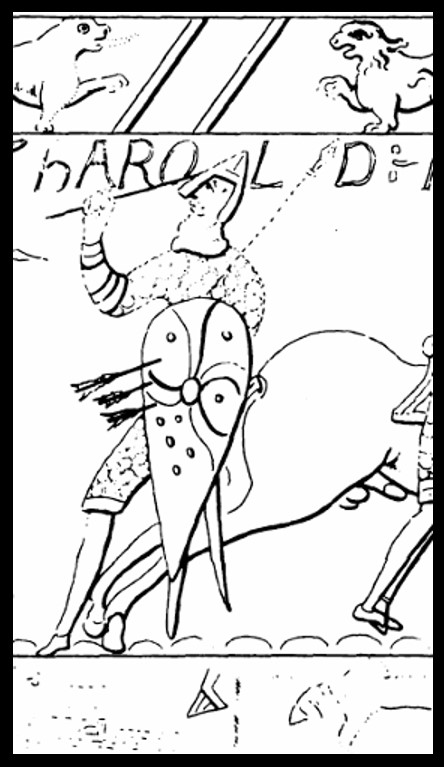
Here’s the scene of Harold holding onto the arrow that pierced his eye, just before he died. This is from the 1729 book by Dom Montfaucon, where he copied and published Foucault’s 1721 sketches. BUT, Benoît made a change from Foucault’s sketch. Image Source: Les Monuments de la Monarchie Françoise by Dom Bernard de Montfaucon.
This sketch above, which is supposed to be Monsieur Foucault’s 1721, earliest sketch of the tapestry, is not exactly how Foucault drew this scene when he viewed the tapestry.
If you look at it carefully, you’ll see that a line represents the arrow, and, the arrow is not an arrow with fletches at the end but merely a stick. Also, over Harold’s left shoulder, the spear that he’s supposed to be holding is drawn in dashes.
Both didn’t exist in Monsieur Foucault’s 1721 drawings. It was Benoît who decided that (a) the arrow ought to be piercing Harold’s eye (although he engraved it in without the fletches) and (b) Harold ought to be holding a spear.
As far as storytelling goes, this fits very well with what the tapestry wants to convey, but it’s clear that even in these earliest sketches of Foucault, some parts of the tapestry were missing. As in, Foucault faithfully reproduced, in his sketches, the deterioration in the tapestry.
Harold, his eye, and the arrow today in the Bayeux Tapestry:
So here, below, is what the contemporary tapestry looks like in this same scene.
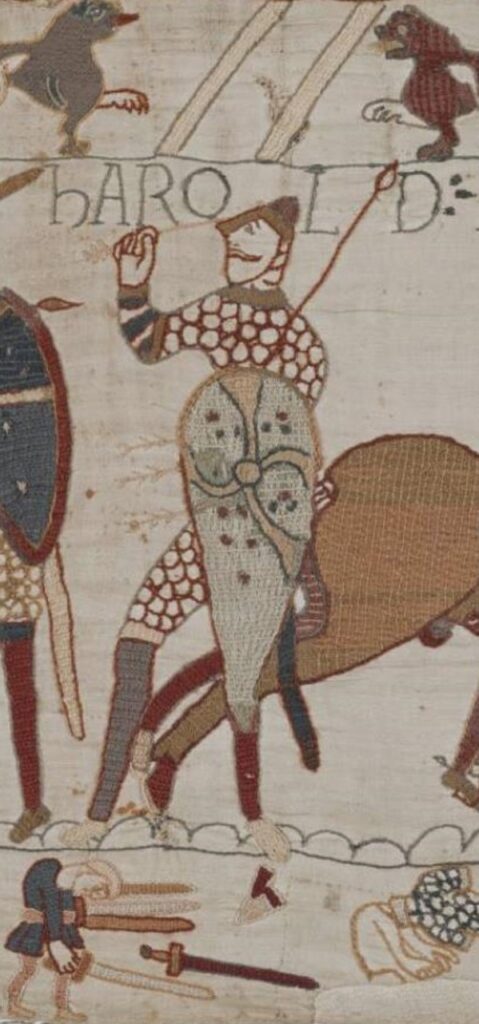
There are many differences from that 1729 published sketch. I’ll explain below, but note one thing from the previous image—there was no leg showing below the point of Harold’s shield in the 1729 sketch—it’s now filled in. Image Source.
So, the differences and the similarities: The arrow is filled in now with fletches, and is no longer a stick. The spear on Harold’s left shoulder is also filled in.
In the 1729 sketch, Harold is missing his left foot—that now shows below his shield. The foot was then added much later.
And, of course, the borders are filled in with embroidery of various images.
Another look at the two images of Harold holding the arrow that pierced his eye, side by side, so you can see the differences at a glance–the arrow with fletches, the spear, and Harold’s left foot below the shield. First Image Source: Les Monuments de la Monarchie Françoise by Dom Bernard de Montfaucon. Second Image Source.
The Bayeux Tapestry. . .incomplete?
The tapestry is two hundred and thirty feet long, and twenty inches wide. Take a look at the end of the tapestry, below.
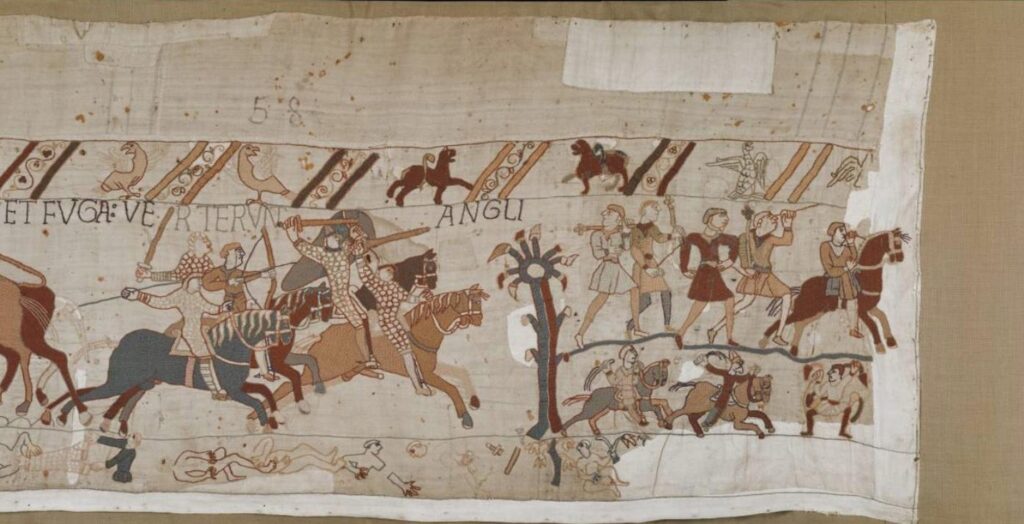
The last scene of the Bayeux Tapestry shows the French soldiers, left on horseback, chasing away the English soldiers (right) after their victory in the Battle of Hastings. I didn’t crop the image, so you can see that this is actually the last scene in the (existing) tapestry. Image Source.
You see how it ends abruptly?
As far as the story goes, we had that looong justification for William taking the English throne from Harold—Harold came to France, William saved him, they fought the Duke of Brittany together, Harold promised England to William with his hands on chests of pious relics, etc.
The tapestry begins with Edward the Confessor, as king of England, giving Harold permission to go to France.
Midway, after Edward’s death, Harold is crowned king in England.
And then, William conquers England and. . .where is he, seated on a magnificent throne, crowned inside Westminster Abbey? The first English king to be crowned in the Abbey, as the story goes?
Instead, the tapestry ends with a chase of soldiers? We had King Edward at the beginning, King Harold in the middle, shouldn’t we finish with King William in the end?
The tapestry is also obviously incomplete because there’s no finishing right-hand vertical embroidery border (as there is a left-hand border at the beginning).
I don’t think anyone actually knows what happened to that end bit of cloth. The theory is that when the tapestry was brought to Bayeux Cathedral to hang in the nave, it was found to be too long.
And so, someone chopped off a bit of its length, maybe twenty feet! Oy.
Adieu, Bayeux, adieu:
We went to Bayeux really, only to see the tapestry, of whose fame I’d heard of and read of for many years. But, now that we were there, our next stop after leaving the Bayeux Museum, where the tapestry is displayed so well, was, naturally the cathedral.
The Bayeux Cathedral that Odo, warrior-clergyman, brother of the Conqueror of England, bishop of Bayeux, built. For the consecration of which, William came back to Normandy, and in the nave of which the tapestry first hung. The cathedral will be a blog post sometime in the future.
For now, Bayeux, adieu!
If you’ve enjoyed reading this post, please share it, so others may read also. Thank you!
Primary Citations and Sources: Edward A. Freeman, A Short History of the Norman Conquest of England; John Collingwood Bruce, The Bayeux Tapestry Elucidated; Charles Dawson, ‘The Bayeux Tapestry in the hands of ‘Restorers’ and how it has fared.’ article in The Antiquary; Jacob Abbott, History of William the Conqueror; Dom Bernard de Montfaucon, Les Monuments de la Monarchie Françoise; Hilaire Belloc, The Book of The Bayeux Tapestry; Article from The Art Bulletin, An Illustrated Quarterly published by the College Art Association of America, Volume 6, September 1923—June 1924; W. R. Lethaby, Westminster Abbey Re-Examined.
On the next blog post—I’m giving a lecture for Medium Day, 2025 which is on Friday, September 19th–Writing the Bejeweled Past: Turning Fact into Fiction in India’s Mughal Empire.
Search Engine Keyword Phrases: Norman Conquest; Conquest Normans; Norman Invaders; Norman Invasion; 1066 Norman Conquest; 1066 Norman Invasion; Norman Conquest tapestry; Norman Invasion tapestry; reasons for the norman conquest; what is the norman conquest and why was it important; consequences of the norman conquest; Norman Conquest Bayeux Tapestry; William the Conqueror; William the Conqueror children; Bayuex Tapestry


One Reply to “All Hail William, The New King–The Unsurpassed Bayeux Tapestry–Part 3”