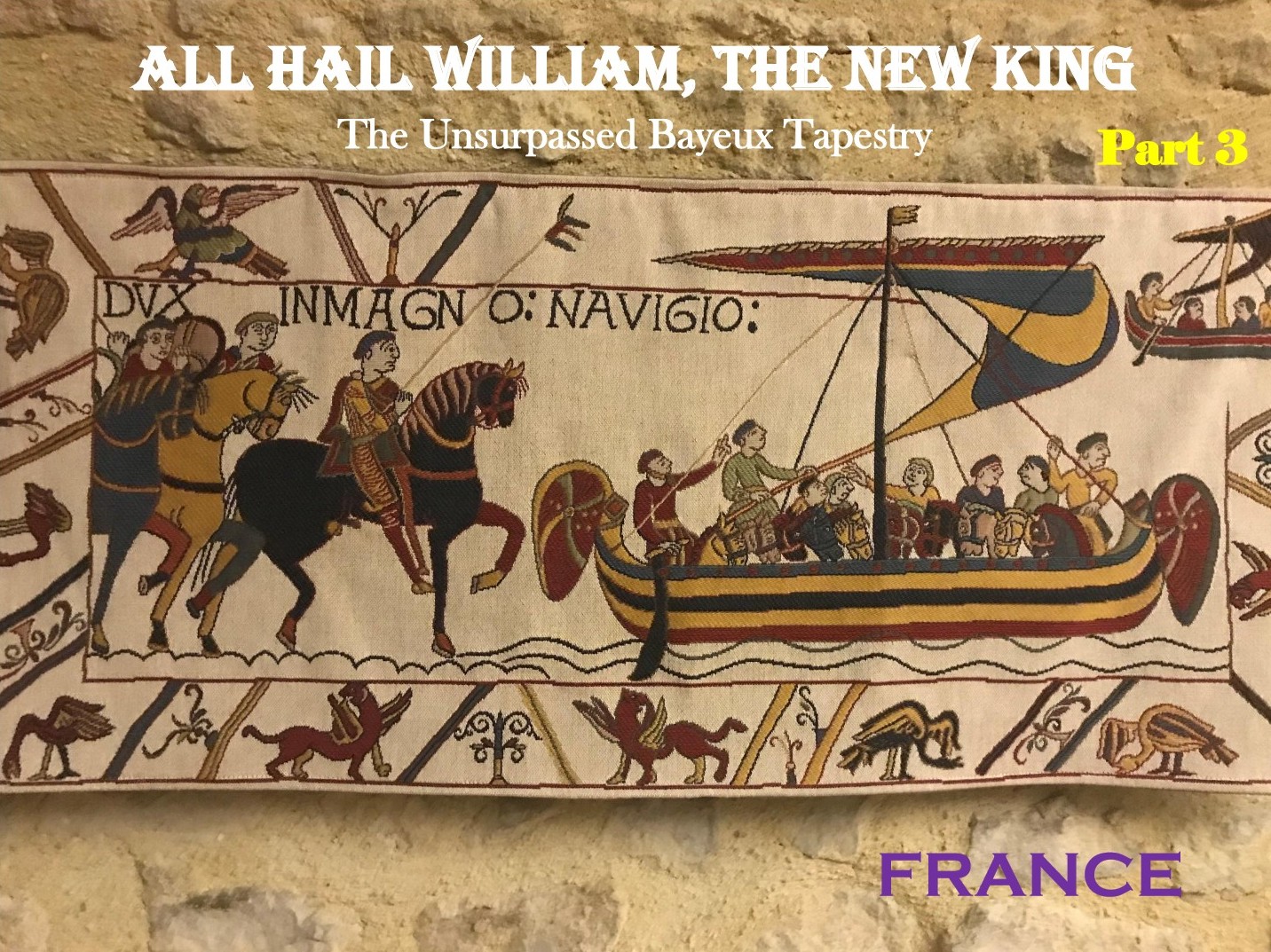
The featured image for Part 3 of the post on the Bayeux Tapestry.

All Hail William, The New King–The Unsurpassed Bayeux Tapestry–Part 3

THE BAYEUX TAPESTRY, THE SCENES, EXPLAINED.

When William, the French Duke of Normandy, went across the English Channel in September, 1066 CE, to take England and make it his own, he gave two excuses for this unreasonable aggression.

One, he said that King Edward the Confessor, who was his uncle once removed (see the history in Parts 1 and 2 of this blog post), had, during William’s first and only visit to England some fifteen years earlier, declared that he wanted William to follow him  on the throne.

The first scene of the Bayeux Tapestry shows Edward the Confessor, giving Harold, Duke of Wessex, permission to go to France.

The very first scene of the Bayeux Tapestry—detailing William’s conquest of England—is a meeting, presumably at the Palace of Westminster which was the royal abode then, between Edward the Confessor and his successor, Harold.  Harold was Edward’s brother-in-law—Edward had married his sister. Image Source.

Two, William said that the man who donned the crown after Edward the Confessor’s death in January of 1066 and became King Harold, had also promised him (promised William that is) that he would absolutely not take the crown after Edward, and that it would be kept for William.

I can, and will, poke several holes into both these excuses.

Continue Reading
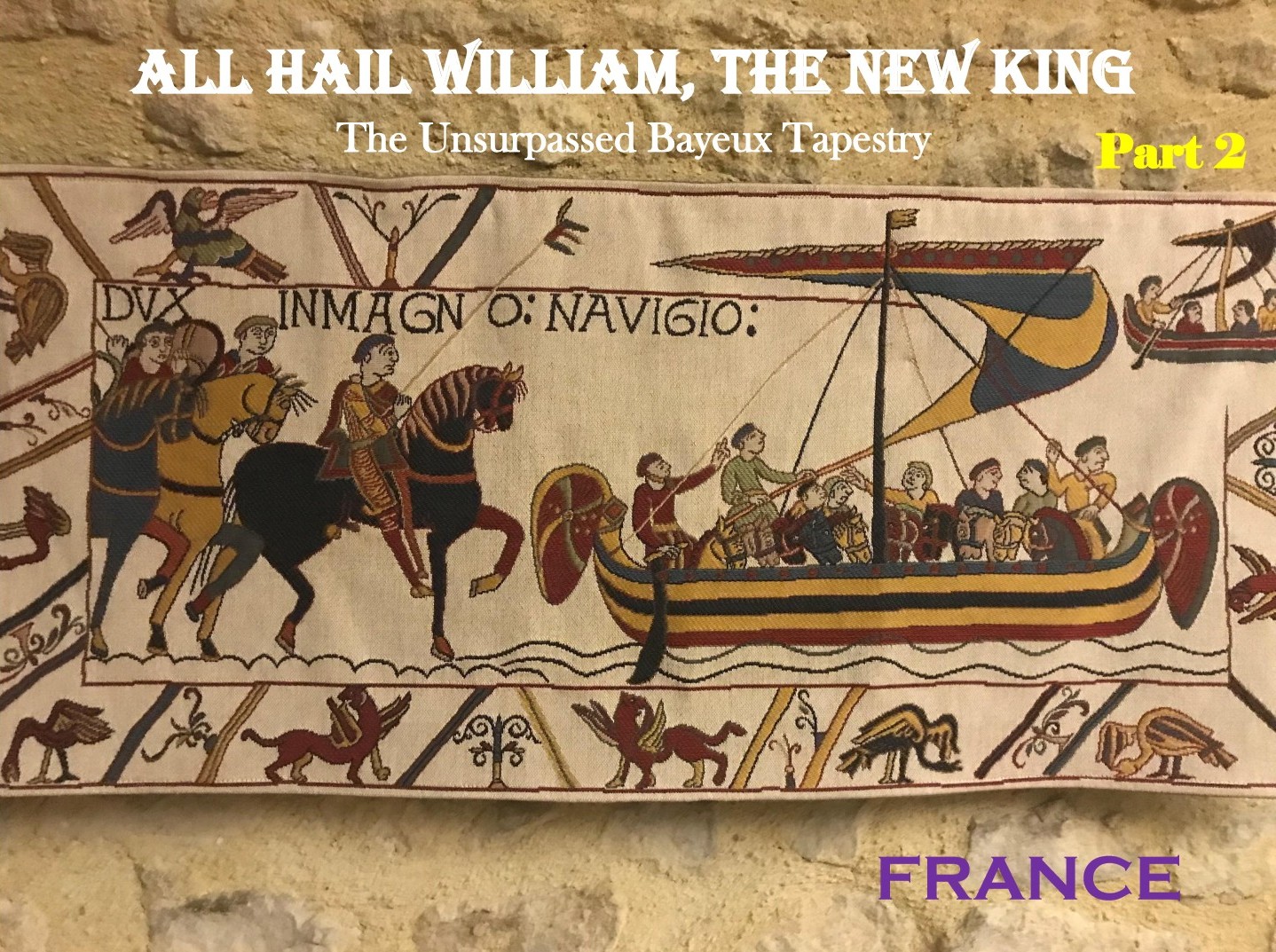
Part 2 of the blog post titled All Hail William, the New King. The unsurpassed Bayeux Tapestry.

All Hail William, the New King–The Unsurpassed Bayeux Tapestry–Part 2

In 1066 CE, a French usurper, William the Conqueror, came to the English throne.  He was the Duke of Normandy, and his story was told very soon after The Conquest on a length of embroidered linen, using ten hues of subdued colors.  This is the Bayeux Tapestry.

The tapestry was made for the consecration of Bayeux Cathedral—William the Conqueror’s brother, Odo, was Bishop of Bayeux, and responsible of the building of the cathedral (future blog post).  At that grand event, the Bayeux Tapestry was displayed for the first time, and for many centuries after, hung in the grand nave.

Continue Reading
The Norman Conquest and the Bayeux Tapestry--Part 1

All Hail William, the New King–The Unsurpassed Bayeux Tapestry–Part 1

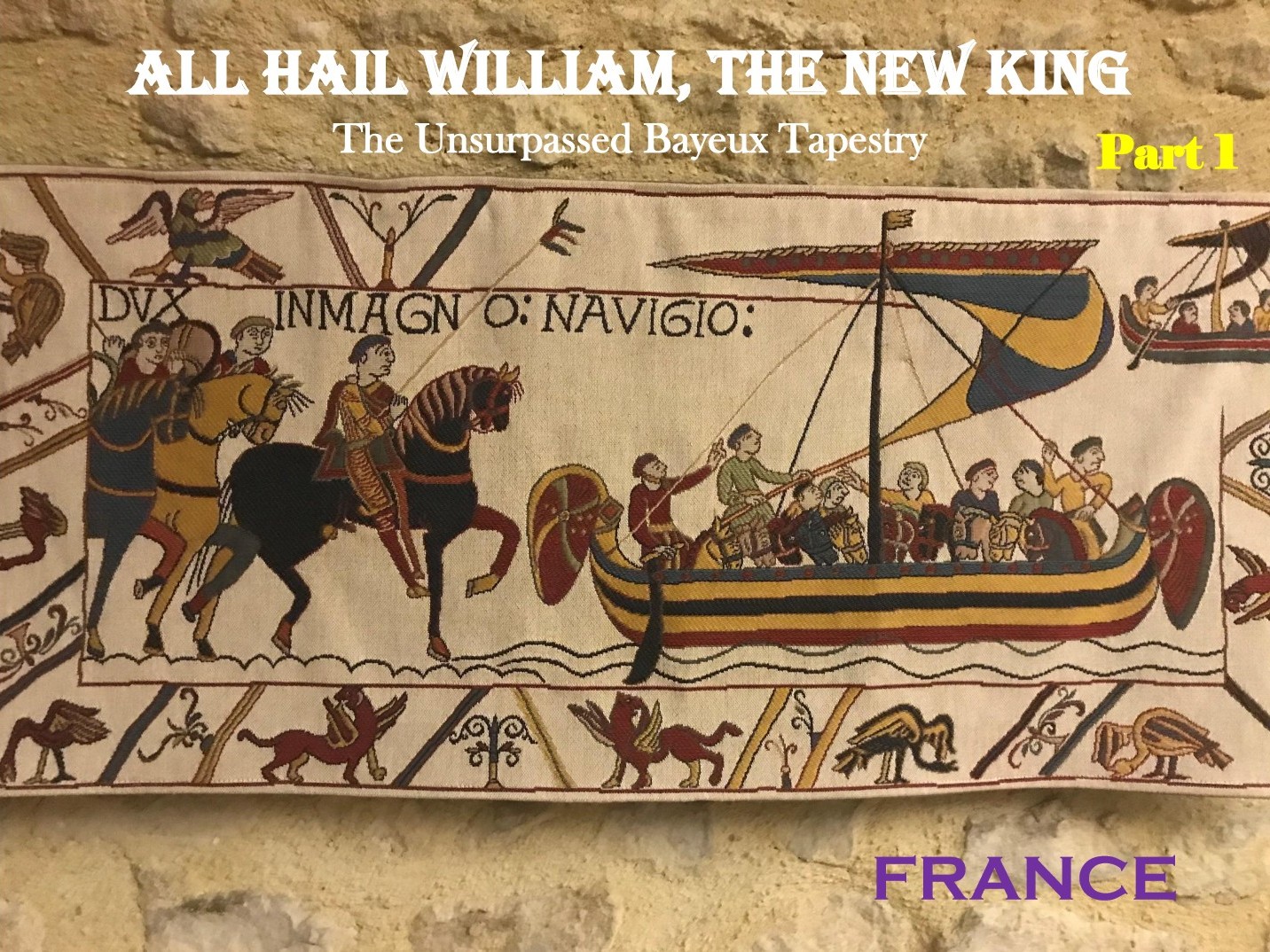
At the end of September, 1066 CE, William, Duke of Normandy, took a boat across the English Channel to land on the coast of Sussex. A little more than a fortnight later, he had defeated the English king, and established himself sovereign in a Norman Conquest.

So complete was William’s victory that the very character of English society altered beyond recognition. Language, law and politics knelt to Norman rule.  The English nobility fled the country in large numbers, or died during the invasion, and their daughters, sisters, and wives who inherited their estates, married William’s French nobility. Most of the high offices in the land—both the laity and the clergy, including the Archbishop of Canterbury—went to the French.

Continue Reading