

(Part 3 of 4)
THE GRIEVING WIDOW BECOMES THE PRINCE’S MISTRESS
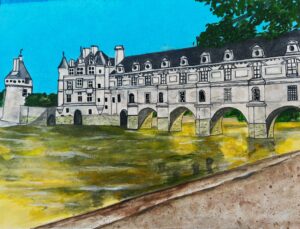
Built and owned almost entirely by women in its long history is an exquisite castle called the Ladies Chateau today. Château de Chenonceau is complete with turrets, white icing walls, and the lush green-blue forests of the Loire Valley framing it on the other bank.
There is a drawbridge to access the chateau, but it has almost never—in the chateau’s five hundred year history—been pulled up for safety. There was never a need to defend it. The Château de Chenonceau was a place of retreat for the queens and mistresses of the French monarchy.

Spanning the River Cher, the Château de Chenonceau sits in an open space of dappled sunshine. Its galleried apartments reflect on the waters, birds warble in the woods beyond, and all is peace and quiet. It’s no wonder that both Diane de Poitiers and Henry II’s wife, Catherine de Medici, coveted this castle. Image Source: Indu Sundaresan
The most famous owner of this Ladies Chateau was Diane de Poitiers, mistress to King Henry II. She was almost twenty years older than him, met him when he was very young, and kept her hold on him (despite his interest straying to other women at times) until he died.
In Part 1 of this blog post, we met the man over whom Diane de Poitiers had a great influence, King Henry II.
In Part 2, we delved into Diane’s early history, her childhood, her marriage, her husband, and her father’s great and treasonous fault. Her husband was the Grand Sénéchal of Normandy, almost forty years older than her (yes, you’re reading that correctly). (A sénéchal (pronounced say-nay-shall) was one of the top officers attached to the French court—they each had their provinces; Diane’s husband came from Normandy).
A splendid widow:
Louis de Brézé, Diane’s husband, died of natural causes in 1531 CE. I say natural, because he had attained the grand age of seventy-one when he died—he’d lived out his measure of years for medieval times.
What about Diane? She had been married to him for sixteen years by then. . .and was in the very prime of her life—only thirty years old. They had two daughters, born very early for Diane; she bore the second child when she was twenty-one years old.
As famous as Diane, the owner of the Ladies Chateau, became in later years—her future ‘master,’ King Henry II, was only twelve at her husband’s death—she never talked about her marriage to Louis de Brézé. There’s no account of what she, a fifteen-year-old, felt in being given by her father to a man forty years her senior. She never said a word about whether she had loved her husband, thought and dreamed about another, younger man, or felt the injustice of her marriage.
When her father was imprisoned for treason (Diane was twenty-four that year), she is supposed to have given herself to the king, Francois I (Henry II’s father) to plead for her father’s life. (See Part 2). Maybe. The king himself was only thirty years old then, a fine, young man, a soldier. . .and well, he was king.
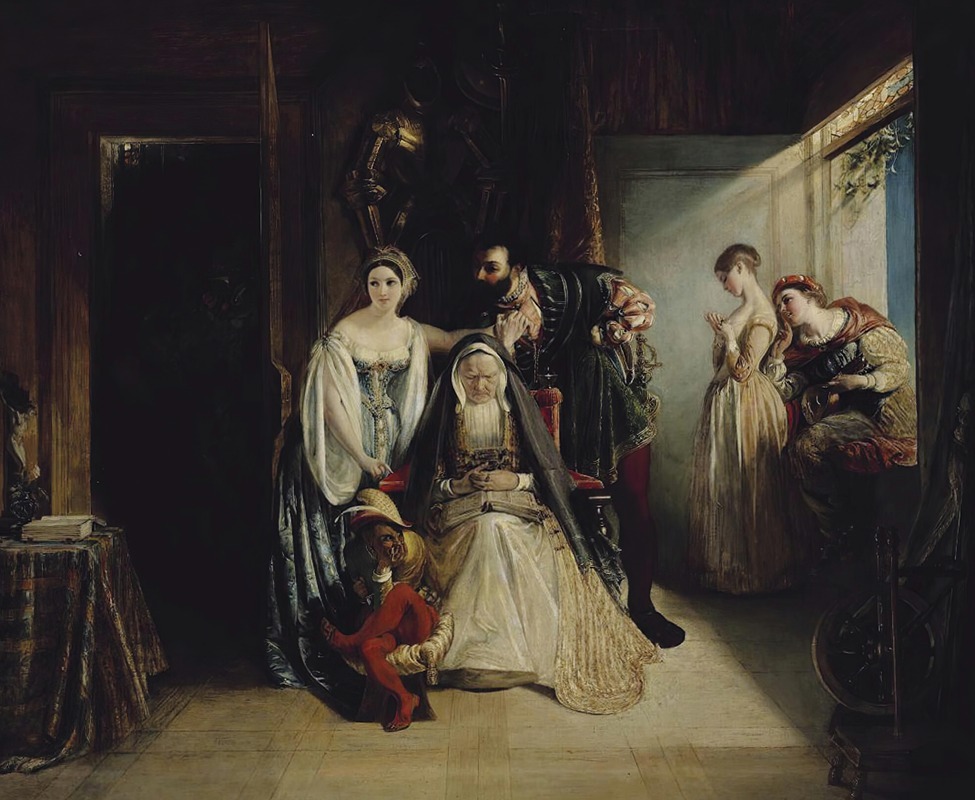
This painting represents Francois I and Diane de Poitiers—he’s holding her hand and leaning in toward her. And, she’s looking away, bashfully. I’m not sure who the old lady is, maybe Francois’s mother, the Queen Mother, Louise of Savoy. Diane was certainly lady-in-waiting to Francois’s wife, and after her death went in the same role to Louise of Savoy.
There are several paintings of Francois I and Diane de Poitiers (see Part 2), all based on the theory that she was, indeed, Francois’s mistress, either before, during, or after her father’s imprisonment. Image Source
Again, Diane de Poitiers was mute—very, very discreet, and so, a little bit of mystery still remains about her.
She did not, it is said, plunge into a heavy mourning with black weeds and shut herself up in her apartments to bewail her fate. After all, given Louis’s great age, it was to be expected not only that she would outlive him, but outlive him for decades.
But, what Diane de Poitiers did do was to build a magnificent tomb for her husband inside Rouen Cathedral and so, whether she had loved him, or grieved his death, she left something for posterity.
The grand funeral procession:
With an eye to the future, this hitherto-housewife of a woman, future owner of the Ladies Chateau, sent her husband’s body on a long procession from her home at the Chateau d’Anet to the cathedral at Rouen, in a very princely fashion.
The casket was preceded by de Brézé’s couriers and warhorses, draped in black cloth decorated with a large white cross. The couriers carried the standards of Louis de Brézé, the Grand Sénéchal of Normandy, along with the King’s colors on a standard of the Chevalier of the Order of the King, a knight’s helmet, the arms of the Sénéchal, and the colors of de Brézé’s house. There was the obligatory, poignant riderless horse in front of the casket.
Twelve men of rank carried the casket on their shoulders, which was covered in crimson satin cloth, richly embroidered. And on top of the casket was a life-size effigy of Louis de Brézé, clad in his robes of state—the satin cloak, the velvet gloves, slippers and toque, its throat encircled with a necklace of shells.
When the cortege reached the cathedral, they went through the ceremonies by depositing the casket near its burial site and placing all the standards next to it. The next day, after a grand mass, Louis de Brézé was buried in the cathedral.
It wasn’t until four years had passed that Diane de Poitiers wrote to the cathedral with instructions on the grand tomb she was going to build for her husband—it took nine years to complete, and was made entirely of alabaster (for the statues) and black marble (the cornices and the sarcophagus).
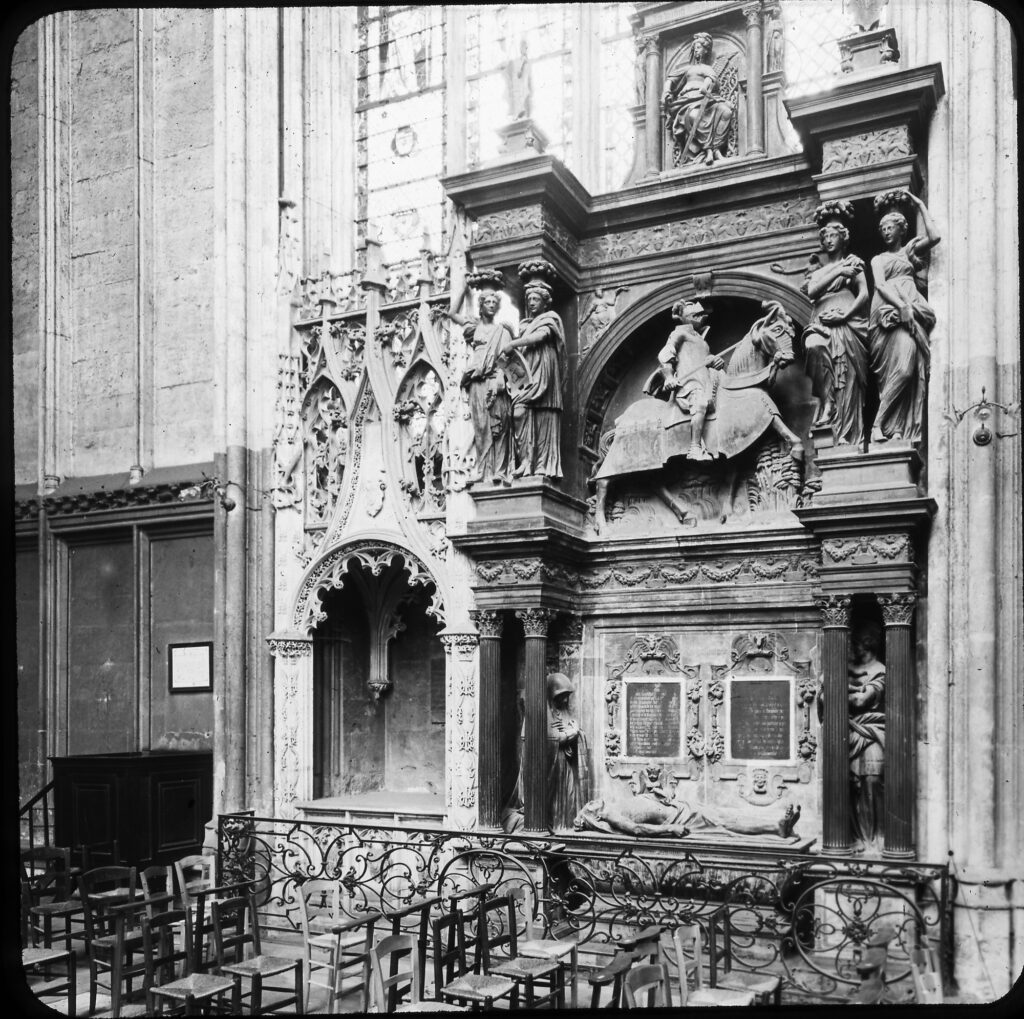
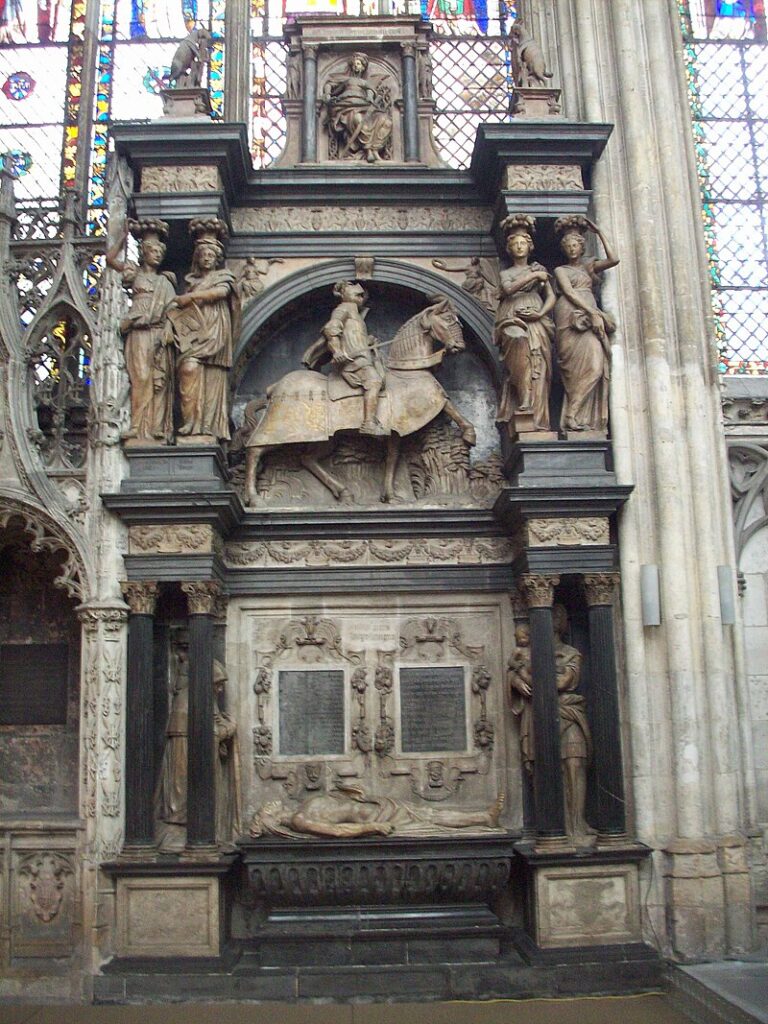
The tomb that Diane de Poitiers built for her husband, Louis de Brézé inside the grand cathedral in Rouen. That’s Louis, alive, under the archway on his horse, and, somewhat morbidly and extremely realistically, in death, lying at the bottom.
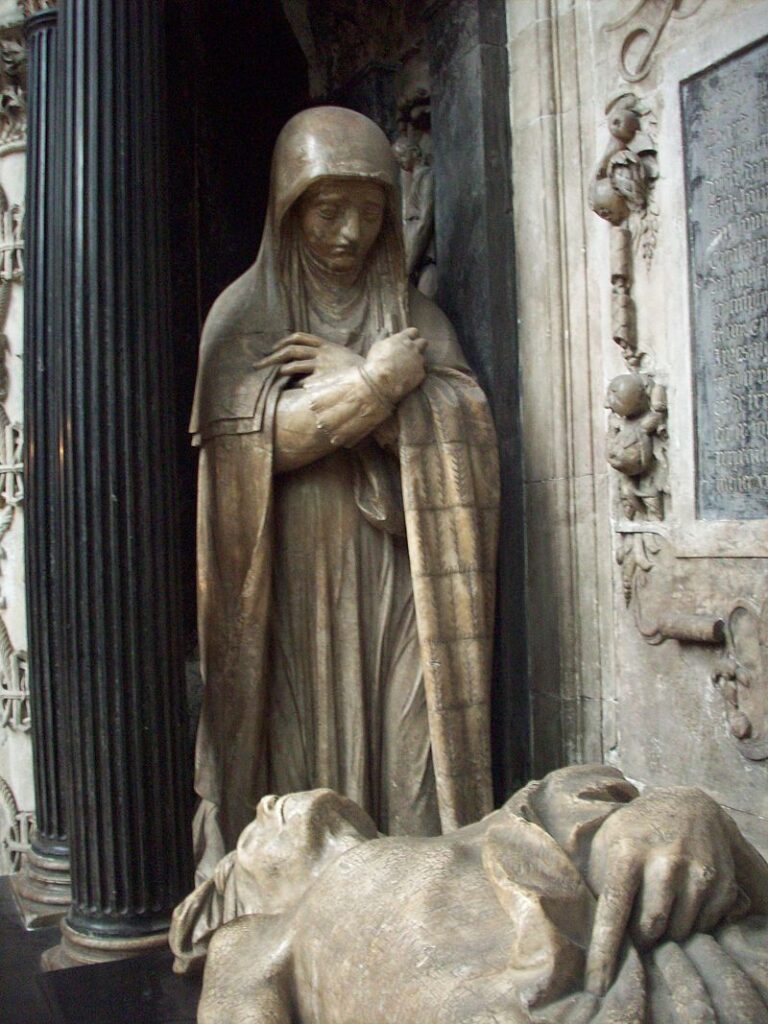
Diane put herself into this monument (third picture). She’s at Louis’s head, kneeling in prayer. First Image Source; Second Image Source; Third Image Source.
Diane was a very rich woman right now—her husband, as Grand Sénéchal, had been a favorite of several French kings. He had even been ‘royal,’ in the sense that his grandfather was a French king, and his grandmother that king’s mistress. Which was probably why he had been attached to the French courts.
His main seat was the Chateau d’Anet, just west of Paris, in what was once the Duchy of Normandy (see my blog post on William the Conqueror of all England, who had been the Duke of Normandy in the 12th Century). Louis de Brézé had several other estates.
Diane de Poitiers herself had been lady-in-waiting to Queen Claude (Francois’s wife and Henry II’s mother) and was currently serving the Queen Mother, Louise of Savoy, in that capacity. All this proximity to the court gave her tremendous access to the royal family, and even though her future lover, Henry II, was only twelve years old, he had already seen and known her all his childhood, loved her deeply and perhaps her influence over him—a child—was already very great.
So, nothing much changed in her life after Louis de Brézé’s death. In later life, she always wore black and white—these became her official colors. She must have worn all black at first, upon becoming a widow. But, later, she relieved the black with the addition of the white—thought it became her very well, and kept to it.
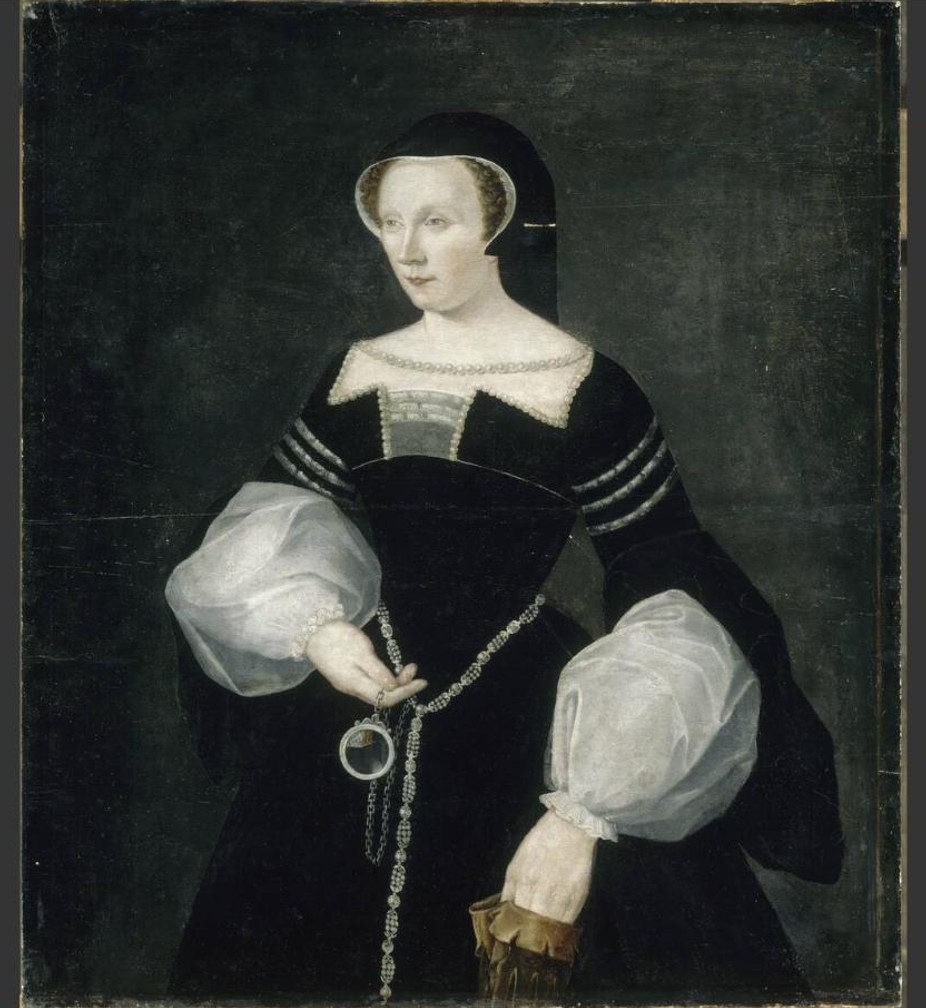
Diane de Poitiers in black and white. She was said to be very fit well into her fifties, so this is probably a very good likeness of her. She’s younger here, just out of mourning, perhaps, but with that slim waist and that porcelain skin that she was famous for. Image Source
The king’s mistress ratifies her future master’s marriage?
I know that’s an obscure and bewildering subtitle—but, hear me out.
When her father was imprisoned at the forbidding state prison of Château de Loches for his part in the Constable Conspiracy (see Part 2 of this blog post), his sentence would have been a beheading. There was absolutely no other possible outcome for high treason against the king of France.
Rumor had it that even after the conviction and the sentence of death, Jean de Poitiers’ life was saved at the very last minute—literally with his head on the block and the executioner’s axe raised—by Diane de Poitiers. And, what did she do? Gave to the king, Francois I—her future lover, Henry II’s father—the only thing she possessed, her grace, her beauty and her body.
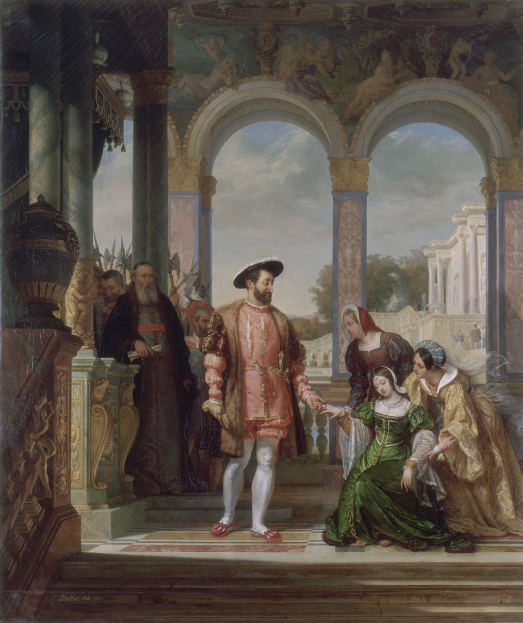
No one quite knows what part Diane played in her father’s pardon, but there are many speculations. And that is what yet another painting shows. A graceful Diane de Poitiers, kneeling, almost fainting with grief at her father’s hard fate. And Francois I, impeccably royal, extending his hand to lift her up. . .into his arms? Image Source
Again, Diane de Poitiers made no reference to this. . .um, transaction, in later years. But, that rumor persisted all her life, and, obviously, since we’re talking about it, well beyond it.
In 1552, when Henry II was king, and Diane the power behind the crown, the Venetian ambassador to France wrote back to his masters that Diane de Poitiers had been Francois I’s. . .er, mistress, or something, before she had become his son’s mistress. Or rather, the ambassador’s very (eloquent!) words were that Diane had been ‘loved and tasted’ by Francois I before Henry II.
The current king, Francois I, continued his visits to Diane de Poitiers—he had been a frequent visitor at Chateau d’Anet when Louis de Brézé had been alive, he had lauded Diane’s beauty on a crayon sketch when she had been married for just four years (see Part 2), and he continued his visits to her after her husband’s death.
The other owner of the Ladies Chateau: Enter the wife, Catherine de Medici
Interestingly enough, it was while the king was with Diane that the treaty for Henry II’s marriage to Catherine de Medici was drawn up in a draft—so, she would have known all the details of it. She would also have known that the Medici house wanted Francois I’s oldest son, the Dauphin—the heir to the throne—for Catherine. But that, the king would not agree to.
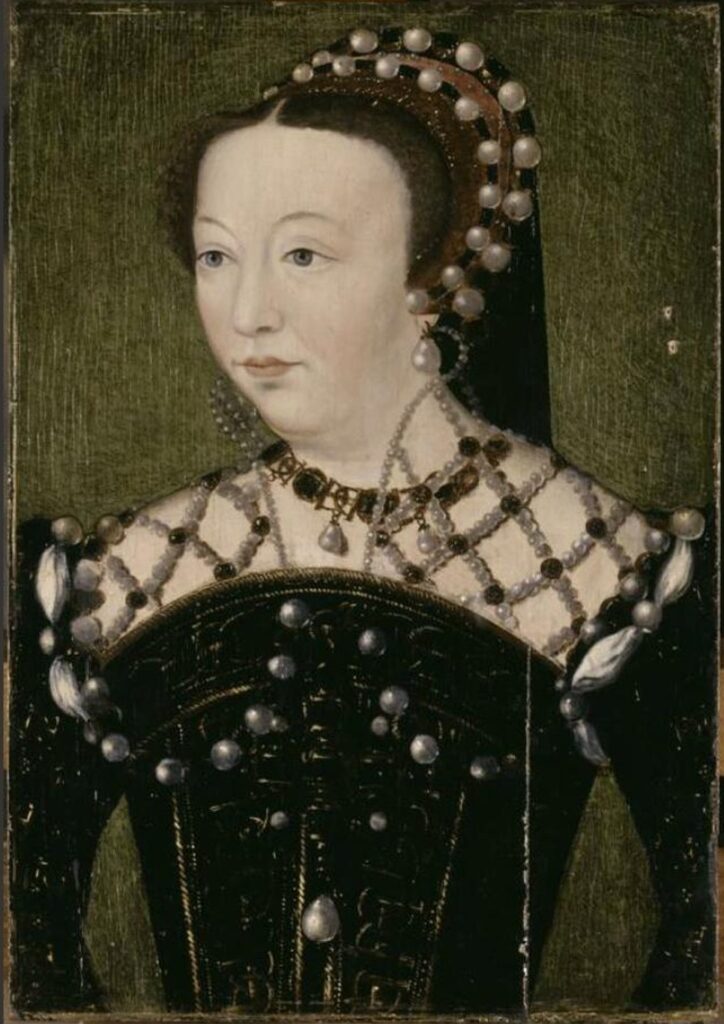
Catherine de Medici in somewhat later life (she was only fourteen when she married Henry II). If the dating of this portrait is accurate, then Catherine was in her late thirties at this time. Remember, Diane de Poitiers and Catherine de Medici were second cousins—they had common great-grandparents, but there’s no record of their being aware of this consanguinity or of it having any effect on their hatred of each other. Because, obviously, one was the unloved queen; the other a beloved mistress. And, more importantly, Catherine coveted the Ladies Chateau that her husband gave to Diane. Image Source
Alliances between the rulers of Europe—always fluid—had shifted again. Everyone was against the Holy Roman Emperor, Charles V, because he was becoming very powerful. Henry VIII of England, had initially been aligned with Charles V, against the king of France (see Part 1 and Part 2), but Henry VIII was now dithering.
The pope, Clement VII, had similarly given his support to Charles V (and would thus have been against the French king). That too, had now changed.
And this offer of Catherine de Medici—from the pope—to one of the French king’s sons was the result.
Why would Francois I want to align himself with the pope in the first place? Clement VII was head of the Holy See, and it was no small piece of real estate. The popes at that time had enormous wealth, a fair amount of political influence, and their own armies to defend their numerous papal fortresses. And, of course, he was the head of the Catholic church, so, religious influence also.
What was Catherine de Medici to the Pope Clement VII?
To begin with, Clement VII was a Medici himself—Giulio de Medici. The Medicis were an enormously wealthy banking family in the 14th and 15th centuries. They also dabbled in wool trade, which increased their wealth and influence. Members of the family married into some of the nobility, the Medici daughters bringing large dowries, the Medici sons gaining a foothold out of trade.
In time, three generations of Medicis essentially ruled over the dukedom of Florence.
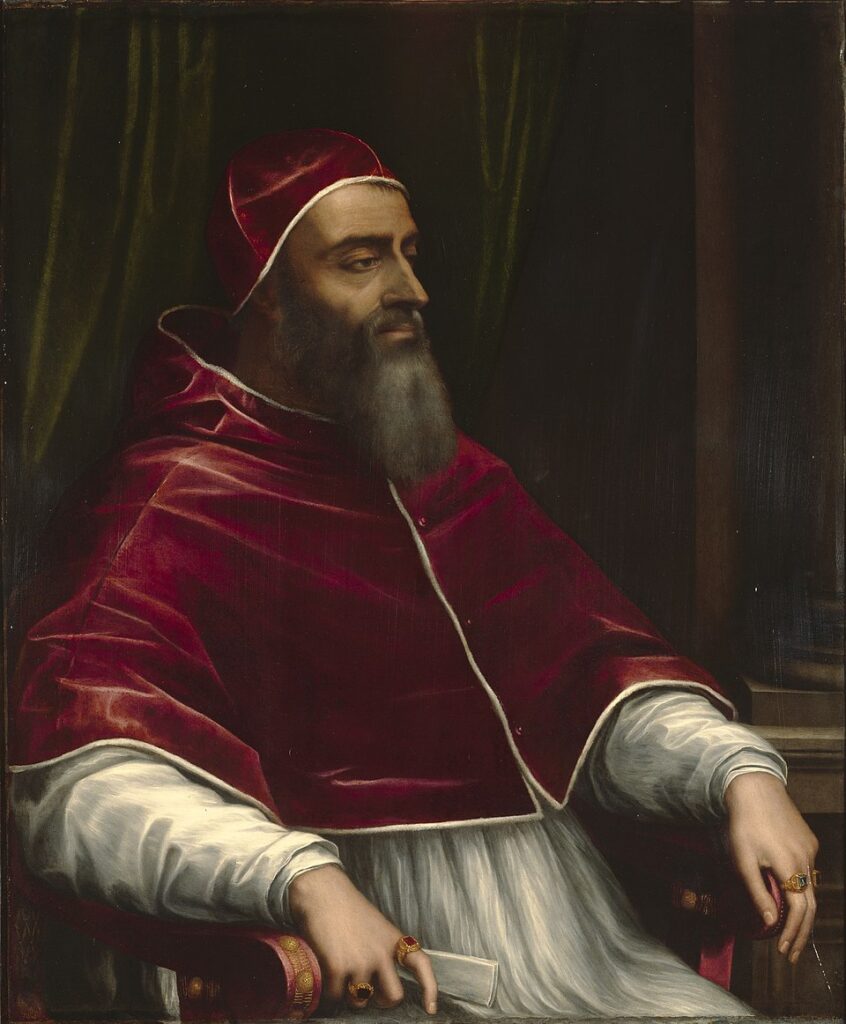
Clement VII, pontiff of the Catholic Church from 1523 to 1534. Image Source
Having done all that they could in the realm of money and nobility, the Medici men turned their attention to that other power in Europe—religion. Two Medici men became popes. The first was Leo X, pope from 1513 until his death in 1521. After a brief gap of a year, the papal throne went to Leo X’s first cousin, the man who became Pope Clement VII.
So, how exactly was Catherine related to the pope? Because, he was the one who arranged her marriage with Henry II.
The pope’s illegitimate child?
One theory I’ve seen floating around is that Catherine was Clement VII’s natural child. It’s possible, of course, since the popes all seem to have had illegitimate children at that time, many of whom gained positions at courts and within governments by openly advertising their blood relationships to these powerful men of the cloth.
But, in Catherine de Medici’s case, the line of descent is very well documented.
Clement VII was Catherine’s granduncle, her grandfather’s cousin. You can say that’s a distant enough relationship for him not to worry about his grand-niece’s future, or more accurately, for his eye to light upon her as a pawn in his attempt to create a nearer alliance with the French king.
But, there was a reason she came to his notice.
Catherine’s mother died within a month of her birth, and her father a week after that. I won’t clutter up my storytelling here with their names, but suffice to say, her father’s uncle (not direct; a cousin) was Clement VII. The previous Medici pope, Leo X, was also Catherine’s father’s uncle—a direct uncle, Leo X and Catherine’s grandfather were brothers.
The infant Catherine then went into the care of her father’s mother, who was the-then Pope Leo X’s sister-in-law. He invited them to the shelter of his papal palace, and Clement VII (Leo’s cousin) who was a cardinal, escorted them to Leo. When Leo X died, Clement VII (who, for another year was still only a cardinal) took over the charge, nominally, of both Catherine and her illegitimate half-brother.
Catherine’s actual guardianship went to her aunt—her father’s sister. But, Clement VII, now pope, still had control over her movements and he sent her and her aunt to live in Florence, in the magnificent palace of the Palazzo Medici.
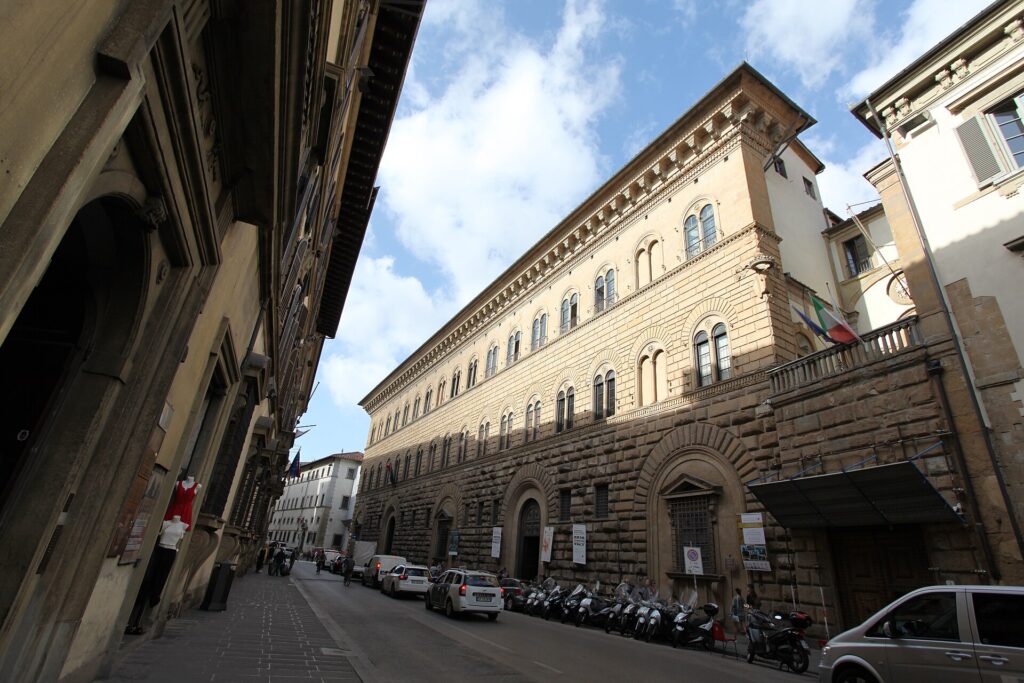
The Palazzo Medici in Florence where Catherine de Medici spent part of her childhood under the sharp eye of her paternal aunt. Image Source
In 1527, the pope, Clement VII himself fell into several difficulties, most notably, the Holy Roman Emperor, Charles V, sacked Rome and took him prisoner. Catherine de Medici, in Florence, was the same age as her future husband, Henry II. And, during this very year, Henry was also a prisoner in Spain, held captive by Charles V (see Part 1 for Henry II’s childhood history).
In Catherine’s case, the revolutionaries considered her important enough that they wanted to have control over her whereabouts. So, they put her in various convents, away from her natural guardians (again, eerily similar to Henry II’s situation) and eventually she went to reside at a Benedictine convent—the Santa Annunziata in Florence.
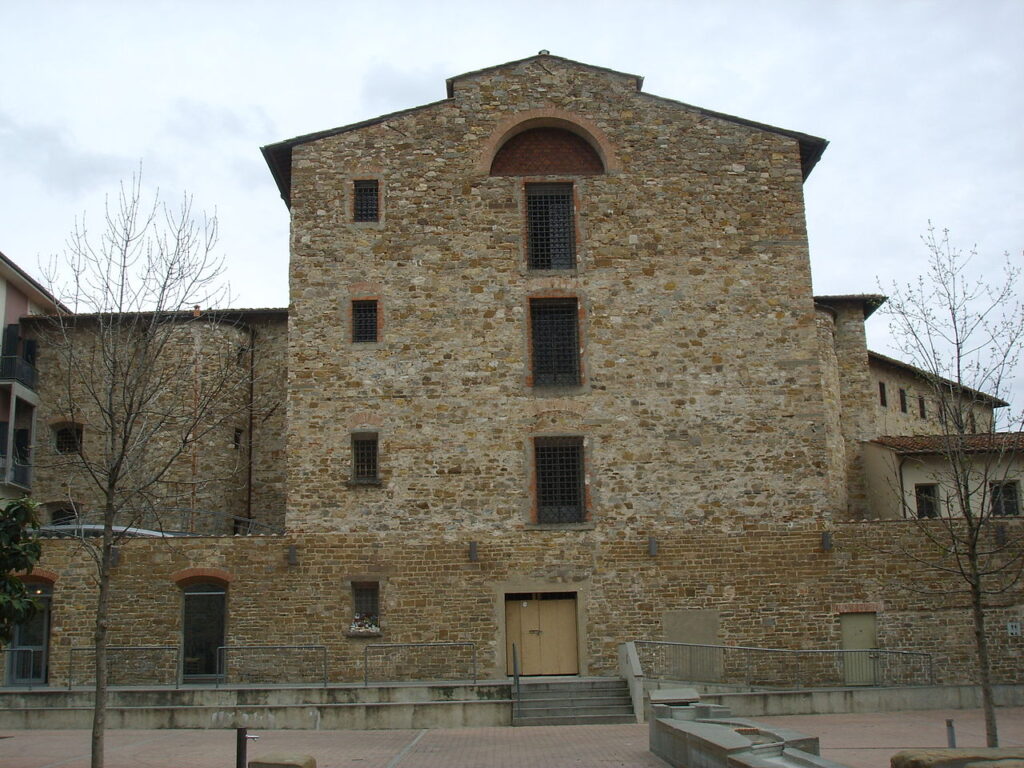
The Santa Annunziata convent is called the Monastero delle Murate today. The ‘murate’ means ones who are walled up, cut off from the outer world. In Catherine’s time, the girls who entered the nunnery had to symbolically walk through a hole made specially in these grim, outer walls, which would then be walled up again behind them, signifying their complete retreat from the outside world. Image Source
Even though the novices had to walk in through a wall, the rules at the convent had relaxed a little bit, and it was a school for pupils of the nobility. Or perhaps more importantly, Catherine’s great-grandfather had significantly funded the convent in his time, so a Medici would always be treated with kindness within its boundaries.
It was here, from her nun-teachers, that Catherine learned grace, manners, courtesy of speech—all of which would help her in her future years as dauphine of France (she absolutely enchanted her father-in-law, Francois I; in fact he was the only one at the French court who gave her affection. And, being king, his support was extremely valuable). The nuns, supposedly, were also very well versed in political intrigues with the Medici partisans in Florence, and that too Catherine watched and learned.
Eventually, in 1530, Clement VII sent for Catherine to come and live permanently with him. She was eleven years old.
It was this year that Francois I sent a proposal of marriage for his son, Henry II and Catherine to the pope. The Holy Roman Emperor, Charles V, also wanted Catherine for one of his partisans, and so Clement VII had to decide whether to throw in his lot with the French king or the man who had grown so dominant in Europe. He decided for the French king.
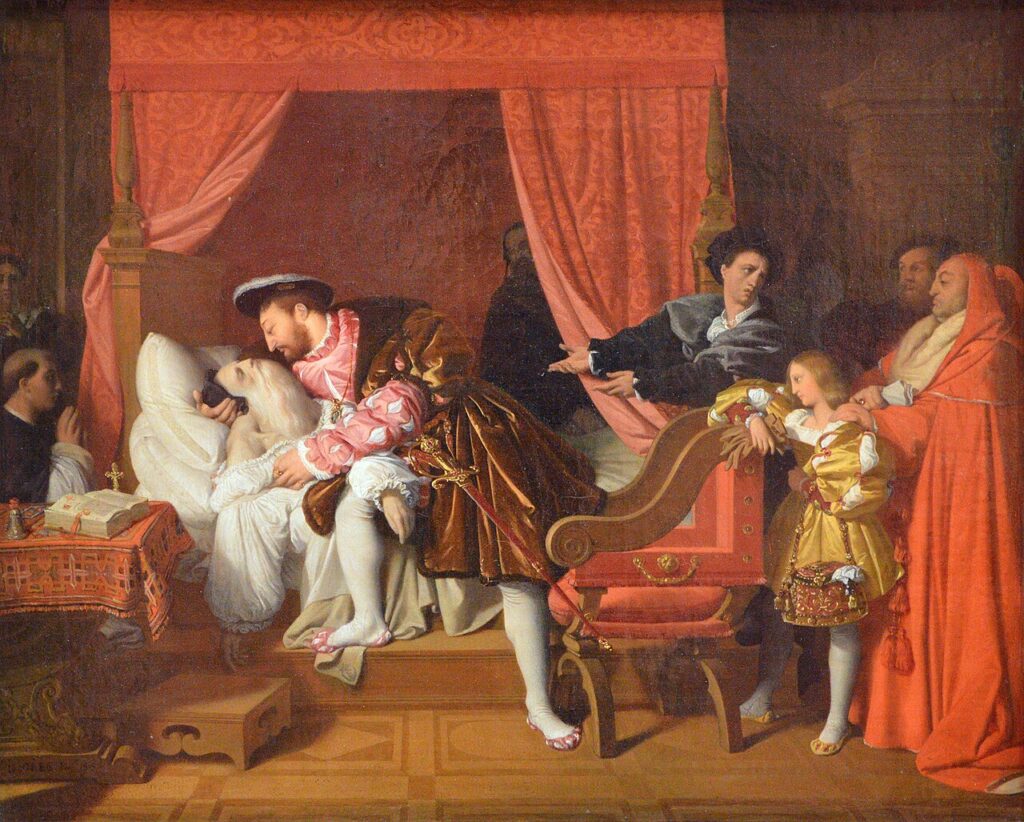
Henry II’s father, Francois I, loomed large over French (and European) politics and culture. For all his carousing with the women of his court and battling away at the Italian Wars, he was deeply interested in art. He lured Leonardo da Vinci to the vicinity of his Chateau d’Amboise and gave him a chateau of his own to live in for the last years of his life. (Both Amboise and Leonardo’s house will come up in future blog posts). This painting is probably an idealization of Francois, the king, holding a dying Leonardo da Vinci in his arms.
Now you know why France owns the Mona Lisa. Image Source
Francois then cannily suggested that Catherine should be sent to France immediately—let her grow up here, get used to our ways, learn to love my second son Henry. And when the children are a bit older, I’ll get them married.
This proposition Clement VII was too cunning to accept. What, have Francois I not go through with his promise for the marriage and instead have the opportunity to hold Catherine hostage for the rest of her life? There she would be, nobody’s wife, and Clement VII could not pawn her away anywhere else in Europe.
Nice try, dude, was the response Clement VII sent to Francois I. In the meantime, Clement kept up a conversation with Charles V’s ambassadors for that other marriage, you know, just to keep his hand in, and in case Francois I backed out in the end.
Francois, as I mentioned above, drafted a marriage contract between Henry II and Catherine de Medici, and sent it to the pope in 1531. The king discussed it with his courtiers, perhaps, but did so in Diane de Poitiers’s house, the Chateau d’Anet. So, she knew the terms of the treaty very well, and probably approved of them. She was party to arranging the marriage of the boy who would, in a few years, become her master.
Catherine, meanwhile, in love:
Apart from her half-brother, there had been another young man in Catherine’s childhood with whom she had shared a house under the guardianship of her aunt. Ippolito de Medici was actually her father’s cousin, but only eight years older than Catherine. And, he was an extremely handsome man.
He had been ruler of Florence before—under the good auspices of Clement VII—and it was Clement VII who stripped him of his rulership and bestowed upon Ippolito a cardinal’s hat because he wanted a close family member in his papal palace upon whom he could rely.
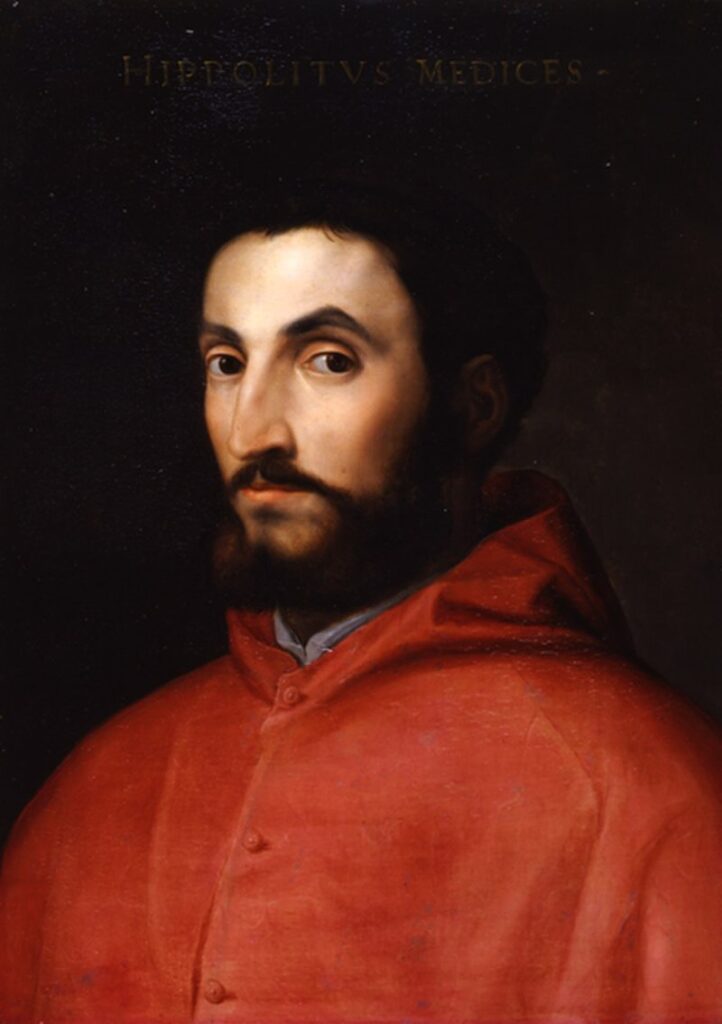
The handsome Ippolito de Medici, the reluctant cardinal. I suppose if the pope is your uncle, you can enter the church directly as a cardinal without having gone through a course of religious study. Image Source
All very good. But, did Clement VII force the cardinalship upon Ippolito when he realized that some sort of love or affection was growing between the (very) young Catherine de Medici and her cousin? (Or rather uncle, but everyone just called each other cousin—Ippolito was her cousin, the pope was her cousin, etc.).
You needed a special papal dispensation to be consecrated a bishop, and I suppose, in this case to be made a cardinal without ever having been ordained a priest. Ippolito never undertook any religious studies; his inclinations were all extremely temporal. He tried flinging away the cardinal’s hat several times, including attempting to assassinate somebody, but Clement VII turned a blind eye to all his tantrums. There was no escaping the church for Ippolito, and since he could not escape it, there was no way for Catherine de Medici to become his wife.
And. . .the royal marriage takes place:
Henry II married Catherine de Medici in 1533 at Marseille, when they were both fourteen years old. The pope, Clement VII, came in a grand flotilla of galleys draped in cloth of embroidered gold, with magnificent state apartments on board the ships, and thousands of gold coins for Catherine’s dowry. All this was a grand display of very un-pontiff-like wealth, but they were Medicis after all, and everyone knew they had a ton of money. And with Clement sitting at the head of the Catholic Church, also plenty of influence.
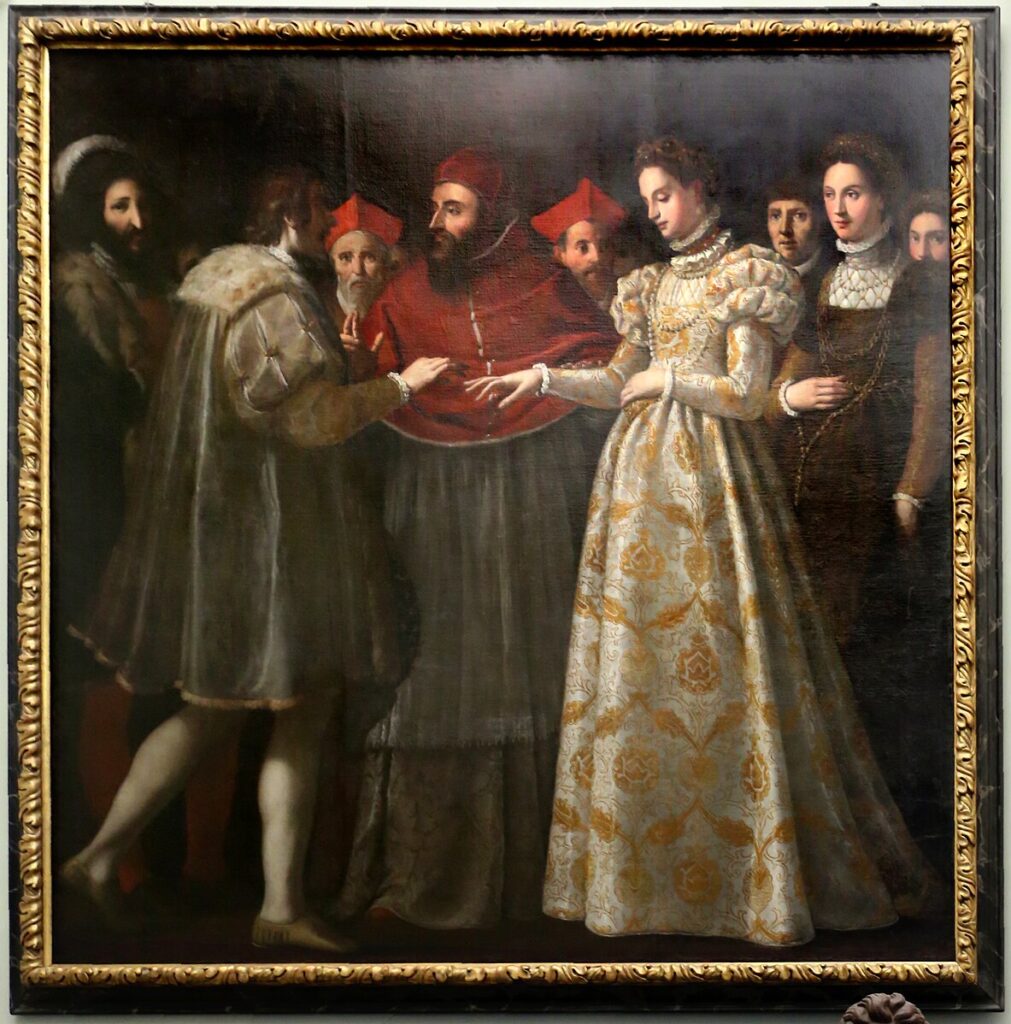
I’m not sure when this portrait of the marriage between Henry II and Catherine de Medici is dated. I can easily identify two people. One on the left, face-forward, is Francois I, overseeing his son’s ceremony—again, that House of Valois nose is prominent, and Henry acquired it from his father. The second person is the pontiff in his papal robes, Clement VII, conducting the ceremony.
But. But. Neither Catherine de Medici, in full light, nor Henry II, his face shadowed, look anything like themselves. And, they’re both older than their fourteen years. The painter got the father and the pope right, but not the two principals. Image Source
After the ceremony, the pope stayed on for thirty-four days. I guess they knew their biology then; Clement VII was waiting for confirmation that Catherine de Medici was pregnant. In fact, he’d insisted that Henry and Catherine should consummate the marriage on the very first night. But, they were mere children and might not. . .know what to do. There’s a theory that the king, Francois I, went to the bedchamber to. . .er, direct the operations to a success.
Where was Diane de Poitiers all this while, when her fourteen-year-old future master was getting married? Perhaps, she was at Marseille also, as part of her current lover’s, the king of France’s entourage.
Diane de Poitiers turns her attention to Henry, second son of the king of France:
Three years after Henry’s marriage to Catherine de Medici—she had not become pregnant all that while—the dauphin, Henry’s elder brother, heir to the throne, and Francois I’s oldest son, died.
He was poisoned perhaps; in any case, his death was suspicious. Remember, the Medicis originally set out to marry Catherine to this dauphin—they wanted her to become queen of France, and were forced to accept the second son, Henry. So, the thought is that they were responsible for the heir’s death.
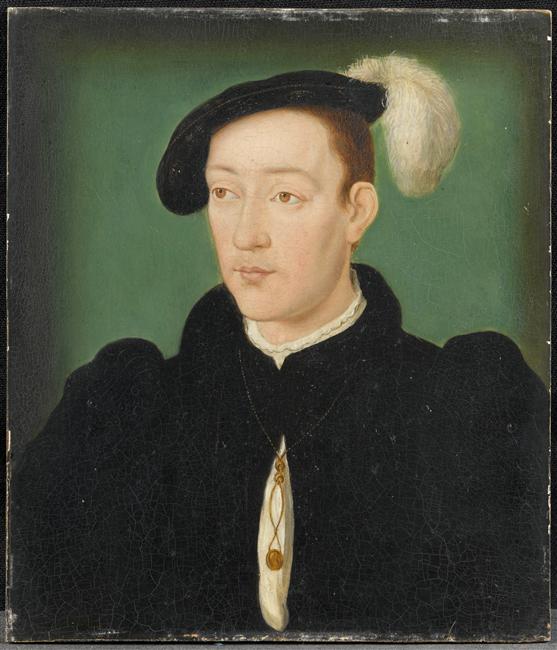
The dauphin, Francois, Henry II’s older brother. They had both been sent to the court of Charles V as hostages in exchange for their father’s freedom. When they returned after four long years of imprisonment, some. . .spark had gone out of them both. They turned quiet, thoughtful, uninterested in hunting, jousting and other royal sports. (See Part 1 for more details on this) Much to their father, Francois I’s disgust.
This Francois—the dauphin named for his father, died as quietly as he had lived. And Henry, merely the second son until now, became the dauphin. And, eventually the king of France as Henry II. Image Source
The king of France raged, an Italian was brought to trial (he had been the one to offer that last glass of water to the Dauphin before he died), the Italian was tortured, and confessed to the Medicis being behind the whole thing, but also. . .the Holy Roman Emperor, Charles V. Most likely, the Italian had been hired by Charles V—long story behind motive, Charles V wanted to stop the Dauphin from being married into a powerful European family. (Remember, from Part 1, that at this point Charles V’s sister, Eleanor, was married to the king, Francois I).
Catherine de Medici herself did not suffer much from this suspicion, because she had endeared herself to her father-in-law, perhaps despite himself. And, despite the fact that she had not provided a child yet.
And so, Henry became the dauphin, and Catherine de Medici, would, after all, become the queen of France.
Diane de Poitiers pounces (?) on a young Henry?
Henry II was never brought up, or thought of, as the heir to the French throne. His father’s favorite was the third son, Henry’s younger brother—maybe, that’s why, when Francois I had to send his children (male heirs) to the court of Charles V as hostages, he sent the older two?
The elder brother was petted and cared for, because he was the dauphin.
Henry’s mother died when he was five years old. When he was six, his brother and he went to the Holy Roman Emperor as hostages—they spent four, neglected years there, no education, barely any new clothes, allowed to roam about (under guard), lived almost as wild animals. When they came back, they could not speak French very well anymore, in fact, even the fact that they were to be released had to be translated to them (see Part 1 for this story).
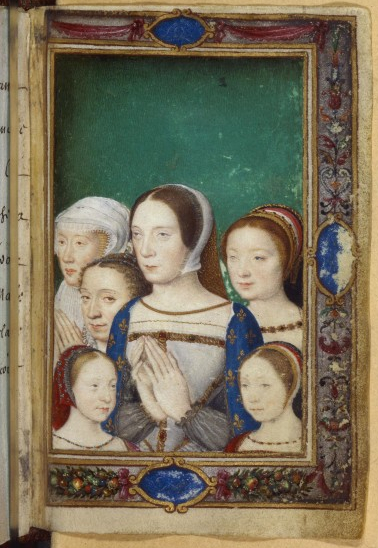
Claude, Queen of France, the first wife of Francois I. And, Henry II’s mother. Claude was twenty-four when she died, and Diane de Poitiers and she were of the same age. Claude had seven (!) children in that brief span of life—seven, that is, who survived and are officially recorded. Image Source
Diane had been lady-in-waiting to both Queen Claude (Henry’s mother) and Louise of Savoy (paternal grandmother), and as such, saw a great deal of the royal children. Presumably, they went under their grandmother’s care after their mother’s death.
There are stories of Henry II’s childhood love for Diane de Poitiers—that she gave him that maternal love, that attention he so yearned for. That his own love her was so strong that, before being sent as a hostage, he had hugged Diane goodbye, and upon his return, went seeking her out.
Now, with his elder brother dead, and himself the heir to the kingdom, his father thought that there was a problem. Henry was shy (neglectful of his duty to his wife, Catherine de Medici), he was awkward, he had no real. . .presence, no bluster, no authority. How was he to rule France?
So, Francois I went to his on-and-off mistress, Diane de Poitiers, and asked her to take Henry in hand.
There are varied accounts of when Diane de Poitiers turned her charms upon Henry—in one, she began to enchant the boy when he was very much a boy, in 1534, when he was fifteen and had been married a year to Catherine de Medici. The other places the full force of her attractions a year after he became dauphin, in 1537, when he was eighteen.
Remember, no matter which age, Diane de Poitiers was a full twenty years older than him, the same age as his mother, Claude.
Henry fell for her charms—he had known her all his life and what had perhaps been a filial sort of love, at the grand age of eighteen, turned into an adult love and lust.
She became his mistress. This, was the beginning; by the end, she would own the Ladies Chateau.
Diane de Poitiers’ first mortal enemy at court:
This blog post is about the Château de Chenonceau—the Ladies Chateau—that both Diane de Poitiers and Catherine de Medici desired in the Loire Valley. But, Catherine, when her husband began the affair with this much-older woman, was as young as him, and fighting hard for her place at court.
Catherine de Medici was now dauphine—wife of the dauphin, and future queen of France. You’d think she’d have some power, wouldn’t you? But, after four years of marriage, she still hadn’t provided an heir.
(In Mughal India—see my blog post on Maryam’s Tomb, Emperor Akbar’s Hindu wife who was mother to his heir, Emperor Jahangir—the conditions for a woman’s worth this close to the throne were the same. The woman who gave birth to a male child was more valued, more respected, had much more power and clout in the harem than one who had only female children or none at all. The only exception was Mehrunnisa, Nur Jahan, the main protagonist in the first two novels of my Taj Trilogy—The Twentieth Wife and The Feast of Roses. And, Nur Jahan was the most powerful woman in that Mughal dynasty that ruled India, very much during the time period of this blog post. Nur Jahan was a mere twentieth wife, and Emperor Jahangir and she had no recorded children—yet, she ruled the empire from within the harem walls.)
So, Diane de Poitiers paid little attention to Catherine de Medici—she would though, later, when Catherine became queen, and much later, after Henry II died. Because Catherine kicked her out of the Ladies Chateau and occupied it herself–as queen regent, she had that power.
Diane de Poitiers’ first enemy—and she was a bitter enmity—was Francois I’s mistress, eight years younger than Diane, a lady called Anne de Pisseleu. Francois probably met Anne upon his own return from captivity from Charles V’s court (when he sent his sons as hostages instead of himself), sometime around 1526 or so. Francois had had another mistress, but he discarded her for the beauteous Anne.
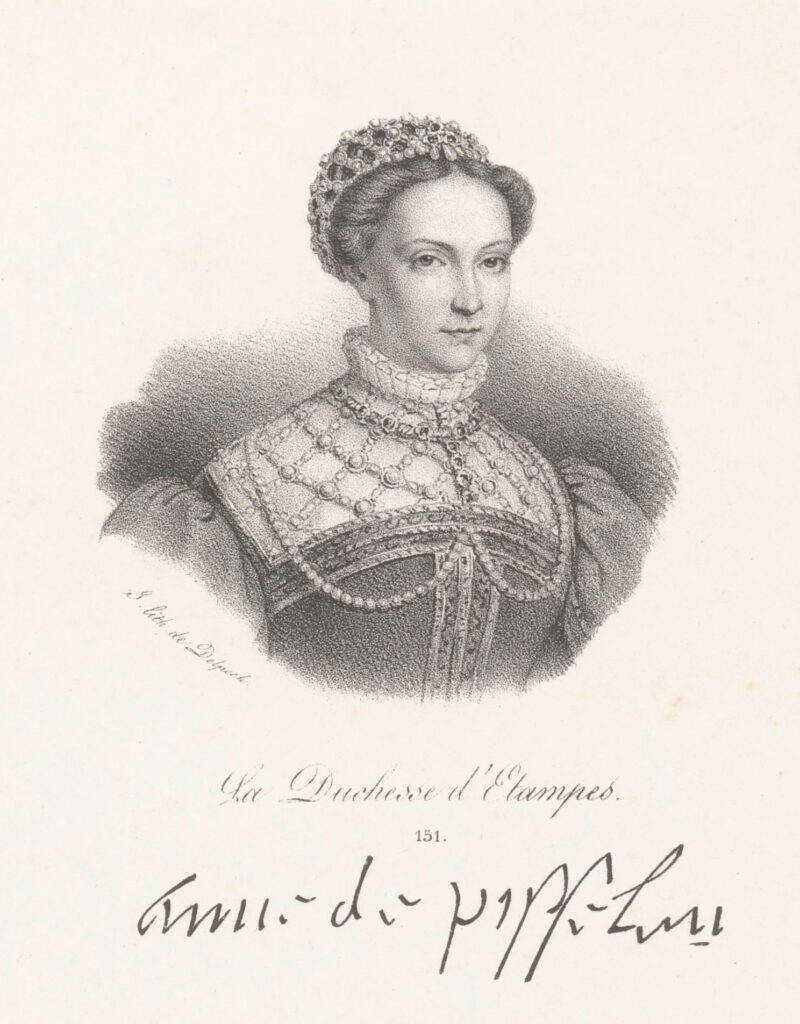
The second mistress of some importance in Francois I’s court was Anne Pisseleu. Her semi-official title—which probably came into being about now—was ‘maîtresse en titre.’ Which meant, loosely, that she had the authority to counsel the king, to make appointments, and to enrich her own family with titles and lands. Just as Diane de Poitiers did with Henry II, Anne Pisseleu kept her hold on Francois until his death.
When Henry II became king, it was Diane—the mistress—and not Catherine de Medici—the new queen—who divested Anne Pisseleu of her powers. Image Source
In 1534, Francois I married Anne to some man and made him Duke d’Étampes—so, she held the title of Duchess of Étampes. The husband looked the other way—he knew he had been brought in to do so, and to provide Anne with a certain level of respectability—and enjoyed the benefits of his wife being the king’s well-established mistress.
What of Francois I’s wife, Eleanor, sister of Charles V (Francois married Eleanor when his sons were returned to him in 1530—that was part of the treaty surrounding their return)? She figured as much in the French courts as did poor Catherine de Medici. The wives were to provide heirs—the mistresses ruled the kingdom.
So, Anne was extremely powerful and meddled in things in the royal household and at court, and got several high positions for her family. All this was a matter of course.
But, Diane de Poitiers, also mistress at the court—though only of the dauphin—was naturally in a position where Anne would be jealous of her. Francois I would die, also as a matter of course, and then Diane would rule supreme as the mistress of the new king, Henry II.
The two royal mistresses at loggerheads:
Diane de Poitiers could not have but been aware of her age—I mean, how old she was.
And, Anne used it mercilessly, going so far as to say that she herself was born on the day that Diane married Louis de Brézé. This is not true, there was only a gap of eight years between the two women. But, it must have vastly irritated Diane, who was thirty-eight years old when she began her affair with the eighteen-year-old Henry II.
Then Anne took up the cause of Francois I’s youngest son, Charles.
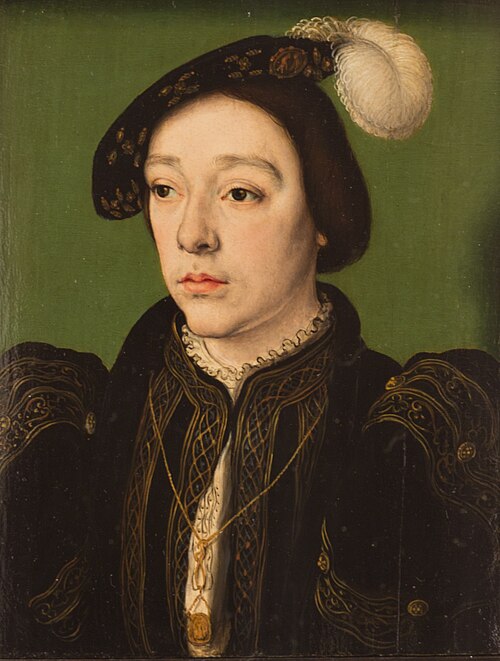
Francois I’s favorite third son, Charles, the Duke of Orleans. Image Source
Remember I’d said that Francois’ third son, Charles, was his favorite—that boy who had not been sent as hostage to Charles V of Rome? Anne began scheming for an advantageous match for this boy with the Austrian royals, by which his power would increase greatly, and would endanger Henry II when he came to the throne.
This, of course, Diane could not have, so she resisted. And then Charles V came by with the offer of either his daughter or his niece, with several properties attached to them—this was also a proposal for Charles, the third son. Anne made this treaty happen; with this marriage, Charles the son would have the support of the Holy Roman Emperor.
But Charles the son, that pawn in the hands of his father’s mistress, died very soon after.
Then, the two women launched into an all-out war of gossip and rumors. Diane de Poitiers, as mistress of a mere dauphin, could not very well retaliate openly with the king’s mistress. So, she set rumors afloat—that Anne was sleeping with her brother-in-law because the king did not satisfy her, that Anne slept with another noble at court, that Anne slept with Charles V, the Holy Roman Emperor when he was given safe passage through France.
Anne had recourse to more official channels, because she was the power behind Francois I’s throne. Court poets wrote about Diane de Poitiers as the ‘old woman of the court,’ the jezebel who painted her face, whose complexion was false, along with her teeth, whose hair was white, and whose wiles were all deceitful.
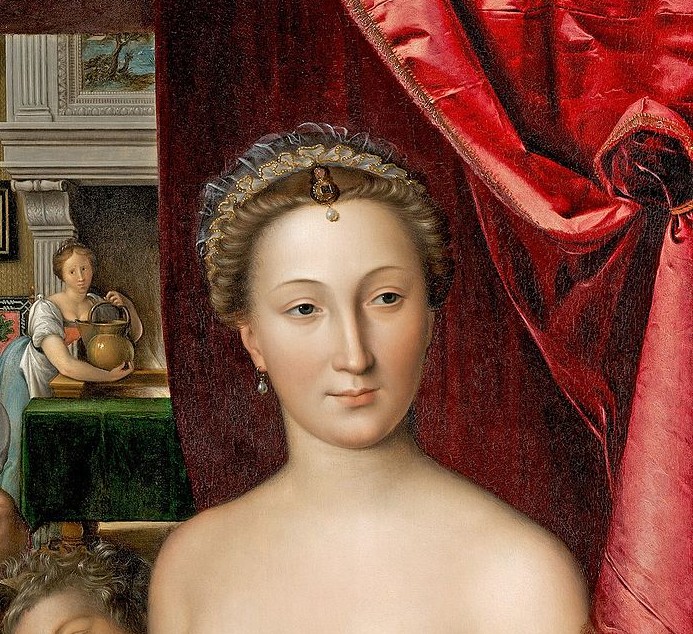
This is supposed to be Diane de Poitiers, used as a model for ‘A Lady in her Bath.’ There’s some doubt about it—but, it’s very like Diane’s image in other paintings. And, perhaps, she was about thirty-eight years old in this picture. So, not bad looking and certainly not deserving of being called the ‘old woman of the court!’ Image Source
And then, comes a strange connection between Château de Chenonceau and one court poet who trashed Diane, whose poem when published, was dedicated to a bishop, Francois Bohier. This Bohier was the brother of Antoine Bohier, who owned the Ladies Chateau, and who had to give it up to Francois I, and which subsequently went to Diane de Poitiers.
It was a revenge of a very circumlocutory kind, but a revenge nonetheless. The payback, which happened when Henry II became king, was against his queen, Catherine de Medici, who had yearned for the Ladies Chateau for herself—we’ll see why in Part 4 of this blog post. Anne Pisseleu, of course, who caused the poet to write this harsh poem, was long out of power.
However, while Francois I was still alive, matters between Diane and Anne became heated enough that the king banished Diane from the court. She retired to her Chateau d’Anet. . .and Henry II followed her there, refusing to see his father. This was in 1544, when Henry and Catherine de Medici’s first child was born.
A good mistress?
However much Diane must have wanted Henry II by her side, perhaps all the time, she was wise enough to understand that in his longevity—in the longevity of the immediate branch of his family—lay her own.
So, she encouraged him to go to his wife often. Henry also had a surgery of some sort, to correct a physical deformity, and that led to Catherine getting pregnant soon after. As in, the fault had been his, not hers.
Anyhow, in January of 1544, Catherine de Medici gave birth to their first child, a boy who was named Francois after his grandfather. The succession to the throne was now no longer in doubt.
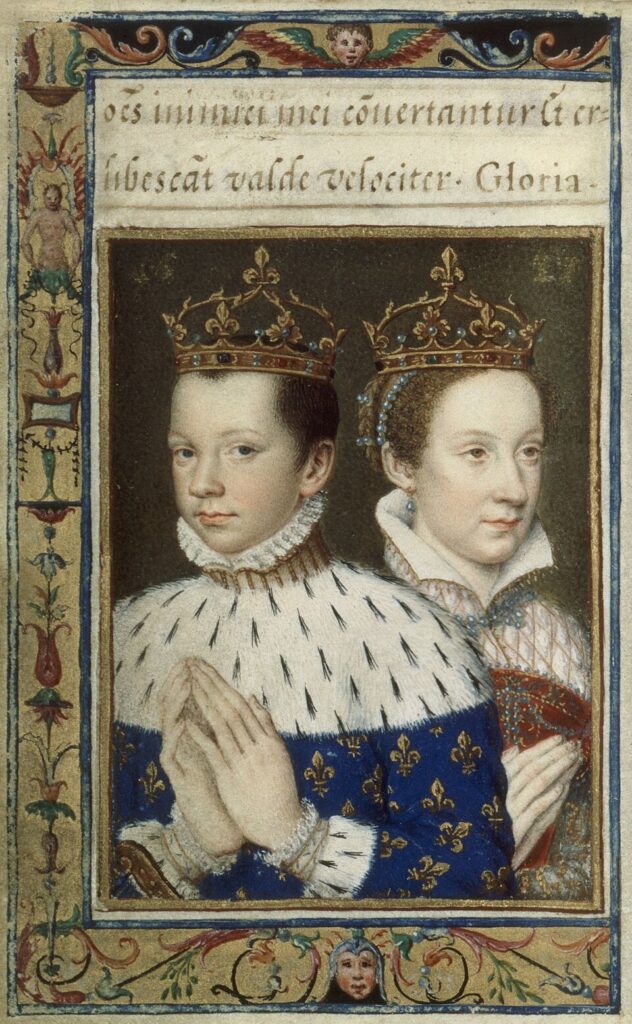
This is Francois II, king of France (very briefly) after his father, Henry II. Remember from Part 2 of this blog post, this Francois II was betrothed to Mary, Queen of Scots. Mary was brought to the French court when she was six years old, grew up as a childhood playmate with the boy she went on to marry and became Queen of France. After his death, she went back to Scotland. And eventually, lived the rest of her life out as Elizabeth I of England’s prisoner. Image Source
Catherine de Medici would go on to have nine more children and ten more pregnancies. And, Diane de Poitiers, who had her husband tethered to her own will, was the one who made this possible. You know, she did it for her country, for France.
What about Diane herself?
There’s no record of Diane and Henry having any children. Henry II did not—very much like other kings of France who also did not—restrict his amorous intentions only upon Diane de Poitiers. She was supreme, that was understood, and also clear was the fact that she would never be superseded by any woman, queen or mistress.
So, Henry II had other mistresses, at least three others, with whom he had a child each.
As for Diane? One Père Anselme (whose real name was Pierre de Guibours) wrote several volumes on the topic of the genealogical and chronological history of the royals of France. At the time of his writing (maybe 1645 CE at the earliest), he mentions a lady he knew as a Dianne de Poitiers, who was close to eighty years old. And, that she was Diane’s and Henry II’s daughter.
It’s not possible—the numbers don’t add up. If you do the math, then Diane de Poitiers had this daughter when she was sixty years old.
And that’s the closest Diane and Henry II came to having a child together.
An uncrowned queen of France:
Three years after the birth of his first son, Henry II became king of France when his father died.
And, the court changed, because a new, uncrowned queen was at the head of affairs. Diane de Poitiers banished the previous mistress, her first enemy, Anne Pisseleu, from the court and dismissed all the courtiers she had appointed.
Henry brought back to life the Valentinois title—remember, in Part 2, Diane’s ancestors, in fact, the head of her house at Saint Vallier, were the counts and dukes of Valentinois, whose seat was in Valence, just south of Saint Vallier. The dukedom was extinct. King Henry II revived that title again. . .and bestowed it upon his favorite, Diane, for life.
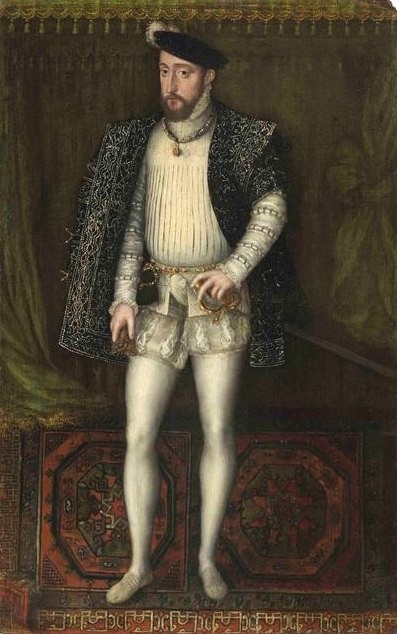
We haven’t seen Henry II yet in the previous parts of this blog post, so, here’s a look at the new king of France with the Valois nose he inherited from his father, Francois I. And, a look at French fashion for men—the doublet, the cape, the beret, the hose on his legs and those shorts called slops. Image Source
Diane de Poitiers was now the Duchess of Valentinois. If she could not be queen, or a princess, a dukedom (a duchessdom?) would do very well, as the rank of lower royalty and those next in line to real royalty.
Then, she set to work (just as her predecessor, Anne had) to make appointments among the clergy and the army. She dismissed one cardinal and put another in his place. She made two men who were sympathetic to her—the Constable of Montmorency and the Duke of Guise—the two top military commanders. She fired the treasurer, the chancellor, and the head of parliament, and put other men in their places.
Diane de Poitiers becomes a rich woman:
In this, medieval France, everything had a price. And the king, as the head of the country, received the payment.
A hundred years later, the king of France, Louis XIV, would declare, “L’État, c’est moi.” Which literally means, in me, in my monarchy, in my very person, is vested the entire country. I am not just the head of the country, I am the country.
(Just from researching this blog post, I’ve come to the realization that the French monarchy, for centuries, with their absolute and unyielding power, were setting themselves up very nicely for the French Revolution that was to come—there was just no other way for France to move forward to rid herself of such tyranny and despotism.)
But, Henry II and Diane de Poitiers were at some distance from the Revolution and could exercise their autocracy in what were, at that time, accepted channels.
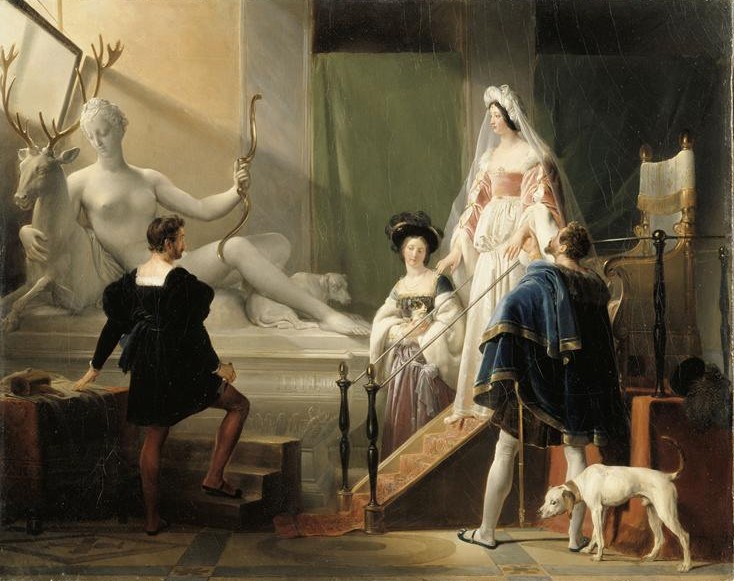
This painting shows Diane de Poitiers (right, on the steps) in the workshop of the sculptor who made the marble statue of Diana which stood in the center of her Fountain of Diana in her Chateau d’Anet. Presumably, the man looking up at her, near her, is Henry II. Image Source
One of the um, privileges of the king was accepting payments for posts and military commissions. If you wanted a promotion in the army? Pay the king. In the navy? You wanted to become a solicitor? A judge? A governor? Every post had its price, and that money rolled into the king’s hand.
Diane de Poitiers’ father—yup, that unfortunate Jean de Poitiers (see Part 2)—had paid a previous king twenty thousand écus for the governorship of the Dauphine (the area around his estate of Saint Vallier). When Henry II’s father, Francois I, came to the throne, he wanted to bestow that governorship elsewhere. This bribery was such a well-established practice that there were also rules established if a return was demanded—Francois I paid back the twenty thousand écus when Jean de Poitiers was forced to surrender his post.
That was fair, at least.
When a new king came to the throne—as Henry II did—all these. . .er, contracts were reexamined, not just with a view to either stopping them or continuing them, but also to renegotiate the price, if possible. Which meant that the solicitors, lieutenants, governors and judges had to dip afresh into their pockets if they wanted to keep their positions.
This revisiting of the contracts was called the droit de confirmation—droit is right, something like the right to be confirmed (back into their positions). And, the money received from all of this droit de confirmation, which was enormous, of course, went to. . .our very own Diane de Poitiers.
All of it.
It was all sort of underhand, under-the-table money, even though it was a well-accepted practice, and so the kingly coffers (the official state coffers, I mean) did not get that sum. The king would use it as his own personal purse, and do what he wanted with it. You know, buy another chateau, or build one, or put it aside as dowry for one of his girls who would make an advantageous match. Whatever.
Still, a lot of people were outraged when Henry II gave Diane all of this money.
What did Diane de Poitiers do with that wealth? Enter, the Chateau d’Anet:
A hundred kilometers west of Paris is the Chateau d’Anet—the Grand Sénéchal of Normandy owned it, and he, Louis de Brézé, was Diane’s husband. It was here he had brought his child-bride (he was forty years older than her and she was a mere fifteen years old when she married him). Louis de Brézé had other estates—he was a fairly wealthy man—but this was his seat. Even so, it wasn’t much—a mere red-bricked mansion, not particularly lovely but certainly serviceable.
When Francois I threw Diane out of the court at the behest of his mistress, Anne, she came back to Anet. Henry II followed her there and lived with her until he was able to reconcile with his father.
Now, with her personal treasury brimming with gold, Diane de Poitiers decided to completely remodel the Chateau d’Anet. She hired Philbert de l’Orme as an architect and he created an absolute marvel in the place of the dull house that had existed.
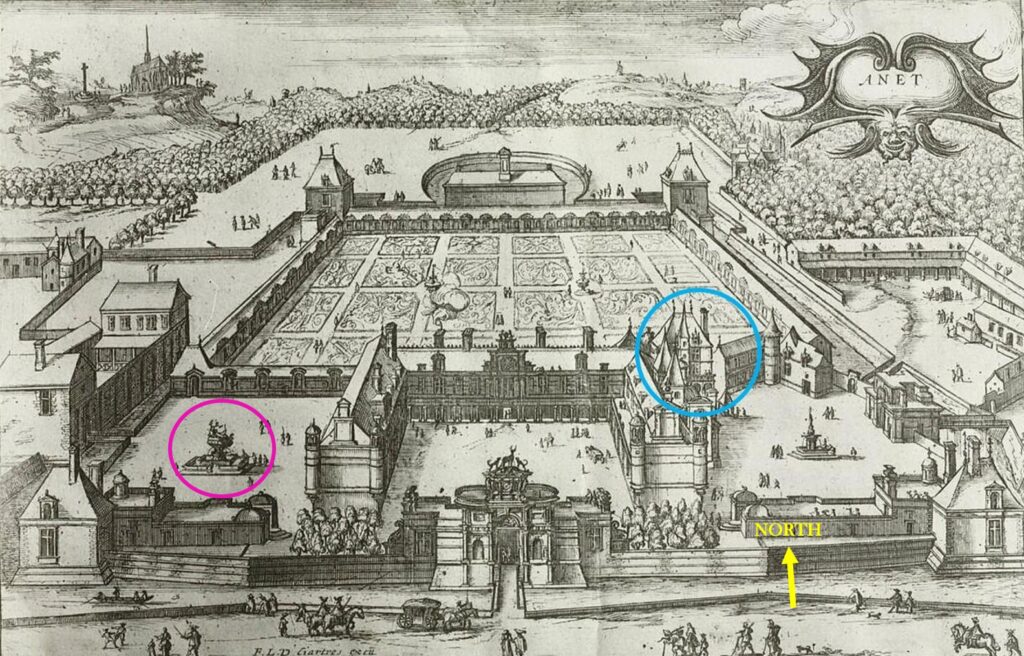
The first picture is a bird’s eye view of the Chateau d’Anet after De l’Orme had wrought his magic upon it. It had three wings, west (left), south and east. I’ve circled the chapel in blue in the east wing, so you can see where it was originally placed. The pink circle, west of the west wing, was where Diane de Poitiers placed the Fountain of Diana.
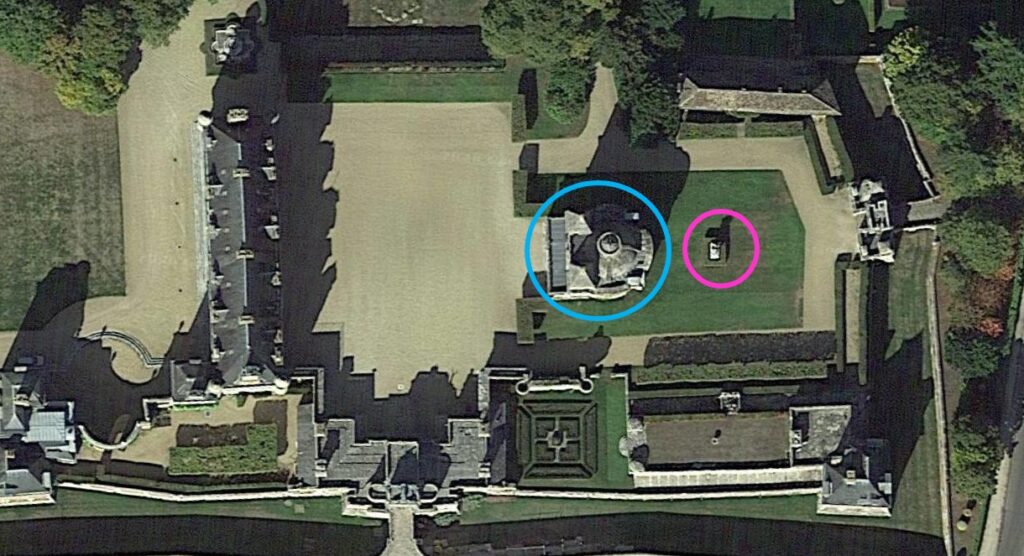
The second picture is a bird’s eye view of the Chateau d’Anet today. Note the position of the chapel (blue) and the lack of buildings around it (the entire east wing was demolished). And the position (pink) of the Fountain of Diana today. More below on the change that happened to it. First Image Source. Second image is from Google Earth.
The newly built château had three wings and two chapels on the premises. Both chapels still exist. But, the French Revolution was not kind to the Chateau d’Anet. As soon as it had been declared a property of France—of all its citizens—people around stormed the chateau. They broke up the south and east wing for stones and marble and carted it away (but, left the chapel standing). Others, more kind, took the furniture and saved it for the future. Only the west wing still remains—some misfortune happened there while it was being destroyed and then it was not touched anymore.
Beyond the west wing (left in the first picture), Diane de Poitiers displayed her Fountain of Diana, modeling herself after the goddess of the hunt.
The whole west area beyond the west wing enclosed tennis courts and stables—all that also doesn’t exist anymore; the statue has been moved to the east, to the lawn beyond the chapel.
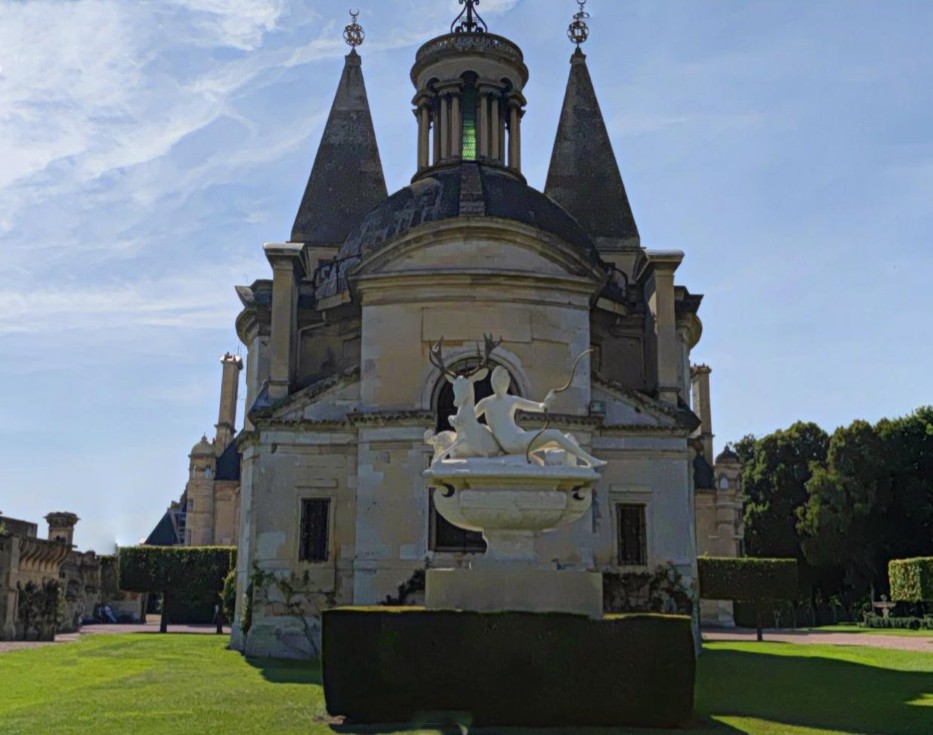
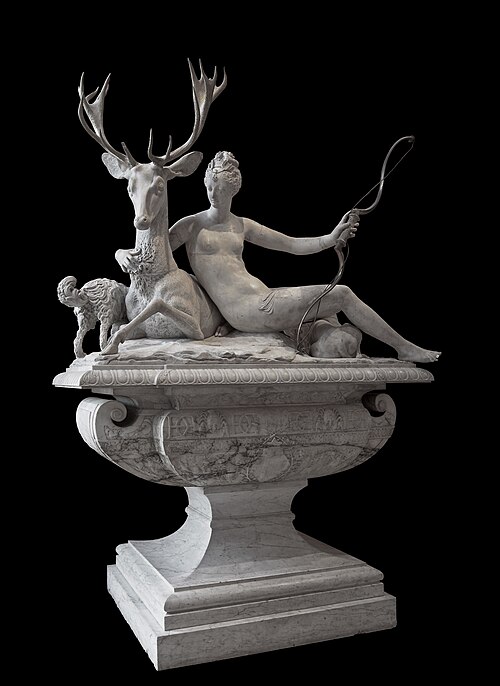
The first picture is the fountain today, in the east lawn, with the chapel looming behind it. The second picture is the original statue in the fountain, in marble; this is in the Louvre Museum. The one on the Anet grounds is a copy. First image is from Google Maps. Second Image Source
There’s also a mortuary chapel on the grounds—look at the Google Earth bird’s eye view photo above (the one of the whole grounds) and you’ll see it on the northwest corner, by itself. It was built after Diane de Poitiers’ death, to contain her remains. During the Revolution, her body was disinterred and thrown into a mass grave—and, more recently, brought back to its original resting place after DNA evidence identified the bones as Diane’s.
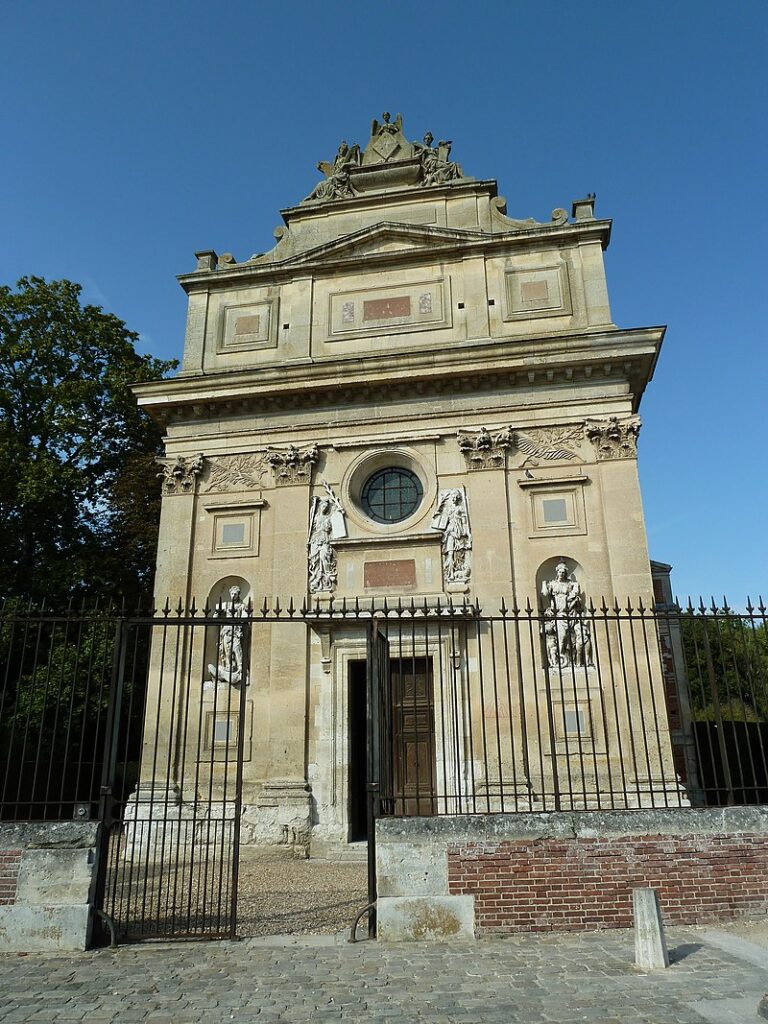
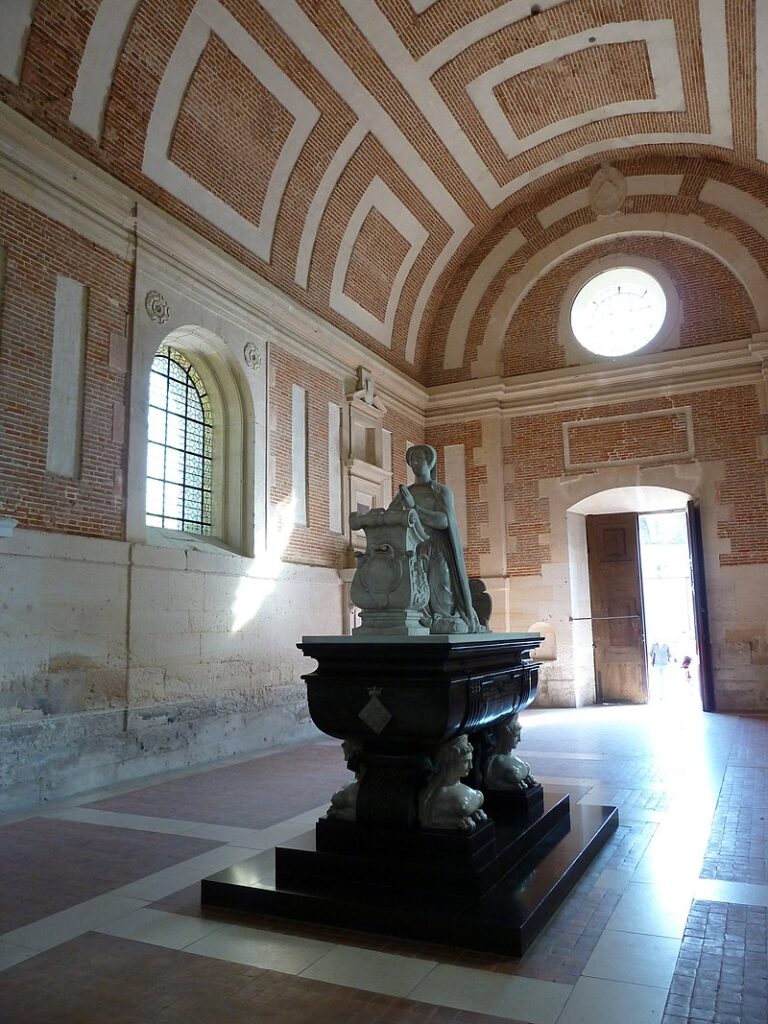
The mortuary chapel today. And, the tomb. First image source. Second image source.
The original portal that Philbert de l’Orme designed for the Chateau d’Anet was in danger of being dismantled during the Revolution, so someone carted it away to preserve at least that part of the architecture. Subsequently, the original portal came to rest in the courtyard of École des Beaux-Arts in Paris—which is where it is today.
The entrance to the Chateau d’Anet today, mimics (somewhat) that portal. It’s much closer, actually to the design de l’Orme drew, not what was executed.
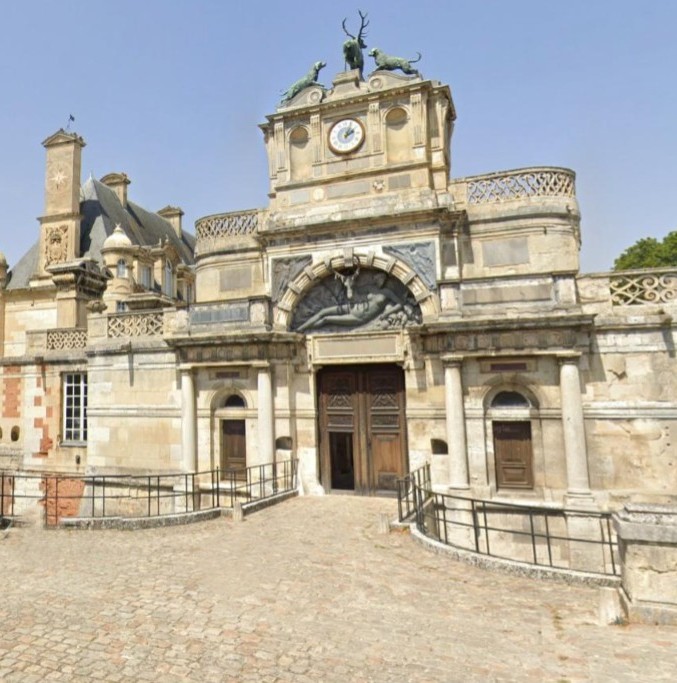
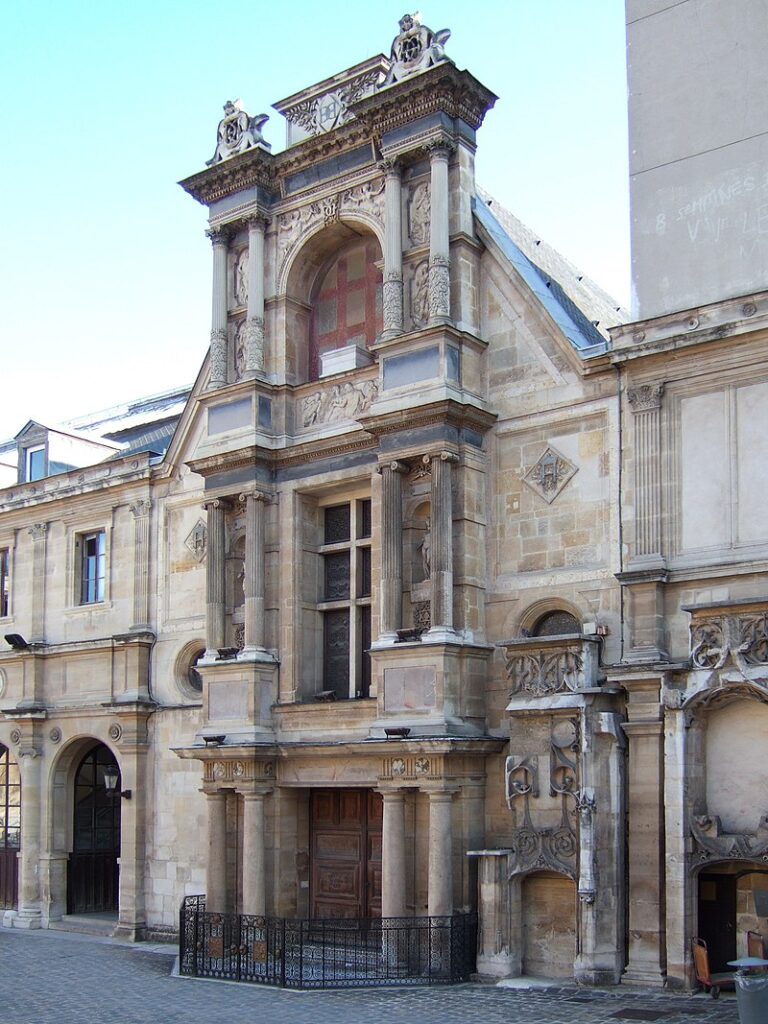
The entrance to the Chateau d’Anet today—more accurate to de l’Orme’s original drawings. Second picture is the portal in the courtyard of the École des Beaux-Arts in Paris, that was taken from the chateau (but doesn’t really resemble the architect’s original drawings). First image from Google Earth. Second image source
My heart yearns after my dead husband?
When Louis de Brézé died, Diane de Poitiers built a magnificent tomb for him within the cathedral at Rouen. It has Louis recumbent in death, with her own statue at his head, kneeling in prayer, palms together.
She carried that part of the grieving widow with her all through her life—despite the fact that she was well-established as Henry II’s mistress, and everyone was aware that she was the real power behind his throne.
During this remodel of the Chateau d’Anet, Diane de Poitiers had these words engraved on the portal (which is now at the École des Beaux-Arts):
To Brézé, her husband, the grateful Diana erects this monument in order that it may be an enduring memorial to this gallant man.
The Chateau d’Anet was rebuilt some twenty-five years after de Brézé’s death, and during that time Diane de Poitiers had been the mistress of one king (briefly), and was now the mistress of another.
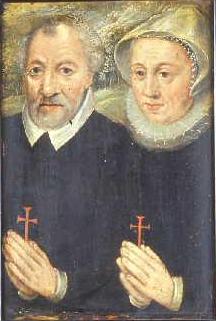
Another curious item is this painting, which is said to date to the 16th Century. It shows Louis de Brézé and Diane de Poitiers together. (Did she have it commissioned? Possibly.) What’s curious is that he’s, well, he’s showing his seventy years here. But, she was only thirty when he died. And yet, here she is, as aged as him, demonstrating a strange kind of faithful devotion by matching his years. Which fits in very well with that inscription of fidelity over the Château d’Anet’s main gate. Image Source
What did Henry II think of this inscription, and its legend of steadfastness? On a chateau that, essentially, he had built for his mistress? Did he even care, now, that he had possession of her, and Louis de Brézé was long gone?
Actually, it seems to have been more complicated than that. If Diane was playing a role, then Henry was also—read on, to the section (in Part 4) where he gives her the Château de Chenonceau and you’ll see what I mean.
Just how powerful were Henry’s affections for Diane?
Henry II had coins struck with Diane’s likeness, with her emblems and with her devices. No other French king had dared to do this with his mistress. However beloved she might have been, the coin of the realm never bore her name.
(Mehrunnisa, Empress Nur Jahan, the twentieth wife of Emperor Jahangir also had this unheard-of privilege, because she was not the sitting sovereign (ah, but she was!), because she lived within a harem’s walls, because she gave birth to no heir to the throne. (The first two novels of my Taj Trilogy are about Mehrunnisa—see The Twentieth Wife and The Feast of Roses).
Yet, she had two of the three privileges of sovereignty in 17th Century Mughal India. She had coins minted in her name and she signed upon imperial documents called farmans. The only thing she did not have was something called the khutba. The khutba was the proclaiming of the sovereign. The muezzins of the mosques all over the empire sang out the emperor’s name after the Friday noon prayers. In an age of no technological means of communication, this khutba was what told the populace, week after week, who their lord was, and toward whom they should bow their heads.)
This coin, below, shows on both its faces the image of Diane de Poitiers. I’m not sure if it was actual currency, or just what they called a ‘medal,’ minted in a restricted amount. Either way, it was a brilliant achievement for Diane de Poitiers.
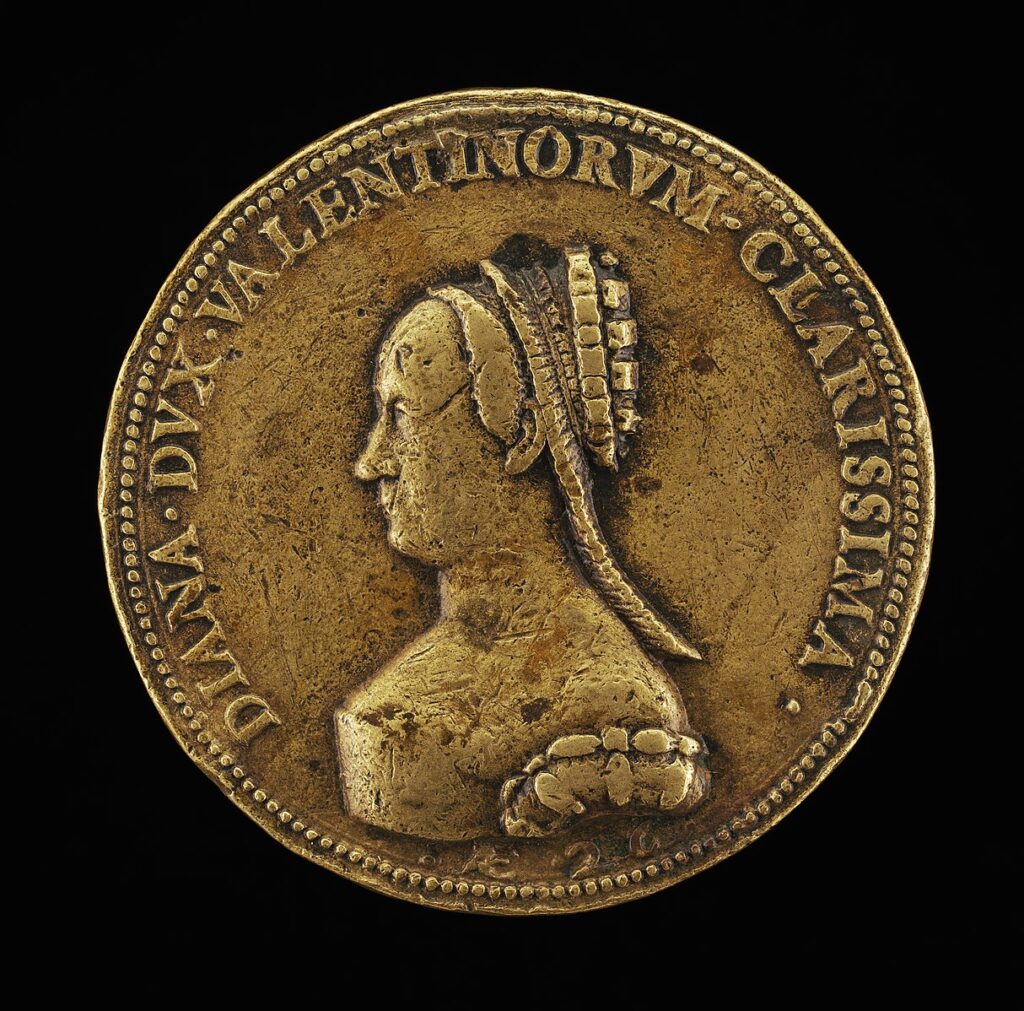
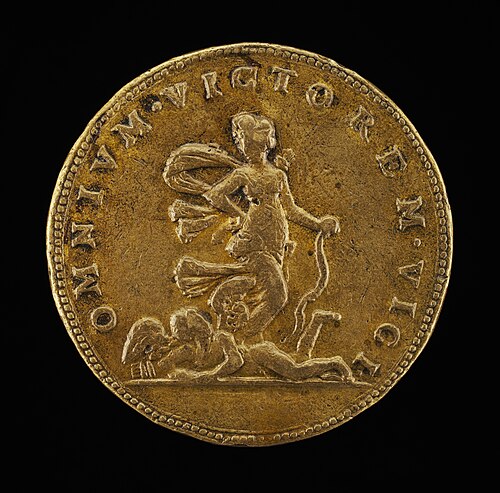
This medal, cast in bronze, has Diane’s head in profile on the obverse side, and identifies her as Diana, Duchess of Valentinois. ‘Clarissima’ means most illustrious, most brilliant.
On the reverse side is a more fantastic image, of Diana, Roman goddess of the hunt, trampling upon Cupid. The legend here Omnium Victorem Vici means ‘I have conquered all. ‘ Boy, had she! One thing to note: The source identifies the medal to be from about 1525—I don’t think that’s possible, Henry did not become king until 1547, so the medal must date after his coronation. In any case, in 1525, Henry would have been six years old, and being held hostage in Spain. And, Diane de Poitiers’ husband was still very much alive then. First Image Source. Second Image Source.
And, of course, Henry II gave Diane de Poitiers that much-coveted, lovely Ladies Chateau on the River Cher, which Catherine de Medici wanted also, desperately.
And so, life went on in the French courts until. . .
. . .Henry II died. This was just three years after Diane de Poitiers got full, legal (so to speak), possession of the Château de Chenonceau.
And, she would only have it legally for those three years.
Because, when Henry died, Catherine became all-powerful. She was the undisputed mother of the heir, she was regent, and Diane de Poitiers was merely the king’s old mistress.
She kicked Diane out of the Château de Chenonceau and went there herself. And so will we in Part 4.
If you’ve enjoyed reading this post, please share it, so others may read also. Thank you!
Primary Citations and Sources: The Library, Fourth Series, Volume VII; Helen W. Henderson, The Enchantress, Being the life of Diane de Poytiers Mistress of King Henry the Second of France; The People’s Magazine, An Illustrated Miscellany; E. Maxtone Graham, Children of France; Reginald Blomfield, A History of French Architecture, From the reign of Charles VIII till the death of Mazarin; Marcel Monarché, ed., The Chateaux of the Loire; H. Noel Williams, King Henri II: His Court and Times; Charles Terrasse, Le Château de Chenonceau by Charles Terrasse.
On the next blog post—what else Diane de Poitiers did to so offend Catherine de Medici—and we’ll visit the wondrous Château de Chenonceau—Mortal Enemies: The Queen and the Mistress who coveted the Château de Chenonceau—Part 4
Search Engine Keyword Phrases: Chateau de Chenonceau from Paris; Chateau de Chenonceau opening hours; why was Chateau de Chenonceau built; Chateau de Chenonceau Instagram; Paris to Chateau de Chenonceau by train; Chateau de Chenonceau price; Diane de Poitiers; Ladies Castle; Katherine de Medici; Renaissance architecture France; castle with arched bridge; Chateau des Dames; fairytale castle Loire Valley; influential French women; Katherine de Medici’s garden; Chateau de Chenonceau flowers; Chenonceau history; Who lived at Chateau Chenonceau; What is Chateau de Chenonceau famous for; where is chateau de chenonceau located; Chateau de Chenonceau fun facts.


One Reply to “Mortal Enemies: The Queen, the Mistress, and the ethereal chateau in France–Part 3”