
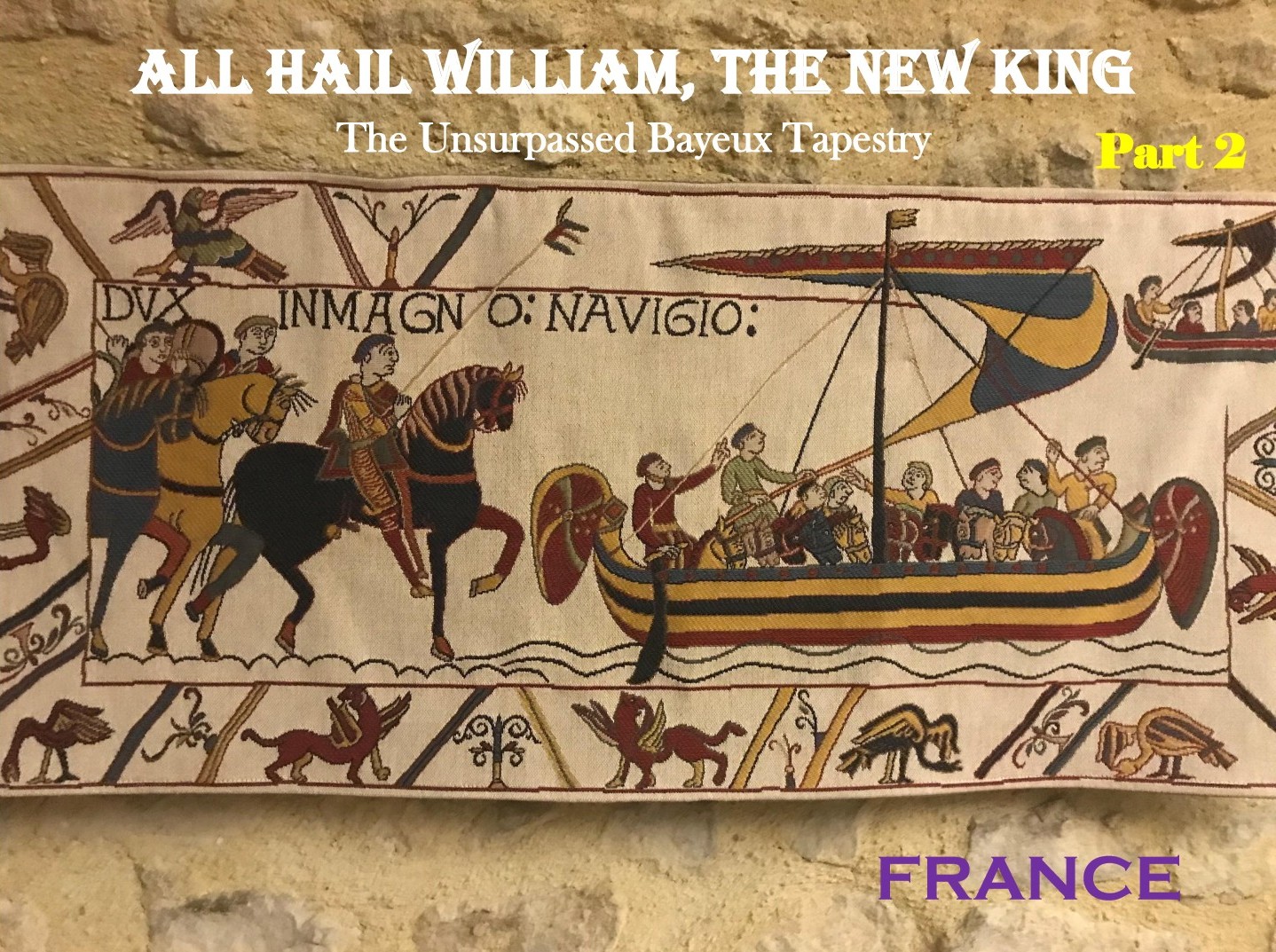
In 1066 CE, a French usurper, William the Conqueror, came to the English throne. He was the Duke of Normandy, and his story was told very soon after The Conquest on a length of embroidered linen, using ten hues of subdued colors. This is the Bayeux Tapestry.
The tapestry was made for the consecration of Bayeux Cathedral—William the Conqueror’s brother, Odo, was Bishop of Bayeux, and responsible of the building of the cathedral (future blog post). At that grand event, the Bayeux Tapestry was displayed for the first time, and for many centuries after, hung in the grand nave.
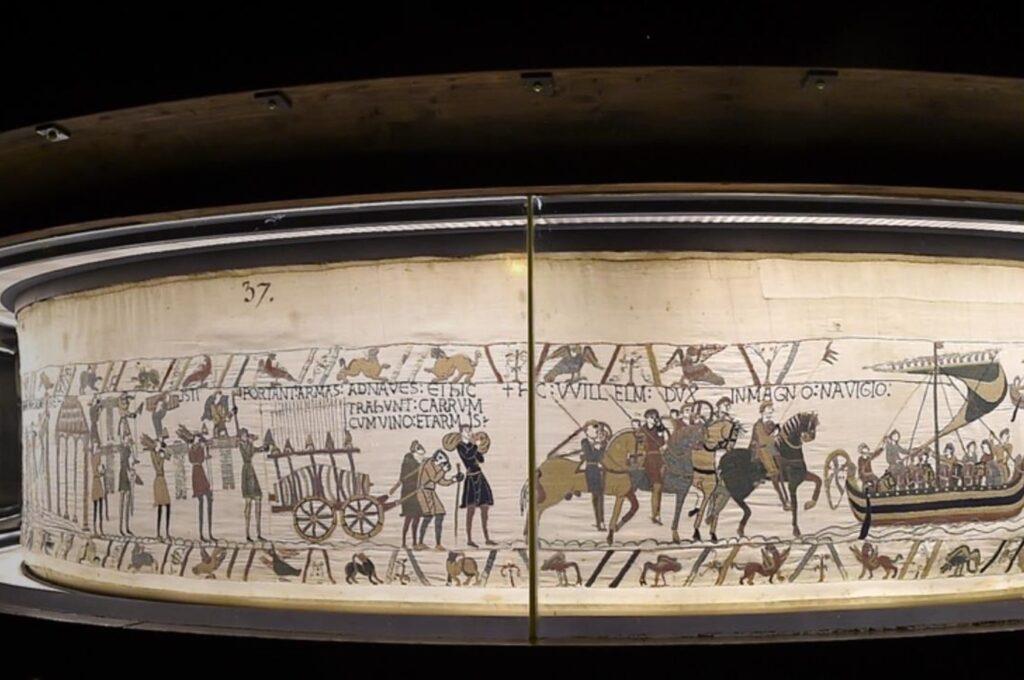
The Bayeux Tapestry today, in the Bayeux Museum in northwest France. Image Source.
After some time, it was stored away, displayed here and there (at the beginning of the 20th Century, it hung in the Municipal Library of Bayeux) and has come to rest in its own museum, inside a humidity and temperature controlled glass case, with lighting that will not harm the now almost-thousand year old fabric.
William the Conqueror’s Norman overthrow of England made the subjugation of an entire country so complete—with English nobles fleeing, leaving their womenkind behind to marry the French vanquishers—that England as we know it today is virtually descended from Norman rule.
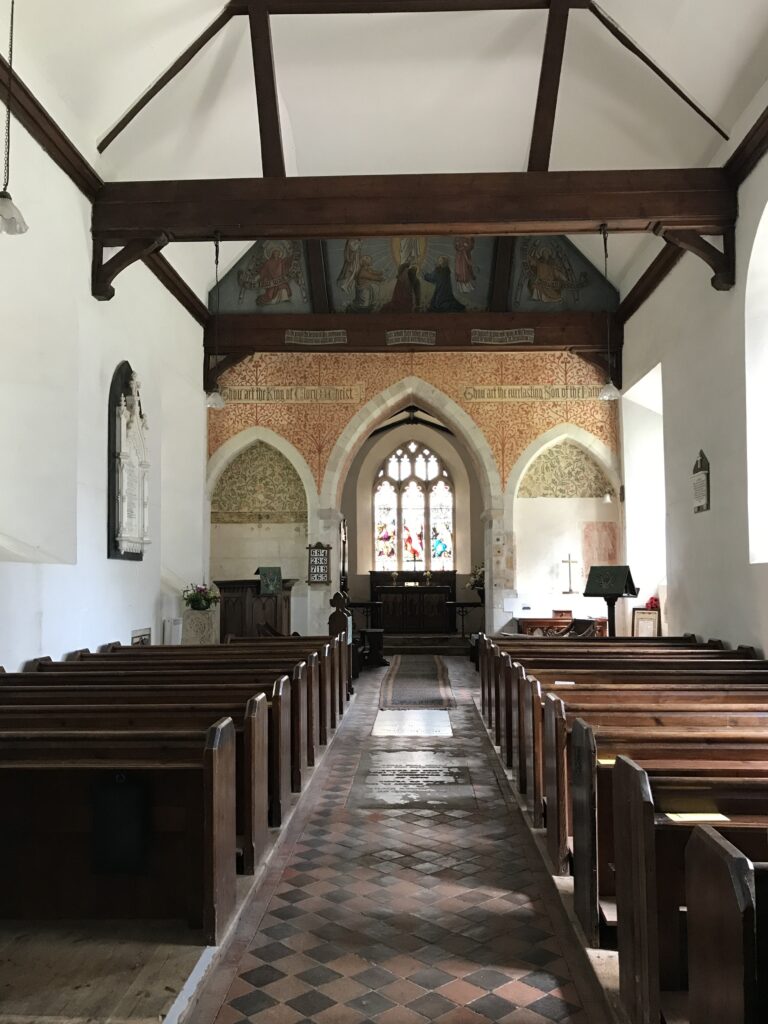
The nave in the tiny church of St. Nicholas in the village of Steventon, where Jane Austen’s father was parish priest. Austen lived in Steventon until she was twenty-five years old. By the time Mr. Austen came to preside over the parish, this church, which dates to William the Conqueror’s Norman construction, was already some five hundred years old. My blog post on Steventon is here.
In almost everything. French became the language of the courts for several decades. Few churches and monasteries remain from pre-Norman times—almost all the churches were rebuilt in Norman stonework (they were mostly wood in the previous Anglo-Saxon times). On my blog, Bath Abbey, Winchester Cathedral, and Salisbury Cathedral, all date to Norman rule in England.
So, who’s this William the Conqueror then?
William inherited his duchy of Normandy in the northwest of France, just across the English Channel from English shores, when he was about seven years old. His age was a burden, surely? Ah, but William had yet another encumbrance to bear. He was not his father’s legitimate son.
His father, Robert, Duke of Normandy, was certainly descended without trial from his own father, grandfather, and ancestral dukes. But Robert did not marry. Before he became ruler of Normandy (long story there, his brother was duke before him and died under suspicious circumstances), he was Count of Hiesmes, of which the town of Falaise was the capital. Falaise is some sixty kilometers southeast of Bayeux—as a point of reference—still well within Normandy.
William the Conqueror had yet another burden. His mother was the daughter of a lowly-born tanner, who plied his trade and his dyeing vats just below the looming walls of the castle that Robert had built for himself. Looking down one day, Robert saw the tanner’s daughter, Herleva, young, comely, and desirable, and brought her into his abode.
She gave birth to Robert’s only son, William.

Herleva’s statue in the town of Huy in Belgium. She’s supposed to have been born there. Image Source.
But, they could not marry—not being of the same social class. And if Robert had married someone else from the nobility, then William would have stood small chance at succeeding after his father, or, indeed of mastering England and gaining his title of William the Conqueror.
William did have two half-brothers. While his mother could not marry his father, she did (or Robert made her) marry a knight at Robert’s court. One boy, Odo, became Bishop of Bayeux and the other, Robert, was eventually Count of Montrain.
Odo and Robert were William’s closest kinsmen, and we’ll see quite a bit them in the Bayeux Tapestry’s story.
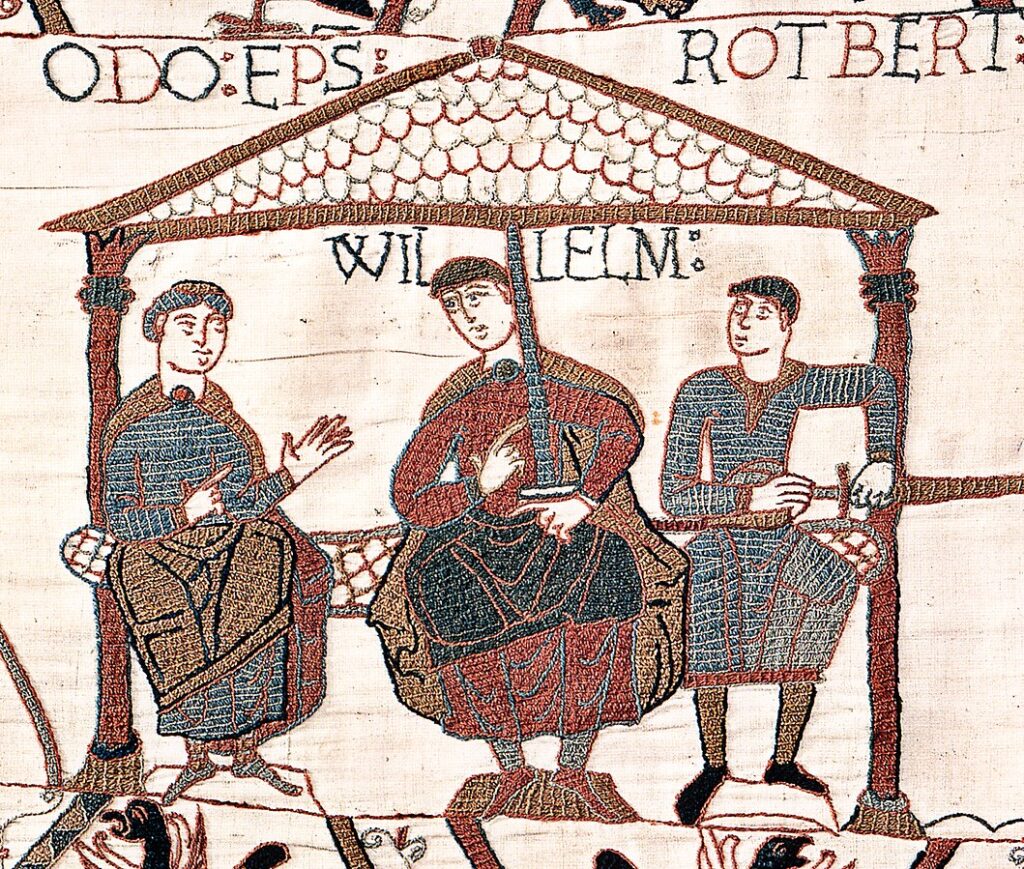
William and his half-brothers, Odo (left) and Robert (right) in the Bayeux Tapestry. Image Source.
These two boys were something like two and three years younger than William, but their affections were strong, and they were probably all brought up together.
And when William went across to England to engage in that decisive Battle of Hastings where he defeated King Harold, Odo and Robert were firmly by his side. Both fought, both escaped mortal death during that struggle, both were brave (even though one was a clergyman), and both were rewarded amply when their brother, William the Conqueror, became king of England.
Oh, that I were a child again, with no weight of a crown to bear upon my head:
William did not have much of a childhood, not as children typically enjoy—their world shrunk to their immediate surroundings, loving parents a blur of adoration, kisses on scraped knees, a blessing upon the forehead while drifting into sleep, the rough play with a ball, or wading through mud and streams.
With no legitimate heirs, William’s father managed to convince the powers-that-be in Norman France that this bastard son of his must inherit his dukedom. When his father died, William was too young to rule, but still considered heir. The Normans—indeed, I think almost everyone at that time—were a battlesome race, and lawlessness and infighting prevailed all around him.
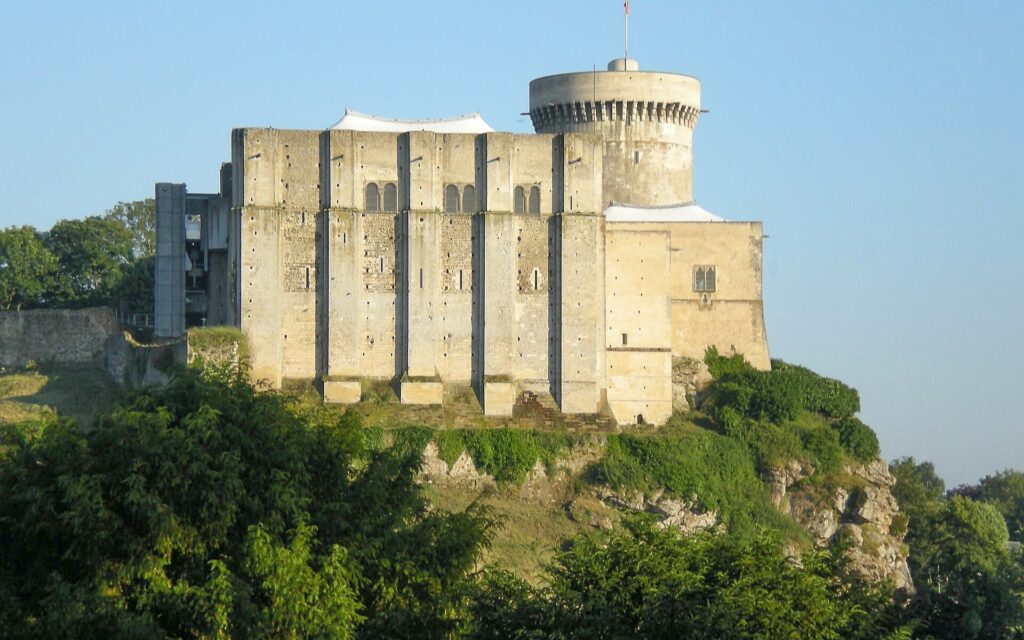
Château de Falaise in Falaise where William the Conqueror was born to Robert of Normandy and Herleva, the tanner’s daughter. This château is of a later construction, but it most probably follows the lines of the one Robert had built—the situation is the same, the giant rock upon which it’s built and the steep walls. Now, imagine a striking Herleva below this eminence, her hands plunged in a tanning vat, swirling leather skins around! Image Source.
William survived his childhood (long story there, of course) until he became old enough to carry the dukedom on his own shoulders.
But, his troubles extended beyond his borders. Normandy was its own kingdom, there was a king of France, and rulers in other duchies. Over the years, William cut his teeth, and learned his skills as a diplomat and a fighter in defending his Normandy. His alliances with various rulers including the king of France were fluid, bending this way once, another way at a different time.
Which means that William had barely a moment of peace while he grew up and ruled.
Add to that, with the medieval tendency to bestow cognomens, and before he acquired that other, rather more fine one of being ‘William the Conqueror,’ William was called William the Bastard.
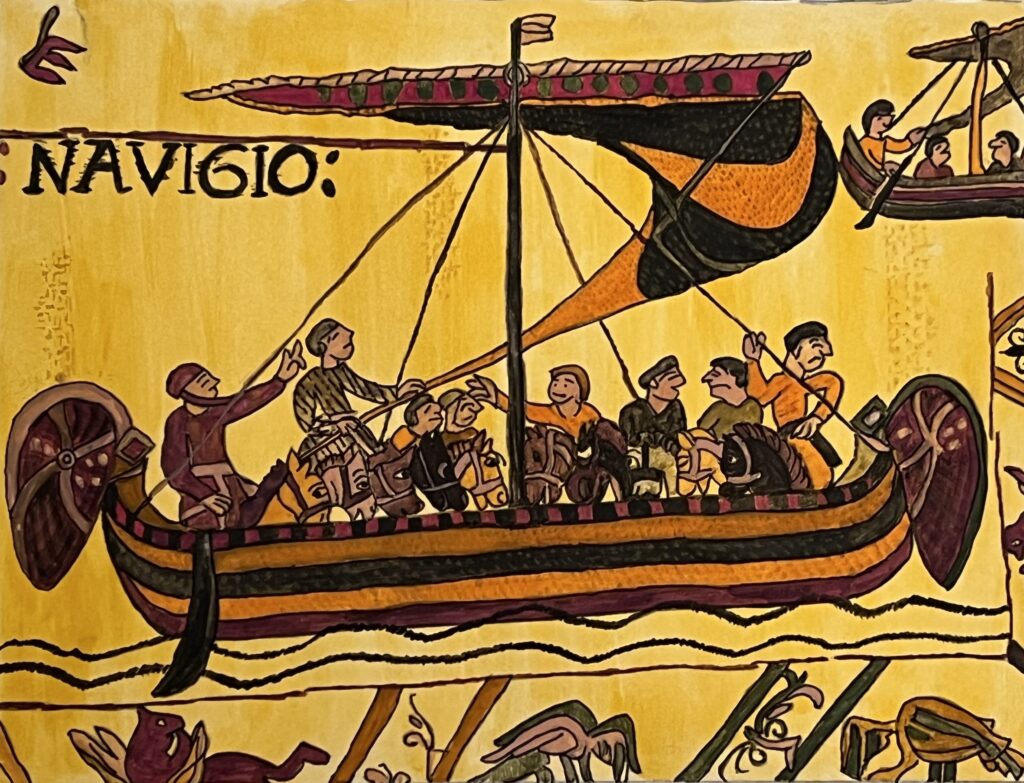
Presumably, after having been Duke of Normandy for many years, when he climbed into the boat that was to take him across the English Channel to take England, he was still called William the Bastard.
That first trip though, to this sceptered isle, this earth of majesty, this England, that was to be William’s:
Edward the Confessor, the king of England, more Norman than English, who had peopled her institutions with as many of the French as he could, had no heirs.
He was William’s uncle once removed, his father’s cousin, who had spent all of his childhood and most of his adulthood in Normandy, because his mother, Emma, had abandoned him there when she went back to England to marry her second English king husband. (See this history in Part 1 of this blog post.)
King Edward’s advisors were also French, and in casting about for a potential heir, they suggested William the Conqueror across the waters. Why? Because if William became king of England, they would be assured of continuing in their high offices in England.
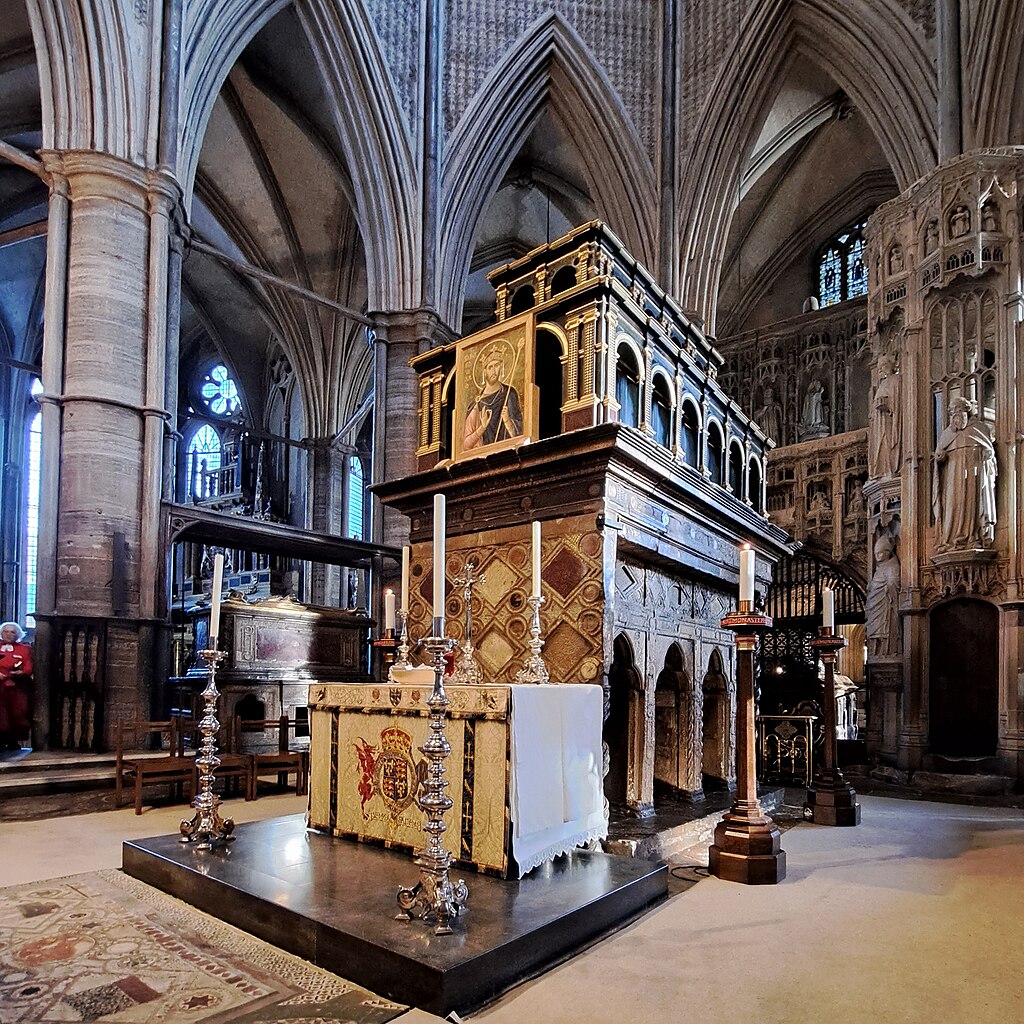
King Edward the Confessor, the French-brought-up king of England, built Westminter Abbey in London. He attended the consecration of the church after its completion, and a week later, he was dead.
Edward, consequently, is the first English king to be buried in Westminster Abbey—this is his tomb behind the high altar.
Edward’s successor, Harold, kept the crown on his head for eight short months until William the Conqueror stopped by to knock it off. Legend is that Harold was the first English king to be crowned at Westminster Abbey—but, William is officially documented as being the first! Did William rewrite history a little bit there? Image Source.
In 1051CE, Edward sent an invitation to William. Come over, my boy, let me. . .either declare you my heir, or. . .you should take the English throne, you know, after me.
The first proposition seems impossible. Even if England was now thronging with the French, the Witan—the wise men who elected the king—were unlikely to consider the very French William as sovereign, he who was visiting England for the first time. And technically, William had no other English connections. Both his parents had been very, very Norman themselves. And then, William’s parents had not been married—perhaps the French, with their very laissez-faire attitude could forgive this blight, but the English?
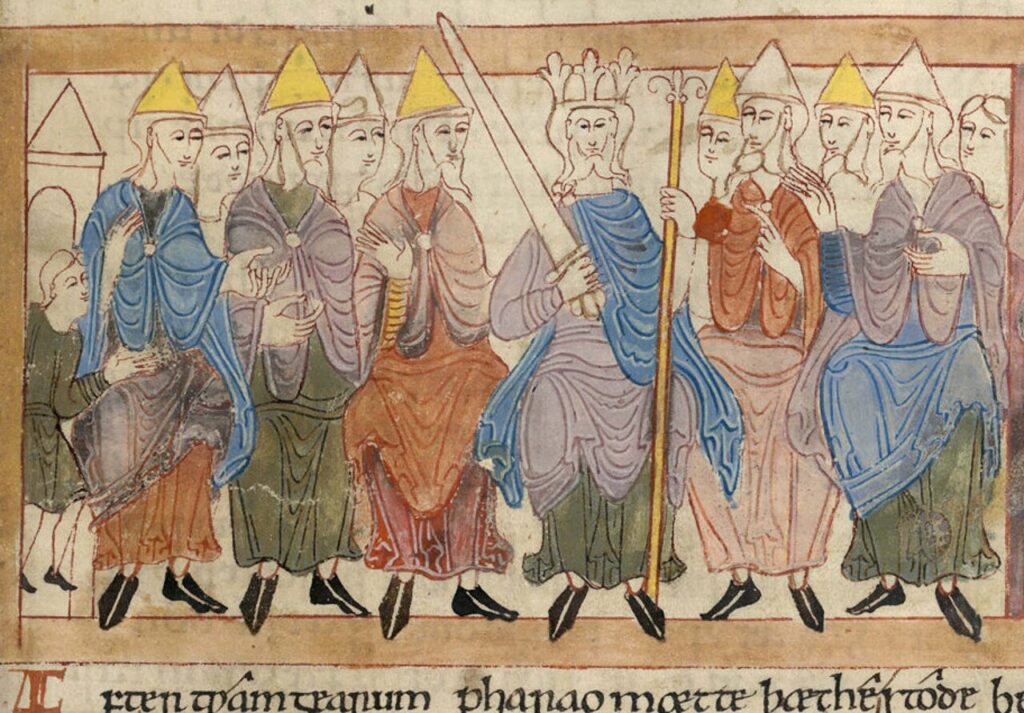
An Anglo-Saxon king surrounded by his wise men, the Witan. The Witan were as much king-makers as ever-present councilors, although their overall power was not, I think, absolute. That belonged to the hand that held the sword, as the very foreign William the Conqueror amply demonstrated when he took over England. Image Source.
What was William’s association with England then? At best, he had an ‘English’ uncle.
It’s more likely that the second proposition is true—that Edward brought William to visit England and told him during that visit that he ought to consider himself heir to England.
I mean, two people can have a conversation about just about anything, and Edward may have wished for this, and William may have agreed, but there was nothing lawful about it.
In any case, when William defeated England, this (second proposition) was what he claimed as a defense —that he had a right to England, because his uncle, the English king, had told him so.
There was also the fact that in a previous generation, William’s father, Robert, had picked quarrels with the then-king of England, Canute (see Part 1 of this blog post) in an effort to put Edward the Confessor on the throne. Maybe, that was Robert’s motivation. But William the Conqueror possibly also understood the conquest of England to be achievable from his father—although he didn’t spell out this justification in words, obviously.
An, as an aside, since we’re reaching back so far in time where the records are, at best, shaky, there’s also another theory. That this purported England visit in 1051 CE never actually happened. William the Conqueror, still defending his changeable Normandy borders, could not have afforded to take the time for a (working) vacation to England.
So then, the first time he saw England, was when he came to take it.
The Bastard takes a wife:
William was born without the sanction of the church. He was Duke of Normandy, but his illegitimacy played a role in his fitness to marry within the royalty and nobility in the duchies around him, and in France.
All royal marriages are the same—the principal actors rarely have a say in how their lives are to take shape, marriages are arranged with an eye toward authority, perhaps proximity of lands, and influence. (This was true the world over, some four centuries later, the Mughal kings in India married (severally, because they were Muslim) to create powerful and loyal allies—see my blog post on Maryam’s Tomb; Maryam was one of Emperor Akbar’s Hindu wives).
William married Mathilda, daughter of the Count of Flanders.
Could his legates have sought a connection other than Flanders? There were the other duchies, of Aquitaine, Gascogne, and Brittany, for example. The king of France did not yet have children, so no hope there. But perhaps, William’s birth was an obstacle. If he continued to rule, well and good, no one would have thought much of his illegitimate birth, but if an upstart with more lawful pretensions came forth. . .and was successful, what would that connection be worth then?
Baldwin, the Count of Flanders, who gave his daughter to William in marriage, obviously had little objection. However the opposition came from a different source, so the story goes.
Mathilda rejected William several times, using this very point of his illegitimacy. But, she had other reasons for refusing William—one strong one, in the form of a handsome young Anglo-Saxon.
The well-connected Baldwin, Count of Flanders:
The Flanders Margraves/later Counts occupied some of the northeastern corner of current-day France, near the Belgian border. Calais, the port city, lay within what was once Flanders, and it’s important, because the crossing of the English Channel between Calais and Dover in England is the shortest and most accessible.
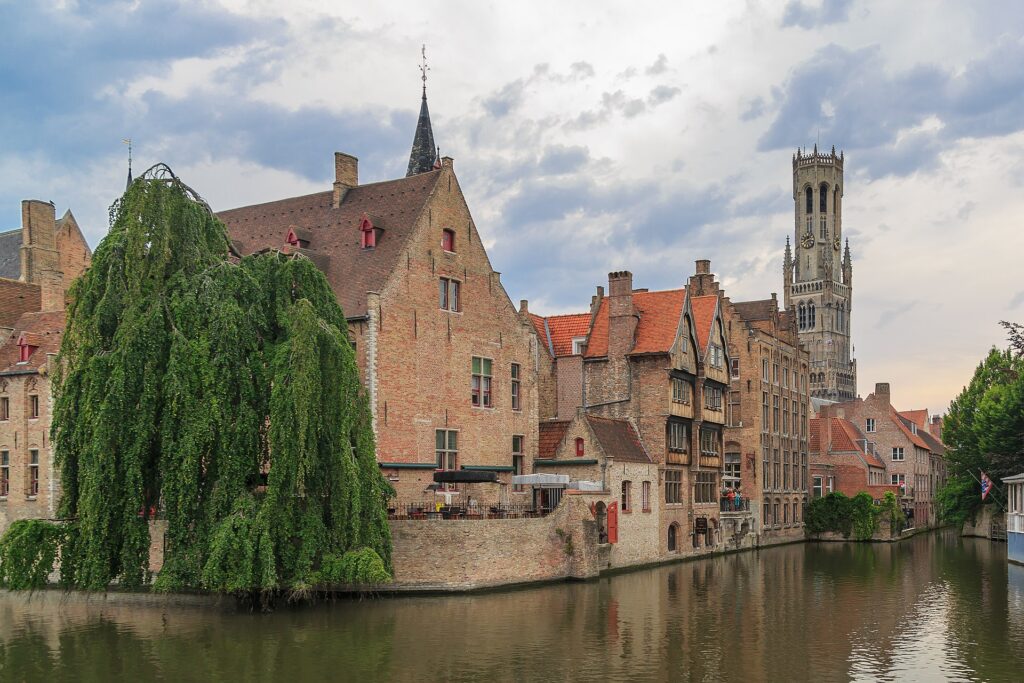
Baldwin V’s capital city, however, was Bruges (in Belgium today). Image Source.
This meant, inevitably, that Baldwin, Count of Flanders, had varied associations with the Anglo-Saxon kings of England. He had married the daughter of the king of France, Adela (Mathilda’s mother, and sister of the current king of France).
Adela was proud of her lofty birth, of her royalty, and had been highly educated for her times—she passed on this pride to her children, including Mathilda, which might have been Mathilda’s reason for rejecting William. Maybe.
Why did William turn toward Mathilda though?
I’ve a bit of a theory here about why William went seeking Mathilda of Flanders for a wife, and it lies in some possibly grimy history in William’s own life. Or rather, that of his father, Robert the Magnificent.
Robert was not the eldest son of the previous duke of Normandy (Richard II, who was Emma’s brother), and his brother succeeded their father as Richard III, Duke of Normandy. Robert, discontented with his estates, rebelled against his brother, was defeated and sent back home with a whipping, and then, suddenly Duke Richard III died—and the throne descended upon Robert.
That sudden death is said to be very suspicious.
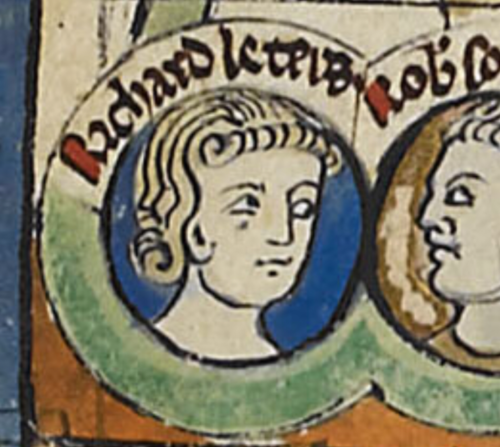
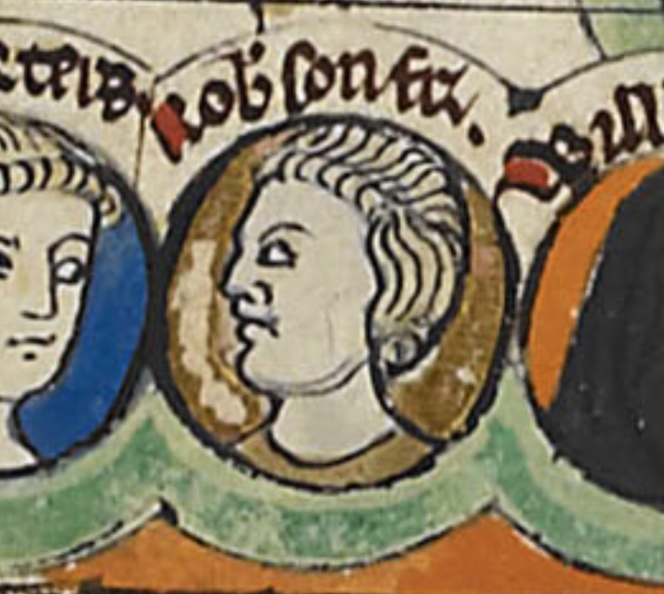
Richard III on the left and Robert the Magnificent on the right. If Richard’s death is indeed suspect, maybe it was Robert himself who gave himself the epithet of being ‘the Magnificent.’ First Image Source. Second Image Source.
What does this all have to do with William wanting to marry Mathilda?
Duke Richard III was married to Adela, daughter of the King of France—yes, Mathilda’s mother. After her first husband’s death, she went on to marry the Count of Flanders.
There were several kingdoms and duchies in France in which William hunted for a wife—and the marriage had to be somewhat semi-arranged. William, as Duke of Normandy, could not very well marry the kitchen maid.
But, he chose Flanders. Why? I think because his father killed his uncle to gain the Normandy dukedom, that uncle who was married first to Mathilda’s mother. So, possibly William the Conqueror was offering some sort of a reparation to his uncle’s wife? Something to think about.
Back to William and Mathilda now. . .jumping ahead a bit:
William and Mathilda had several daughters, and two (important?) sons, William Rufus and Henry. One of their daughters, Adela, married Stephen, the Count of Blois. Adela was obviously named for her maternal grandmother.
Why’s Adela singled out more than her sisters? Because, she became the mother of a king of England, Stephen of Blois. Stephen came to the English throne in 1135 CE, and ruled for twenty years or so. He succeeded two of his uncles to the throne—the first, William Rufus was William the Conqueror’s son, and the second, Henry, was another son. When Henry died, Stephen became king.
Adela is famous as the daughter, sister and mother to kings of England—William the Conqueror’s daughter, William Rufus’s and Henry’s sister, and Stephen’s mother.
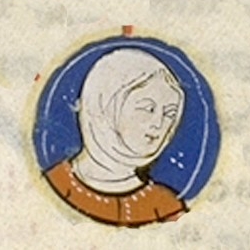
Here’s Adela of Blois. She’s said to have owned another (finer) version of the Bayeux Tapestry. Image Source.
Adela’s known for yet another thing, inadvertent on her part, I’m sure. There’s a 12th Century contemporary tale of another tapestry (not on cloth this time) that she possessed, with the same story as in the Bayeux Tapestry.
That piece of cloth was richer, better, more magnificent than the Bayeux Tapestry. Naturally. Since it’s missing and we cannot see it. More on that in Part 3 of this blog post.
A little detour, to William the Conqueror’s son, King William Rufus:
As an aside, William Rufus—the first to succeed William the Conqueror—had the reputation of being nothing like his cultured, compassionate, and wise father. He was a hard-swearing, obnoxious man, called ‘Red Rufus,’ most probably not because of his choleric temper (although he had that) but because of his red hair.
William Rufus died while hunting in the New Forest. It would seem that they had a very. . .um, interesting manner of hunting a stag. The animal would be led into a clearing, the hunters would surround it in a circle and let loose their arrows. It’s no wonder that someone or the other was injured. Anyhow, William Rufus’s reputation made him a target—especially to his brother, Henry (who became king after him), and there’s enough doubt among historians that the arrow that found its way into the king’s chest was fired deliberately.
To add to that theory, right after he died, the hunting party left him there and went away—imagine this, the king of England lying deserted, and dead, in a forest of trees. Most notably, Henry the brother rode hard to Winchester to lay claim on the treasury of England and then hurriedly crowned himself king.
Another hunter found the king’s body in the forest and took it to Winchester Cathedral for a burial.
Why am I being sidetracked a bit on this Red Rufus? Because, you can see his purported gravestone in my blog post on Jane Austen and Winchester Cathedral, Part 1, bang in the middle of the choir stalls.
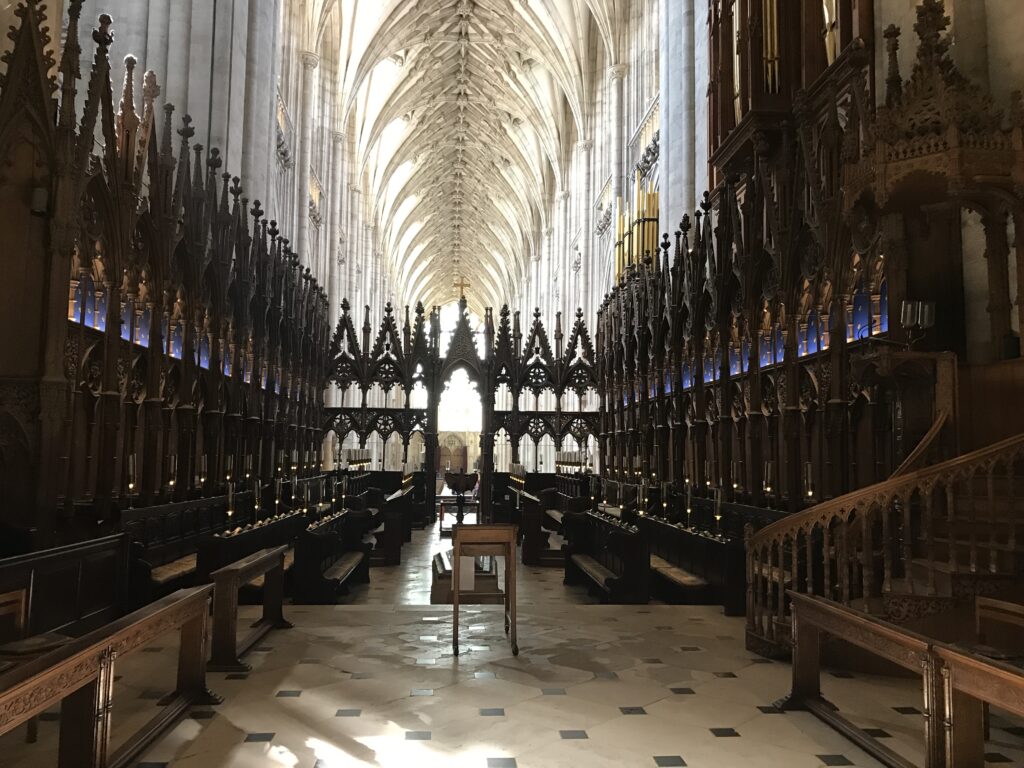

The choir stalls at Winchester Cathedral in the first picture. Just beyond the small lectern in the center, one step down, you can just about see the gravestone on the floor that is perhaps William Rufus, perhaps Henry de Blois. Second picture, a closer look at the gravestone.
But. But. But. My heart yearns toward another:
Back to William and Mathilda’s courtship now. . .why did she initially reject him?
With England being a short hop across the English Channel from Calais in Flanders, and Dover on the English coast, there was a fairly regular contact between the Anglo-Saxons and the Flanders ruler.
In fact, about the time that William went to England (in 1051CE he was already married to Mathilda), an Englishman was seeking shelter at the Flanders court—Goodwine, Earl of Wessex. I bring Goodwine in here briefly, because, in 1066 CE, it was his son who became king of England after Edward the Confessor, and it was from this son that William the Conqueror wrestled England away into his own grasp.
But well before that, several other Englishmen came over from Edward the Confessor’s court—he’d put all his Frenchmen in important positions, and he sent his Anglo-Saxons away as ambassadors to foreign courts.
Mathilda fell in love with a thane—a medieval rank in Anglo-Saxon England, one of the nobility, positioned just below the earls. This man, Brictric, was enormously wealthy, with all of his lands lying westward in England, in the counties of Somerset, Devon, Cornwall and Gloucestershire.
There could have been little, actual courtship between the two, at most, they met often while he was in Flanders, perhaps at garden parties, galas, and celebrations.
Why, oh why, do you cast me off?
The timeline’s murky in this ‘love triangle,’ but Brictric was said to have left the Flanders court well before William came a-courting. Or rather, when William the Conqueror’s commissioners and ambassadors brought a formal proposal of marriage to the count.
The story goes that it was Mathilda who made her wishes known to this lover, Brictric, because he was of a much lower social class than her, and would not have dared to raise his eyes to such a prize.
And, what did Brictric do?
He refused her. He was not in love with her, and could not marry any woman without that all-encompassing affection and regard. Brictric went back to England at the end of his ambassadorship, leaving a forlorn Mathilda yearning for him.
All this is so improbable.
Brictric might not have dared to court Mathilda, but, when she’s practically flinging herself at him, and could probably convince her father to agree to their match, why would he reject her? Her father was wealthy, prominent, powerful, and connected to the king of France and the German court—and, Brictric was just a nobleman, wealthy too, yes, but with nothing like the reach of his prospective father-in-law.
Now, William steps in:
It was Baldwin, Count of Flanders’s distinction (and my other theory about reparation) that nudged William of Normandy to approach him with an offer of marriage to his daughter. William was about twenty years old, and he had been Duke of Normandy since he was seven, so by this time, he was well-established in his reign.
It was not a love match, certainly.
Mathilda objected to the proposal. Her reasons were varied—William’s birth (he was illegitimate); his tenuous hold on the Norman throne (again, because he probably had no legitimate right to it); the constant strife in and around Normandy (which made his hold tenuous, surely?). . .and so on.
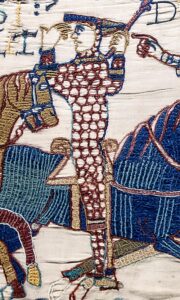
William during that decisive Battle of Hastings which gave him all England in 1066 CE. This is a scene from the Bayeux Tapestry—there’s not much you can tell of William’s pulchritude from this picture, or indeed from any other depiction of him in the tapestry.
Here, his horse falls during the battle, and a rumor spreads that he’s dead. To raise the morale of his soldiers, William jumps up immediately, turns back toward his army and lifts the visor of his helmet to assure them, that he was, in fact, alive and all right. Image Source.
These were all valid concerns. Had she only considered William’s appearance, she would have agreed. He was said to be a fine and handsome young man, with the strength of more than one man, able to wield a heavy bow where others could not even pick it up. And, of course, despite Mathilda’s objections, he had managed to hold on to his fiefdom of Normandy quite successfully—so, he was an able ruler, a fighter, a warrior.
What more could the princess of Flanders want?
And so, (much) time passes:
Mathilda mourned her fickle lover and William’s legates and commissioners kept up the petition for a marriage for seven long years.
At this point, William, acting very much like the Conqueror, went over to Bruges (in current-day Belgium, at that time the capital of Flanders) to accost this elusive lady. He met her coming home from church, clad in her rich garments of silks and satins, and pounced on her.
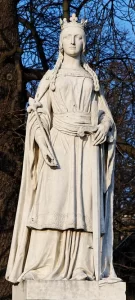
Here’s Mathilda of Flanders, enshrined in stone in a garden in Paris. Image Source.
William rolled Mathilda in the mud, costly vestments and all, and is said to have (physically) slapped her around, also probably telling her that he was her lord and master and she ought to now give in. Or else. (Or else what?)
She did.
What all the sweet and honeyed words of William’s ambassadors had not accomplished in achieving the alliance, William’s. . .er. . .unusual courtship seem to have done.
And. . .the marriage takes place?
Not so fast. Mathilda’s father, the Count of Flanders, was also related to the Normans in some way that is not quite clear to me. William and Mathilda were distant cousins.
All marriages in Europe—especially royal ones—required the consent of the Pope. The pope interdicted this one, on the grounds of this consanguinity—this was in 1049 CE when William was twenty-one years old, and Mathilda was eighteen.
This much, at least, is documented. What is not, is whether this happened before or after William’s violent courtship of Mathilda in Bruges.
In any case, William and Mathilda were married two or three years later, say 1051 CE. (This is also the year William the Conqueror went to England for the first time, to hear from his uncle, King Edward the Confessor, that he was to be heir to England). How that came about without papal sanction is also not recorded—most likely, they pacified their pontiff by reciting several Ave Marias and Paternosters, and funding a few monasteries.
William conquered England in 1066 after the Battle of Hastings, by which time, Matilda and he probably had had most of their children—the total number topped at either nine or ten.
Hell hath no fury like a woman scorned? Brictric’s fate in later years:
When Mathilda became queen of England, she appropriated all of Britric’s lands in the west of the country, had him thrown in jail, and he languished there until he died.
It’s perhaps this fact that has led to all that speculation about the early love affair between Mathilda and the thane Brictric, and his rebuff of all her advances toward him. (Again, why would he have been fool enough to refuse her?)
As in, the love story wrote itself after the fact, given Mathilda’s supposed vindictiveness toward poor Britric.
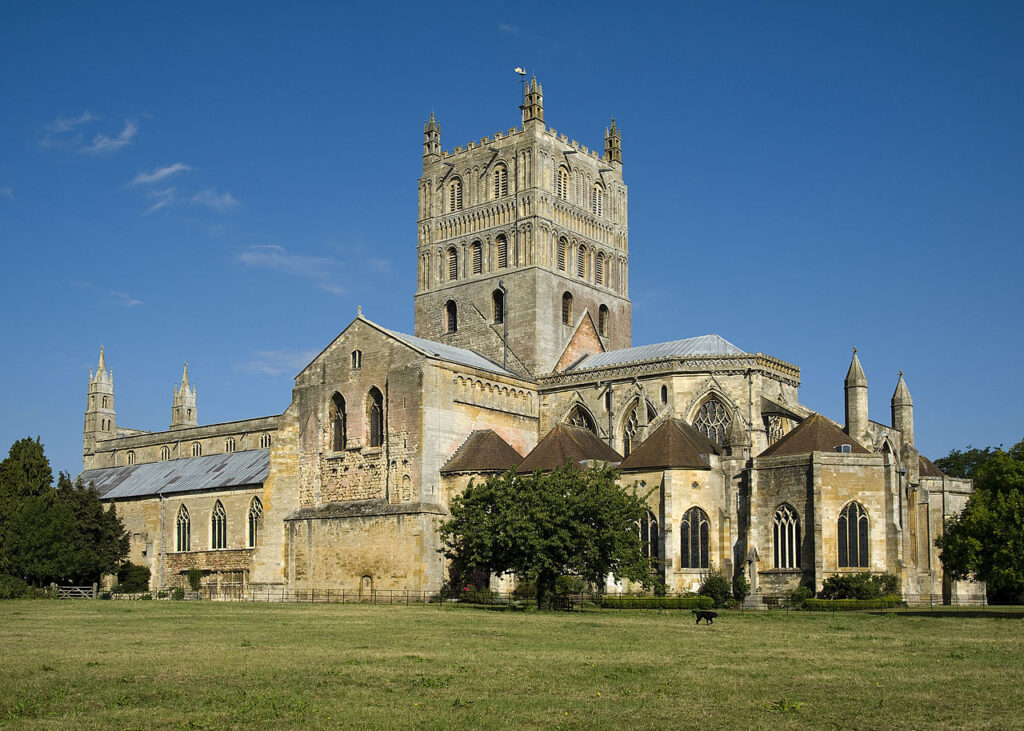
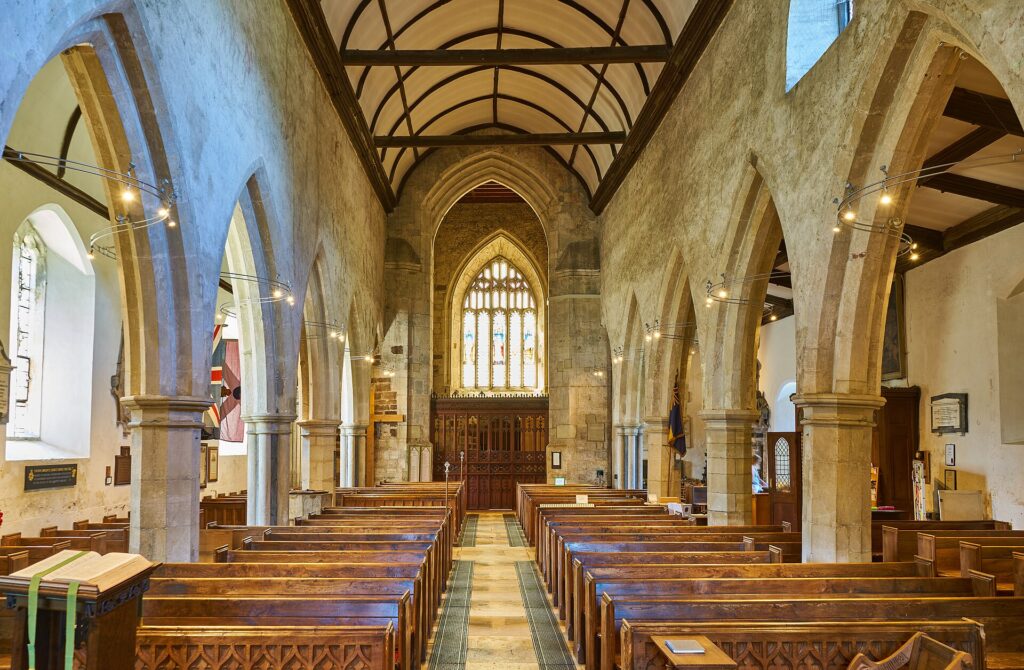
Very little of manors and churches remain today from Brictric’s vast estates. But, almost every place mentioned in the Domesday Book (as belonging to him) does trace its ownership back to him, and also invariably repeats the story of Mathilda’s revenge.
This church on the left however, Tewkesbury Abbey in Gloucestershire, has existed in some form since the 7th Century.
In 980 CE, Tewksbury was under the influence of the monastery at Cranborne Abbey (image on the right). Both churches were patronized by a thane called Haylward the Fair, because of how pale-complexioned he was. It was Haylward who had funded the new Cranborne Abbey, and had subjected Tewksbury to Cranborne because both lay on his own vast lands.
Haylward was Brictric’s grandfather. In his own time, Brictric expanded and built upon Tewksbury Abbey, which probably owes its current form to sometime in the early 12th Century—so here possibly is an example Brictric’s influence.
Brictric then lost both Tewksbury and Cranborne (and 85 other parishes and lands) in 1066CE, right after William the Conqueror came roaring into England. First Image Source. Second Image Source.
This loss of all of Brictric’s property is an absolute fact, recorded in the Domesday Book. After William the Conqueror took over England in 1066 CE, he sent out his men to conduct an exhaustive survey of his new land. And, I mean new. Remember that if William had not visited England in 1051 CE, at his uncle, Edward the Confessor’s invitation, then this was the first time he was on English soil, and he was now king and ultimate ruler.
The survey, more like an elaborate and highly detailed census, right down to the last cow in the barn and the pig in the sty, is called the Domesday Book.
In the Domesday, Brictric is recorded as ‘previous’ owner of several lands—eighty-seven lands in fact, all of which contained villages and parishes along with acreage, and manors with parkland. In other words, before 1066 CE and William the Conqueror’s entrance into England, Brictric was lord of all this real estate.
After 1066 CE?
Zero.
The whole grudge thing with Mathilda sounds a little improbable though. I mean, if Mathilda had pursued Brictric, and he had refused her, it would all have happened maybe fifteen years before The Conquest. Mathilda had since been (presumably happily) married to William the Conqueror. They had had several children. William had made her queen of England!
Why still hold a grudge?
So, I think, it’s more likely that Britric refused to bow to his new Norman king, who was now king of all England, and most likely that the punishment for all detractors was something exactly like this—confiscation, confinement and calamity.
Picking up on William the Conqueror’s life, where we left off. . .
And so, with his personal life in order (married and begetting children), we’re now set to see our good William invade England, and change the very composition of English society.
That, we’ll see in Part 3 of this blog post.
If you’ve enjoyed reading this post, please share it, so others may read also. Thank you!
Primary Sources: Edward A. Freeman, A Short History of the Norman Conquest of England; John Collingwood Bruce, The Bayeux Tapestry Elucidated; Charles Dawson, ‘The Bayeux Tapestry in the hands of ‘Restorers’ and how it has fared.’ article in The Antiquary; Jacob Abbott, History of William the Conqueror; Dom Bernard de Montfaucon, Les Monuments de la Monarchie Françoise; Hilaire Belloc, The Book of The Bayeux Tapestry.
On the next blog post— we’ll follow William into the Battle of Hastings on the tapestry itself—All Hail William, the New King—The Unsurpassed Bayeux Tapestry—Part 3
Search Engine Keyword Phrases: Norman Conquest; Conquest Normans; Norman Invaders; Norman Invasion; 1066 Norman Conquest; 1066 Norman Invasion; Norman Conquest tapestry; Norman Invasion tapestry; reasons for the norman conquest; what is the norman conquest and why was it important; consequences of the norman conquest; Norman Conquest Bayeux Tapestry; William the Conqueror; William the Conqueror children


2 Replies to “All Hail William, the New King–The Unsurpassed Bayeux Tapestry–Part 2”