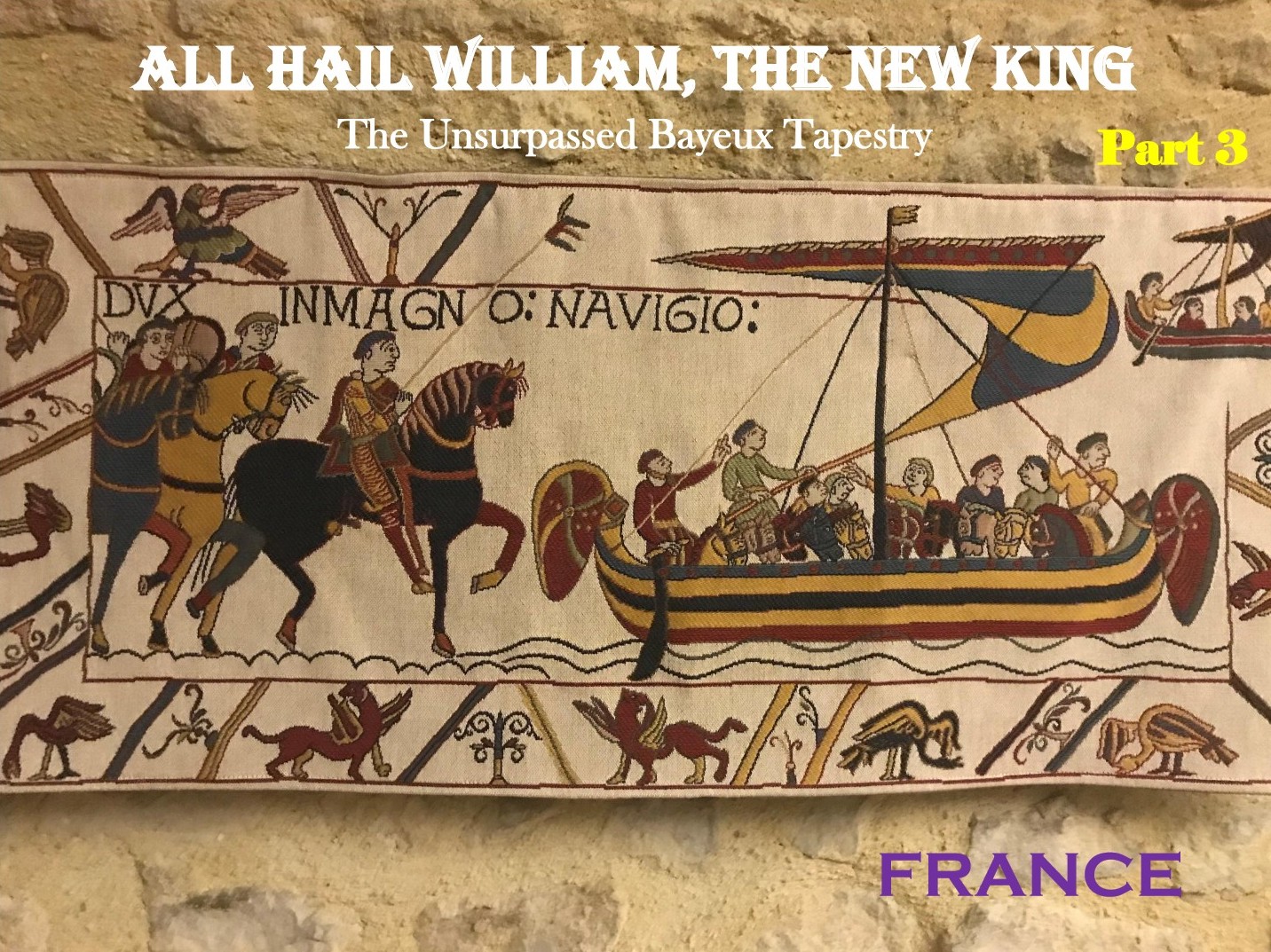
The featured image for Part 3 of the post on the Bayeux Tapestry.

All Hail William, The New King–The Unsurpassed Bayeux Tapestry–Part 3

THE BAYEUX TAPESTRY, THE SCENES, EXPLAINED.

When William, the French Duke of Normandy, went across the English Channel in September, 1066 CE, to take England and make it his own, he gave two excuses for this unreasonable aggression.

One, he said that King Edward the Confessor, who was his uncle once removed (see the history in Parts 1 and 2 of this blog post), had, during William’s first and only visit to England some fifteen years earlier, declared that he wanted William to follow him  on the throne.

The first scene of the Bayeux Tapestry shows Edward the Confessor, giving Harold, Duke of Wessex, permission to go to France.

The very first scene of the Bayeux Tapestry—detailing William’s conquest of England—is a meeting, presumably at the Palace of Westminster which was the royal abode then, between Edward the Confessor and his successor, Harold.  Harold was Edward’s brother-in-law—Edward had married his sister. Image Source.

Two, William said that the man who donned the crown after Edward the Confessor’s death in January of 1066 and became King Harold, had also promised him (promised William that is) that he would absolutely not take the crown after Edward, and that it would be kept for William.

I can, and will, poke several holes into both these excuses.

Continue Reading
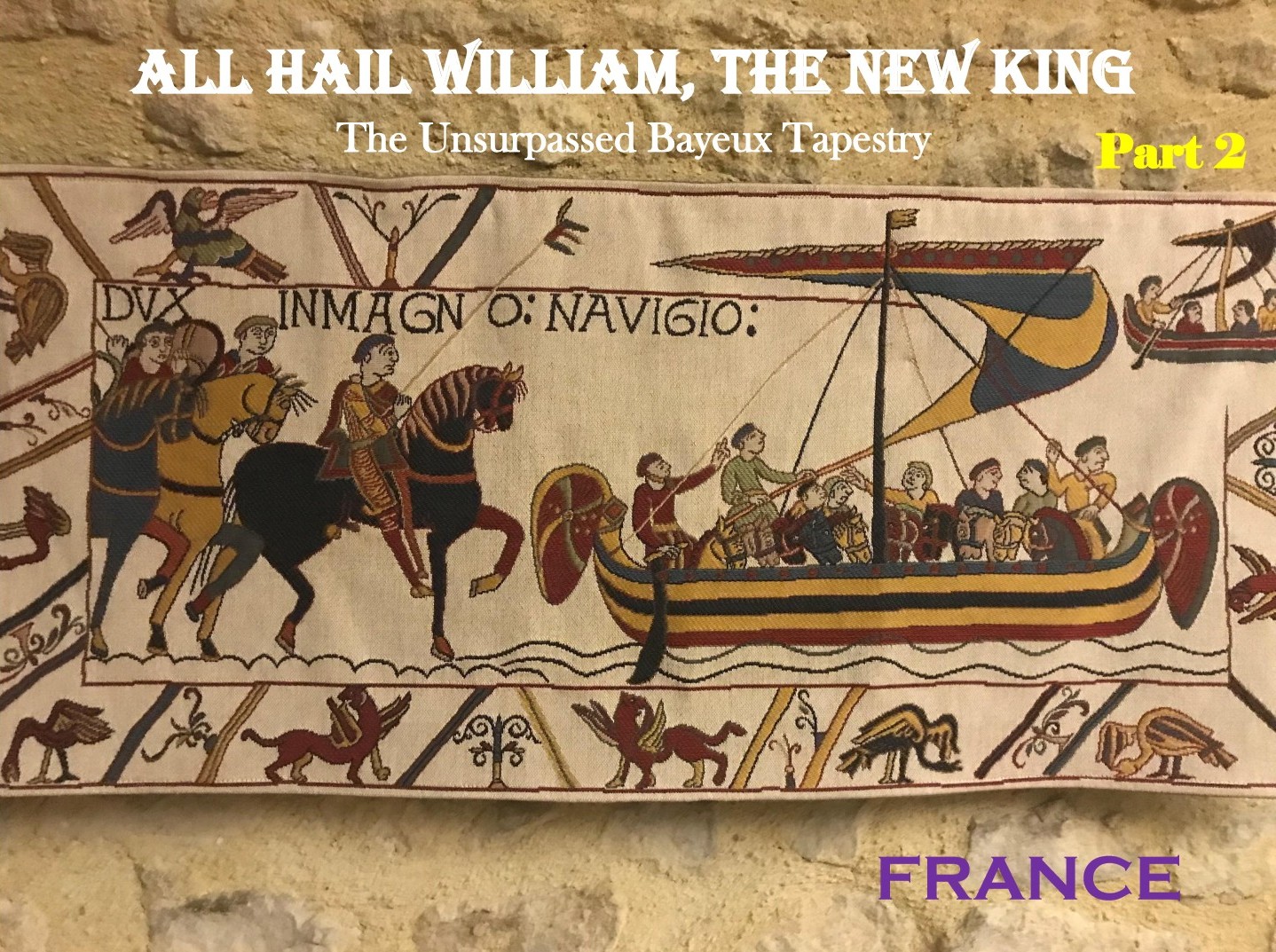
Part 2 of the blog post titled All Hail William, the New King. The unsurpassed Bayeux Tapestry.

All Hail William, the New King–The Unsurpassed Bayeux Tapestry–Part 2

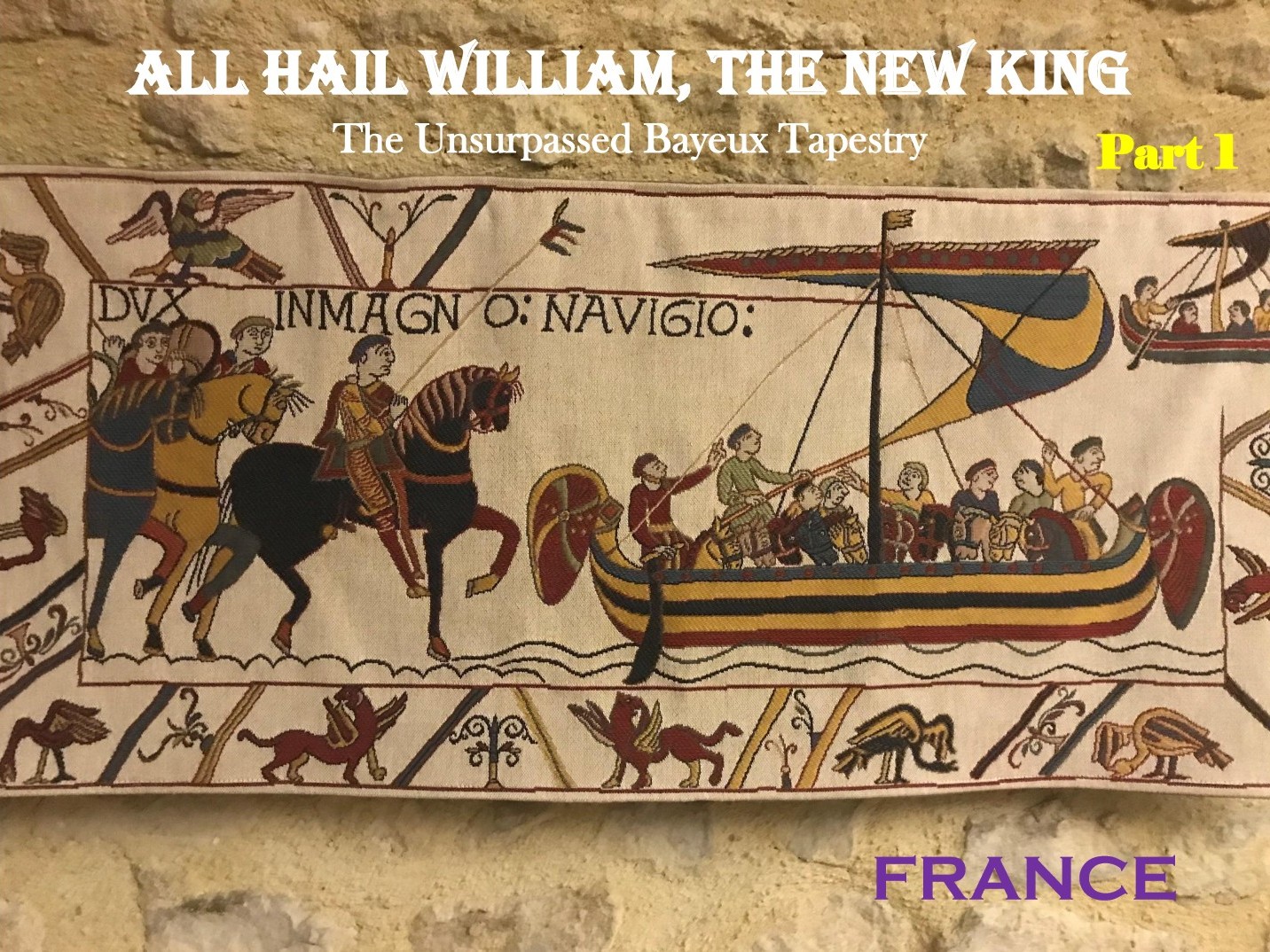
In 1066 CE, a French usurper, William the Conqueror, came to the English throne.  He was the Duke of Normandy, and his story was told very soon after The Conquest on a length of embroidered linen, using ten hues of subdued colors.  This is the Bayeux Tapestry.

The tapestry was made for the consecration of Bayeux Cathedral—William the Conqueror’s brother, Odo, was Bishop of Bayeux, and responsible of the building of the cathedral (future blog post).  At that grand event, the Bayeux Tapestry was displayed for the first time, and for many centuries after, hung in the grand nave.

Continue Reading
The Norman Conquest and the Bayeux Tapestry--Part 1

All Hail William, the New King–The Unsurpassed Bayeux Tapestry–Part 1

At the end of September, 1066 CE, William, Duke of Normandy, took a boat across the English Channel to land on the coast of Sussex. A little more than a fortnight later, he had defeated the English king, and established himself sovereign in a Norman Conquest.

So complete was William’s victory that the very character of English society altered beyond recognition. Language, law and politics knelt to Norman rule.  The English nobility fled the country in large numbers, or died during the invasion, and their daughters, sisters, and wives who inherited their estates, married William’s French nobility. Most of the high offices in the land—both the laity and the clergy, including the Archbishop of Canterbury—went to the French.

Continue Reading
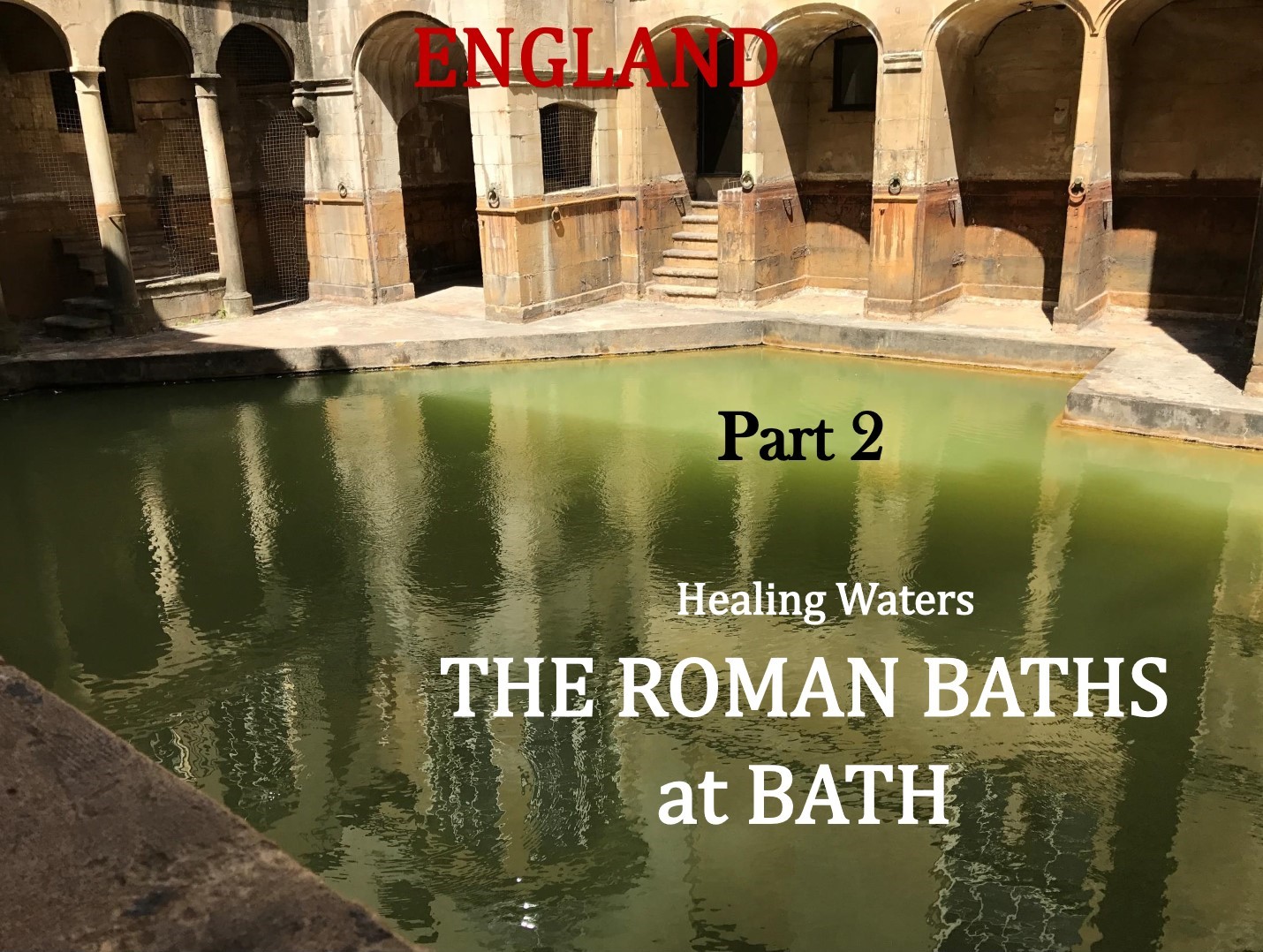
Part 2 of the blog post on the Roman Baths in England.

The Roman Baths at Bath–Healing Waters—Part 2

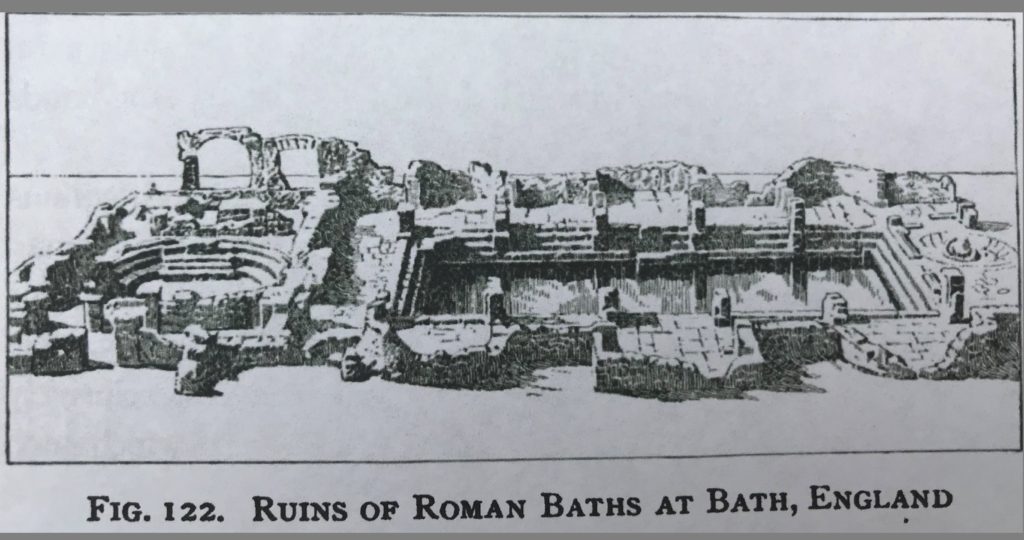
The Roman Baths that were:

The Roman Baths today don’t any longer function as usable baths.  Waters are still pumped through ancient lead pipes into the bath, but they’re green with algae (pretty, actually!)–a sign that it’s not a good idea to try drinking it, or even trailing your fingers through it.

Early excavations unearthed the Great Bath (right) and the circular Cold Water Pool (left).
Source: Outlines of European History by James Henry Breasted. 1914.
Continue Reading
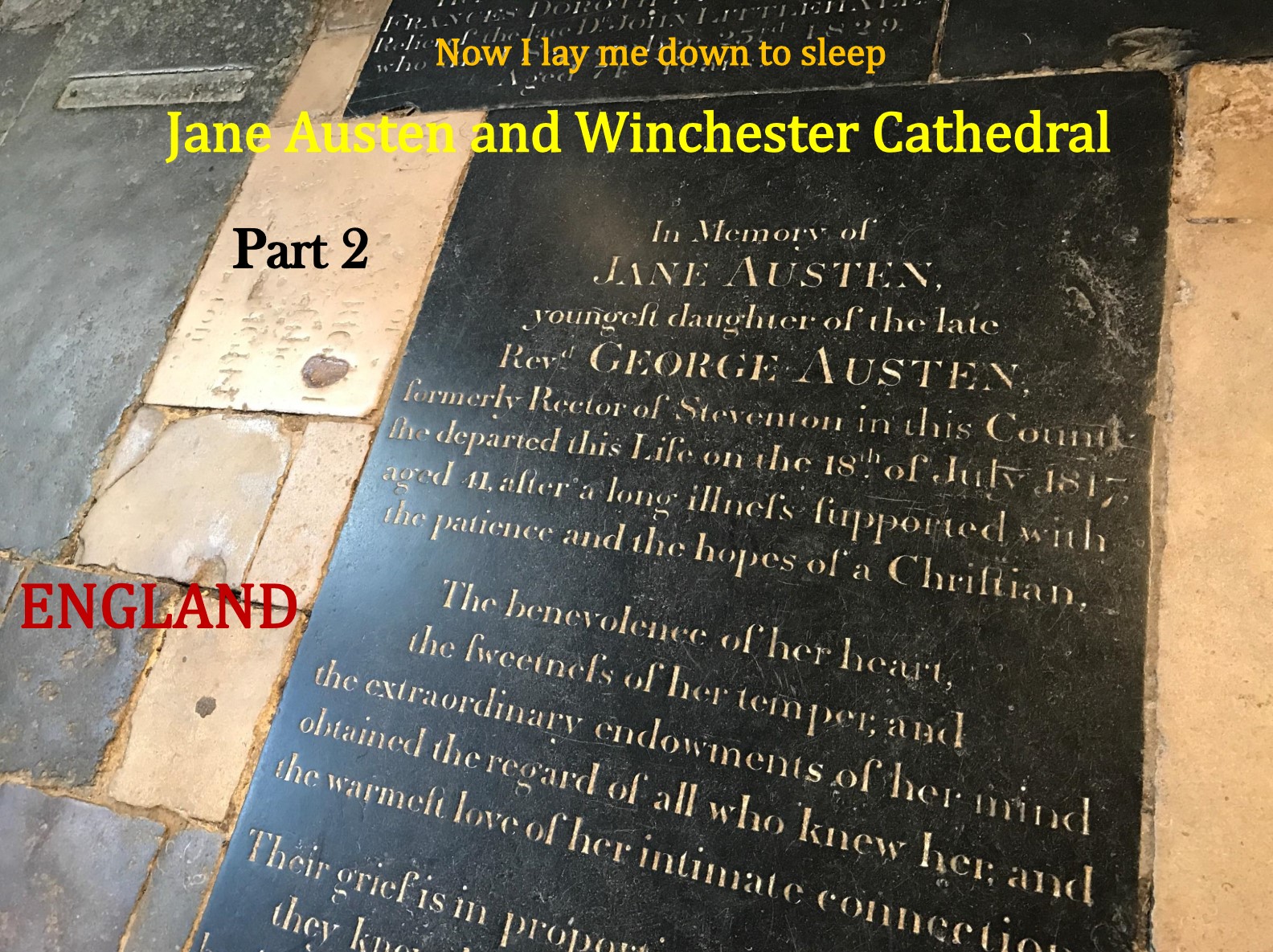
Part 2 of the blog post on Jane Austen and Winchester Cathedral.

Now I lay me down to sleep—Jane Austen and Winchester Cathedral—Part 2

We last left Jane Austen at Chawton Cottage, Part 1, Part 2 and Part 3.  Jane’s most productive writing periods were pre-Bath (before 1801) and after the move to Chawton in 1809.  The first produced Pride and Prejudice, Sense and Sensibility and Northanger Abbey.  During the second, she wrote Mansfield Park, Emma and Persuasion. She also began publishing in this Chawton period, beginning with Sense and Sensibility first.

Chawton Cottage was the hub of comfort for the extended Austen family.  Here, was Mrs. Austen, the mother of Jane and her siblings and grandmother to their children, and the two beloved maiden aunts, Jane and Cassandra.  And, the nieces and nephews came to stay, sometimes for a vacation, sometimes for longer when there was a death in the family and they needed a place to be and someone to cheer them up.

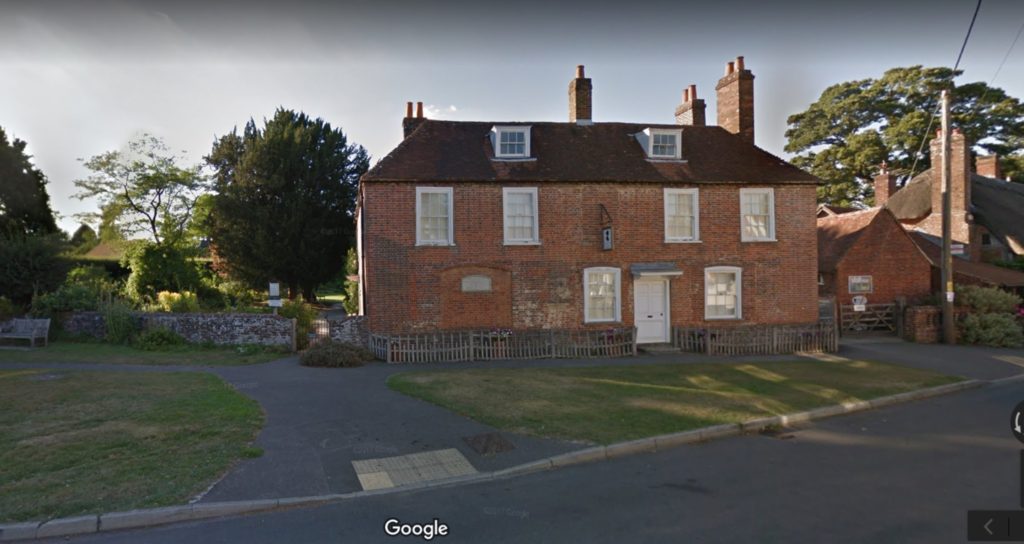
Chawton Cottage, where Jane Austen lived from 1809 until her death in 1817.
Source: Google Street View
Continue Reading
Part 1 of the blog post on Jane Austen and Winchester Cathedral.

Now I lay me down to sleep—Jane Austen and Winchester Cathedral—Part 1

We blew into Winchester Cathedral at the end of a very long day, and I use that verb advisedly.  We had spent the morning and afternoon in Austen country—Steventon where she grew up, and the St. Nicholas Parish Church (Part 1 and Part 2 on the blog) and Chawton Cottage (Part 1, Part 2 and Part 3) where I wandered around for far too long.  So, by the time we got to Winchester Cathedral, there was, it seemed, just a teacup full of time left before the church closed for the day.

But, stepping inside was into a sea of calm.  I paid my respects at the grave, and still had time to walk around the cathedral, breathe the air, and dwell on its history.  And while Jane Austen is arguably its most important occupant, Winchester Cathedral was there for many centuries before her, and its mellow stones are steeped in legend…and some myth.  Read on.

Continue Reading
Part 3 of Jane Austen in Chawton Cottage

At Home at Last: Jane Austen in Chawton Cottage—Part 3

(Part 1 here; Part 2 here)

Jane, her sister Cassandra, and their mother moved into Chawton Cottage in 1809, thanks to her brother Edward Knight’s generosity.  One other person came to live with them.  Martha Lloyd was a longtime friend, and a few of Jane’s surviving letters are written to her.  She was the sister of Jane’s oldest brother James’ second wife, Mary.  Got all that?  (James took over the rectory at Steventon when their father retired; his son by his second wife, James Edward Austen Leigh, is the one who wrote Jane Austen’s first official biography.  So both Martha and Jane were aunts to James Edward Austen Leigh). Continue Reading

Part 2 of the blog post on Jane Austen in Chawton Cottage

At Home at Last: Jane Austen in Chawton Cottage—Part 2

(Part 1 here)

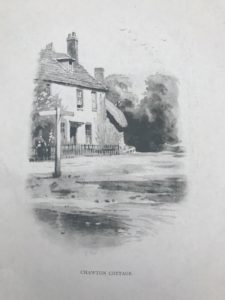
 The front of Chawton Cottage, where Jane Austen spent the last eight years of her life.  Source:  Jane Austen: Her Homes & Her Friends, by Constance Hill.

How Edward Austen became Edward Knight:  Austen’s Emma begins with a marriage between Emma’s governess, Miss Taylor and Mr. Weston, with Emma bemoaning the fact that her companion had now disappeared—moving a whole half mile away to her own house, her own husband, her own occupations.  ‘…Emma was aware that great must be the difference between Mrs. Weston only half-a-mile from them, and a Miss Taylor in the house Continue Reading

Part 1 of the blog post on Jane Austen in Chawton Cottage

At Home at Last—Jane Austen in Chawton Cottage—Part 1

The Bath years, the writing falters, but the research doesn’t

George Austen had had it by 1801.  He had been rector of two parishes, Steventon and Deane, for thirty-seven years.  He had conducted two, maybe three services a week at the two churches.  He had visited the poor, the sick, administered last rites to the dying, and buried them in the churchyards.  He had home-tutored pupils who had lived in his house year-round to prepare for the university.  His wife had to be their de facto mother, and she had fed them, washed their linens, and tended to their fever and chills.  All this, to make extra money to supplement George Austen’s income.  Now, his children were grown up, some were married (Jane and her sister Cassandra were not, and were still at home), he was old(er) and in poor health, and he wanted to live the rest of his life out in a relative peace. Continue Reading

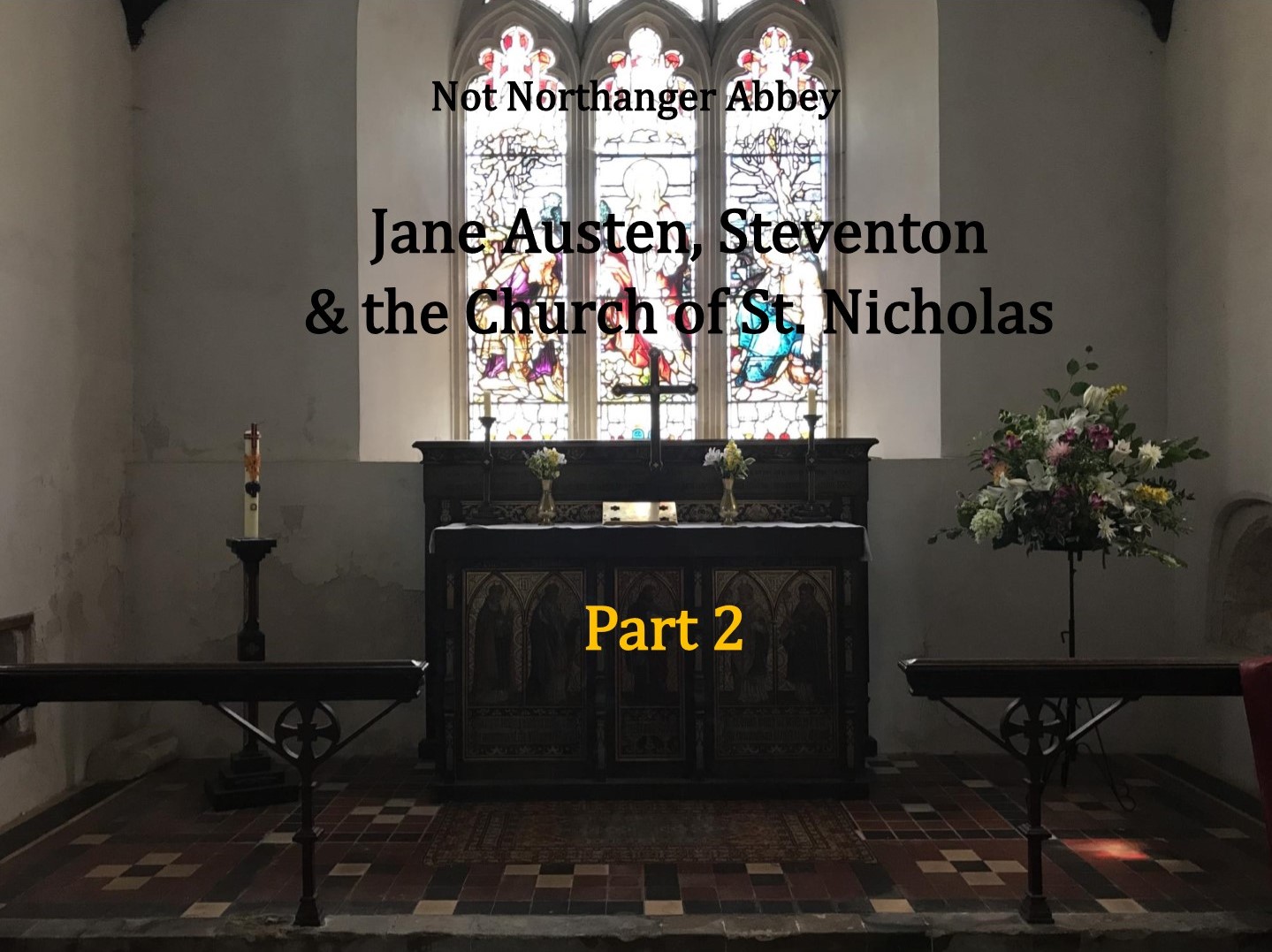
Part 2 of the blog post on Jane Austen, Steventon and the Church of St. Nicholas

Not Northanger Abbey: Jane Austen, Steventon, and the Church of St. Nicholas—Part 2

(Part 1 here)

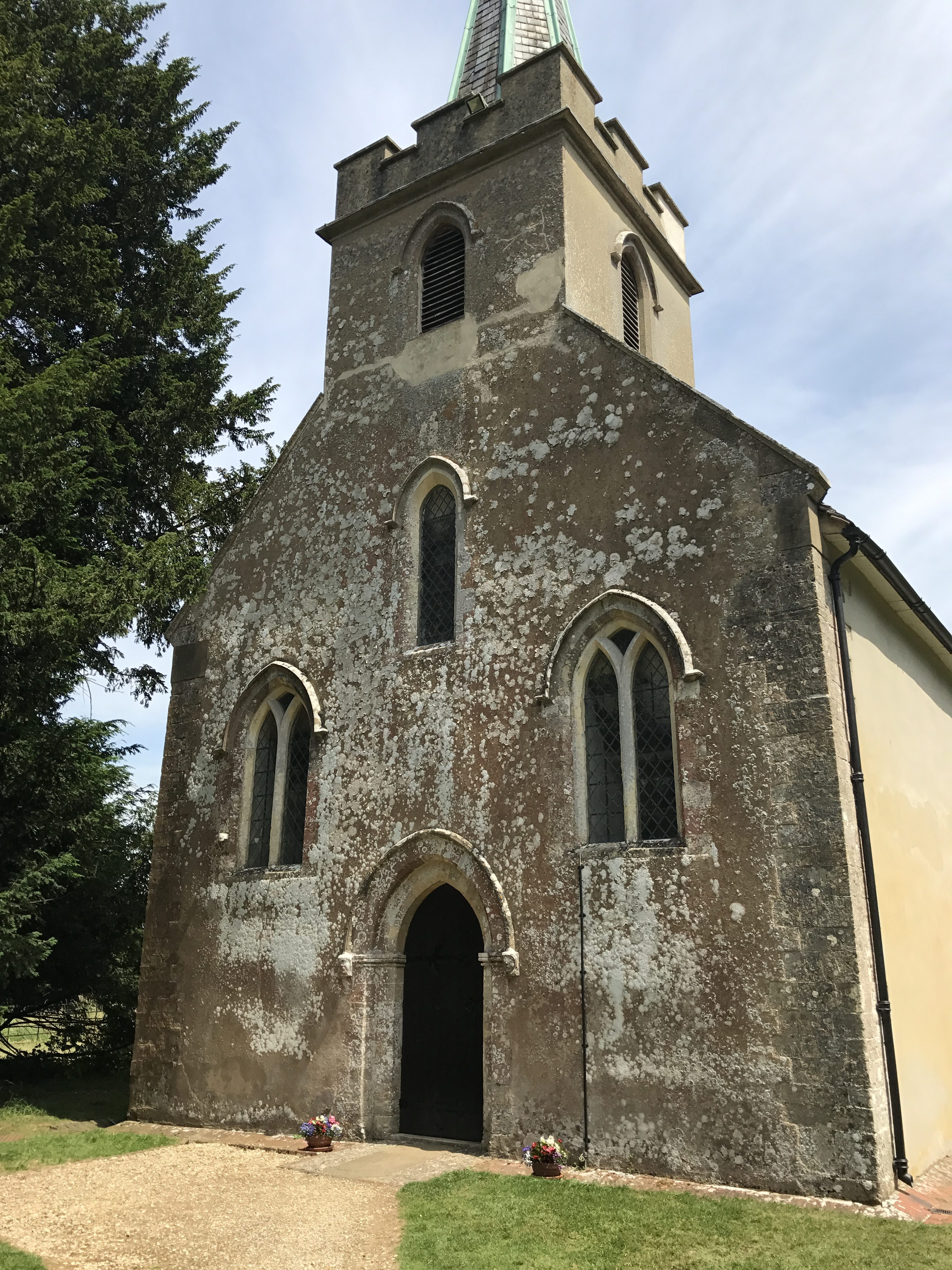
A half a mile south of the old rectory is the Church of St. Nicholas, where Jane’s father preached and led his flock, and where she attended services.  It’s also another smooth, macadamized road today—in Jane’s time, it would have been a rough path, slushy in the rains, dusty in dry summers.

The church dates to the 12th Century, so it had been standing there, among the fields and the pastures, for almost seven centuries by the time George Austen came to Steventon to be rector.  The warm southern wall of the church, right of the entry door, hosted purple and white sweet-smelling wild violets that bloomed in summer.  The close-cropped green of the churchyard was shaded by elms, hawthorns and a mighty, aged yew, which had probably been there for as many years as the church itself. Continue Reading